






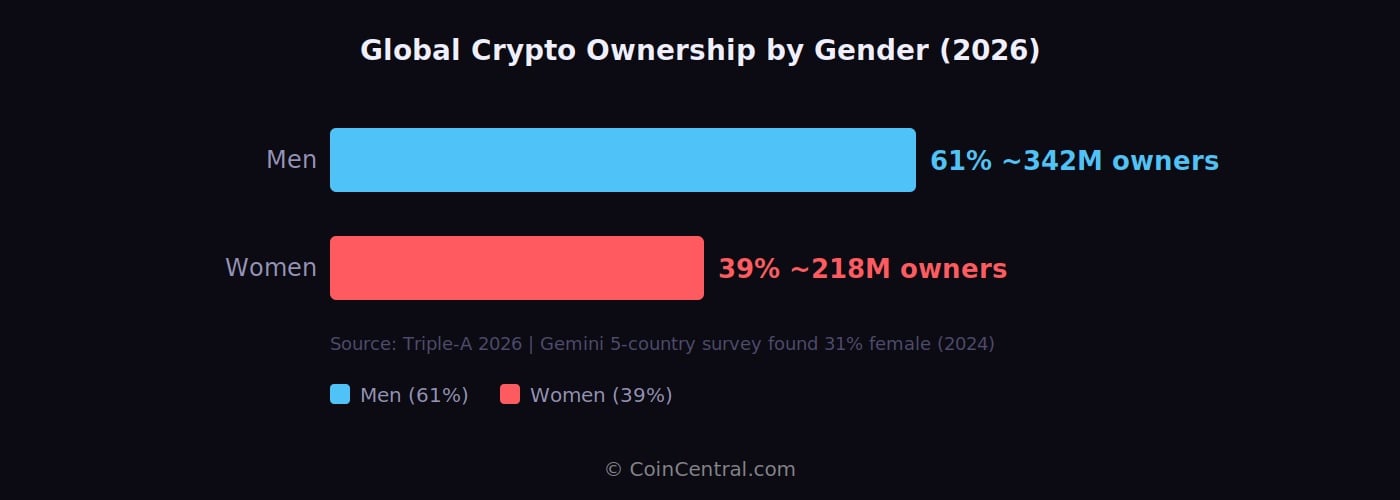
Women own roughly 39% of all cryptocurrency worldwide. Men hold the remaining 61%. That split comes from Triple-A, which estimates about 560 million total crypto holders globally.
In raw numbers, that is approximately 218 million women and 342 million men in the global crypto market. It works out to about two female owners for every three male owners.
But 39% is a high-end estimate. Gemini’s 2024 survey of 6,000 adults across five countries found women at just 31% of owners. The difference reflects methodology: Triple-A models total global ownership, while Gemini surveys active users in mostly Western markets where the gender gap tends to be wider.
This article covers the key 2026 statistics on the gender gap in crypto — from global ownership totals to country-level breakdowns, age demographics, workforce numbers, and the evidence on whether the gap is actually closing.

The Global Ownership Split
The broadest estimate for female crypto ownership puts women at 39% of all holders globally and men at 61%, per Triple-A. With an estimated 560 million total owners, that works out to roughly 218 million women and 342 million men.
A narrower survey produces a wider gap. Gemini’s State of Crypto report, based on 6,000 respondents across the US, UK, France, Singapore, and Turkey, found women at 31% of owners in 2024. The same survey in 2022 found a 42% female and 58% male split — meaning the gap widened in that five-country panel over two years.
The variation between sources comes down to who is being measured. A global ownership model captures the full picture, including emerging markets where women participate at higher rates. A survey of active users in five mostly Western countries captures a more male-skewed slice of the market. Both are measuring real things; they are just measuring different things.

The Gemini data shows a meaningful shift in behavior over time within its panel. In 2022, when crypto prices were high, women made up 42% of owners in that five-country group. As prices fell through 2022 and 2023, the female share dropped to 31% by 2024. This suggests women who entered during the 2021 bull run were more likely to exit when conditions changed — though women who stayed committed to long-term holding at the same rate as men.
Among women who do own crypto, holding behavior mirrors that of men. Gemini found 40% of female owners had held assets for over a year, nearly identical to the rate for men. Women who enter the market tend to stay.
| Source | Market | Women | Men | Year |
|---|---|---|---|---|
| Triple-A | Global (all owners) | 39% | 61% | 2026 |
| Gemini | US, UK, France, Singapore, Turkey | 31% | 69% | 2024 |
| Gemini | US, UK, France, Singapore, Turkey | 42% | 58% | 2022 |
| Security.org | United States | ~25% | ~75% | 2026 |
| Nordic Crypto Survey | Norway, Sweden, Denmark, Finland, Iceland | 23% | 77% | 2025 |
Female Crypto Ownership by Region
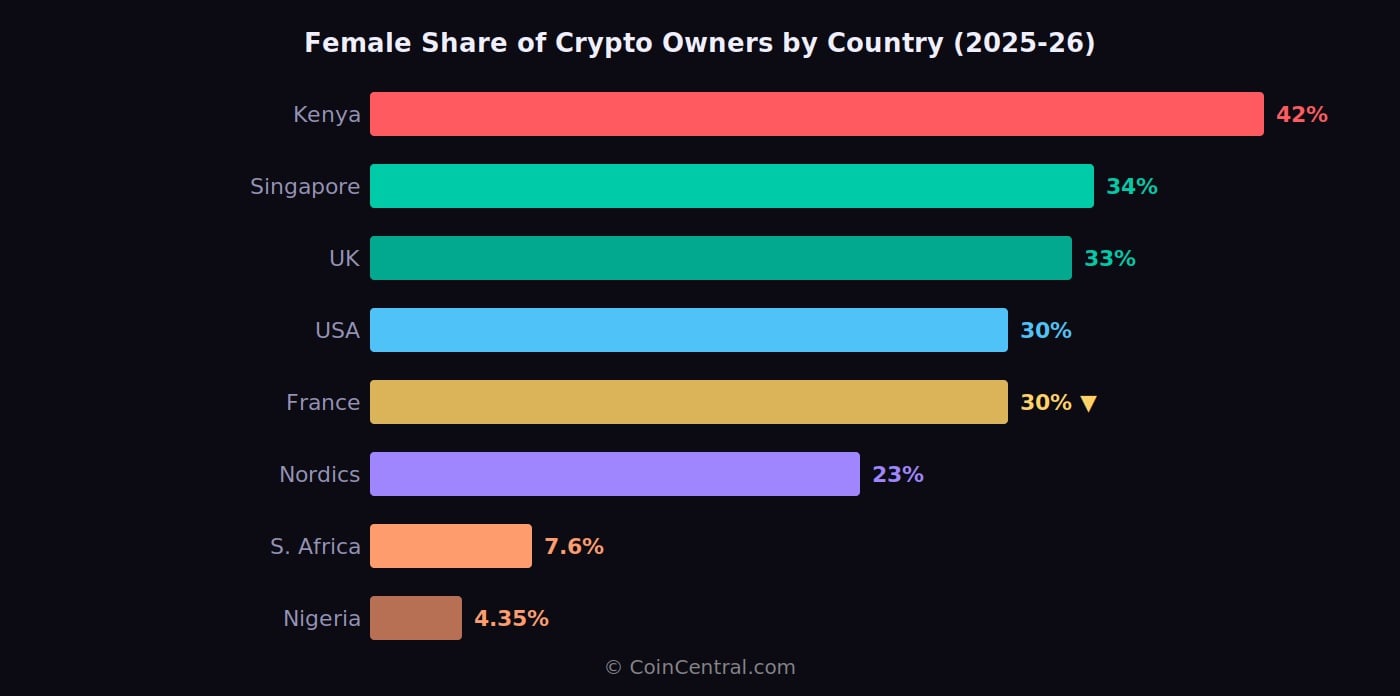
The gender gap in crypto looks very different depending on where you are. Some countries have nearly equal male and female ownership. Others skew heavily toward men.
Africa shows the sharpest contrasts. Kenya stands out with women making up 42% of all crypto owners — the highest share on the continent and above the global average. By contrast, South Africa is at 7.6% female ownership and Nigeria is at just 4.35%. Those differences reflect varying levels of digital finance access across the continent, not just geography.
The Nordic countries have one of the widest gaps anywhere in the world. Only 4.5% of adult women in Norway, Sweden, Denmark, Finland, and Iceland own crypto, compared to 15% of men. Women make up just 23% of all Nordic crypto owners. The 2025 Nordic Crypto Adoption Survey noted this improved from 3.4% the prior year, but the pace of change is slow relative to other regions.
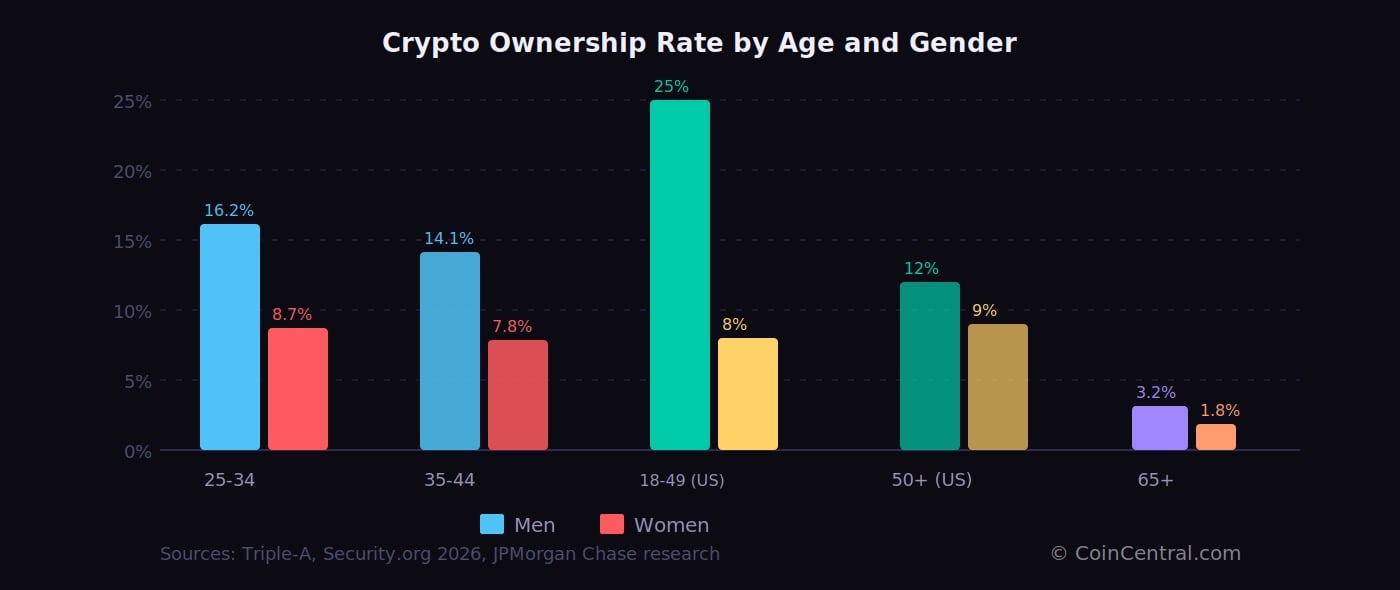
In the United States, men aged 18-49 report a crypto ownership rate of 25%, while women in the same age group report 8%. That is roughly a 3-to-1 gap. For adults over 50, the US gap narrows: men at 12% versus women at 9%, a smaller difference than at younger ages. The 45-59 age band is the largest female segment of crypto ownership in the US, according to Security.org’s 2026 report.
Southeast Asia sits in between the Africa and Nordic extremes. Vietnam has approximately a 4-to-1 male-to-female ratio among crypto users. Broader Asia-Pacific trends show growing female participation driven by mobile-first fintech platforms and practical everyday use cases for digital finance, particularly remittances and inflation hedging.
| Country / Region | Women’s Share | Context |
|---|---|---|
| Kenya | 42% | Highest in Africa; above global average |
| Singapore | 34% | Rising — was 31% in 2023 |
| United Kingdom | 33% | Rising — was 30% in 2023 |
| United States | ~30% | Slow but steady growth |
| France | 30% | Dropped from 35% in 2023 |
| Nordic Countries | 23% | One of the widest gaps in Europe |
| South Africa | 7.6% | Low participation |
| Nigeria | 4.35% | Very low participation |
Country Spotlight: India
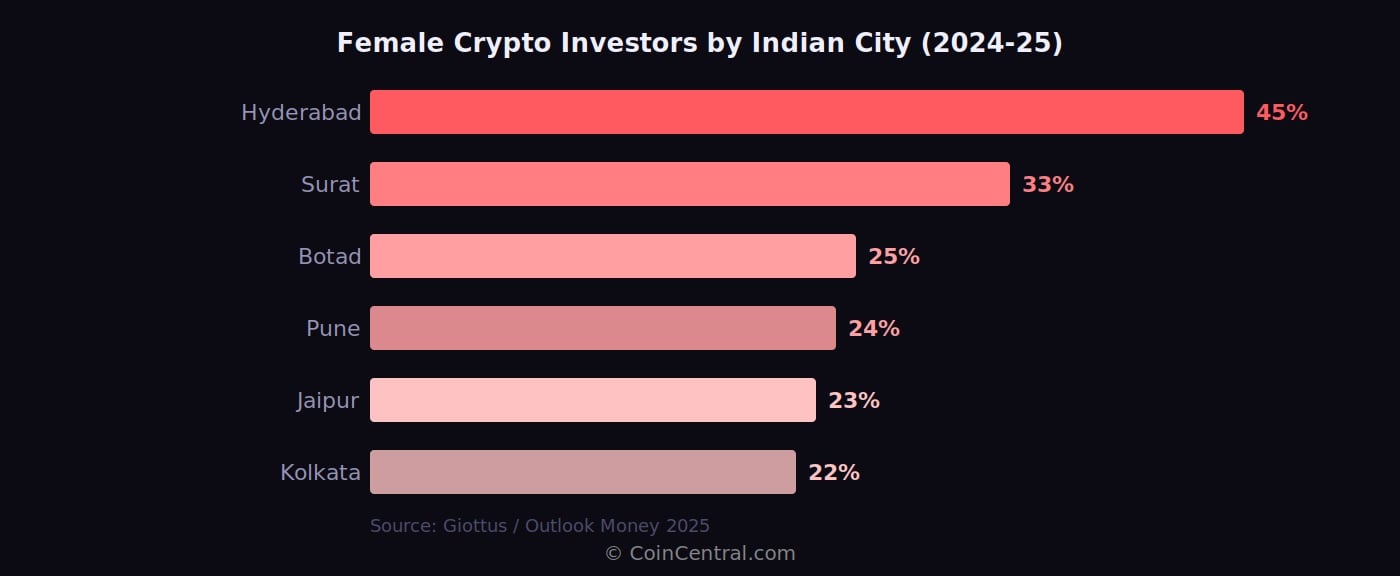
India has seen some of the fastest growth in female crypto participation of any country in the world. Female investors grew by 20% year-over-year between January 2024 and January 2025, according to data from Giottus cited by Outlook Money.
Women now account for roughly 15% of India’s total crypto trading volume. Female investors in India tend to favor long-term holdings in stable assets like Bitcoin and Ethereum rather than speculative tokens, a pattern that holds across multiple city-level datasets.
India ranked first in the Chainalysis 2025 Global Crypto Adoption Index, making it the largest crypto market in the world by adoption metrics. Rising smartphone access, expanding fintech platforms, and community-driven Web3 education programs for women are all cited as growth drivers behind the surge in female participation.
Women aged 25-30 made up 53% of all new female crypto investors in India during 2024-2025. City-level data shows wide variation within the country, with Hyderabad leading at 45% female investor share, where 84% of those portfolios showed positive returns.
| City | Women as % of Crypto Investors | Portfolio Note |
|---|---|---|
| Hyderabad | 45% | 84% showing positive returns |
| Surat | 33% | — |
| Botad | 25% | — |
| Pune | 24% | — |
| Jaipur | 23% | — |
| Kolkata | 22% | — |
Year-over-Year Changes in Key Markets
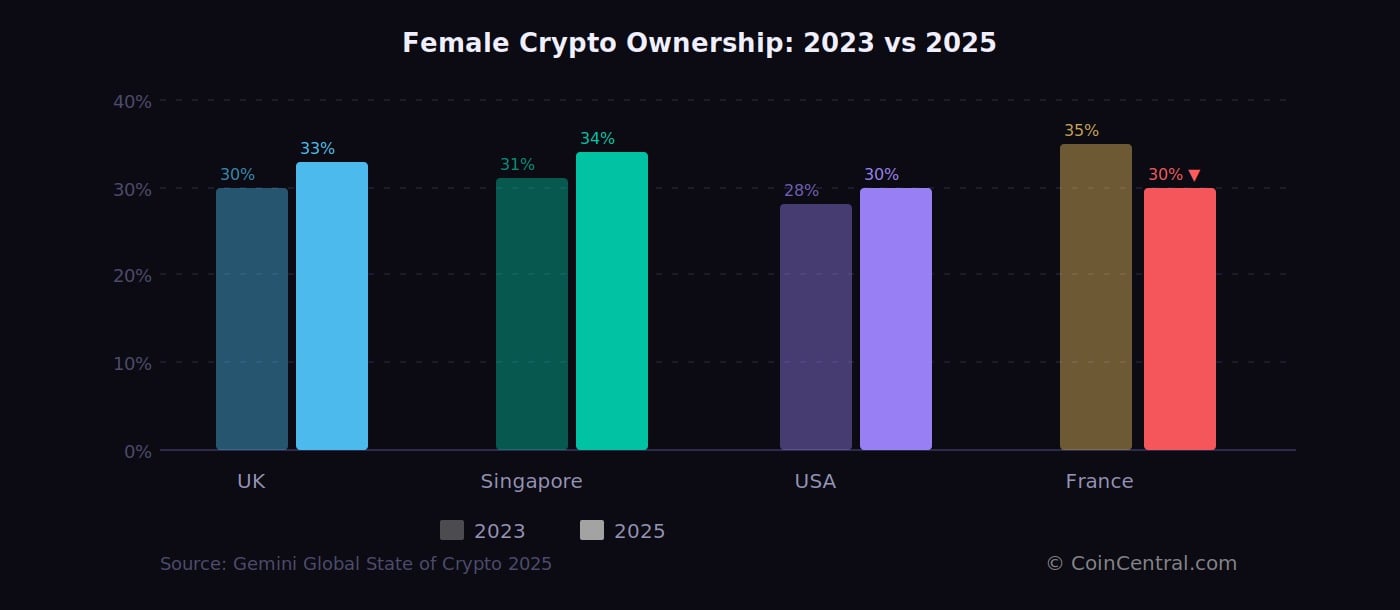
Gemini’s Global State of Crypto report tracks female ownership over time in five specific countries. Data from 2023 to 2025 shows mixed results depending on the market.
The UK moved from 30% to 33% female ownership. Singapore rose from 31% to 34%. The US grew from 28% to 30%. These are small but consistent gains in markets where awareness campaigns and education programs have been active.
France went the opposite direction. Female ownership dropped from 35% to 30%, a 5-percentage-point decline. This shows that gains made in one period can reverse. Progress in crypto adoption is not locked in once achieved, particularly in markets where speculative behavior dominates.
The Nordic region shows very limited movement. Female adult ownership rose from 3.4% to 4.5% in one year — an improvement in percentage terms, but still very low in absolute terms. Despite strong digital infrastructure and high general financial literacy across Scandinavia and Finland, the gender gap in crypto remains one of the widest in Europe.
| Country | 2023 | 2025 | Change |
|---|---|---|---|
| UK | 30% | 33% | +3pp |
| Singapore | 31% | 34% | +3pp |
| USA | 28% | 30% | +2pp |
| France | 35% | 30% | -5pp |
Age and Gender Demographics
Younger women are driving most of the growth in female crypto participation. Women aged 25-34 represent the largest share of female crypto owners at 14%, followed by women aged 35-44 at 11%. These are primarily Millennial and older Gen Z cohorts.
The youth skew appears across the full crypto market. Around 60% of all crypto investors globally are between 25 and 34 years old as of 2025. Gen Z women are showing the fastest year-over-year adoption growth, rising about 16% annually in recent surveys.
Ownership rates by age group consistently show men leading in every bracket. Among 25-34 year olds, 16.2% of men own crypto compared to 8.7% of women. For 35-44 year olds, that is 14.1% for men versus 7.8% for women. At 65 and older, ownership falls to 3.2% for men and 1.8% for women.
In the US, the gender gap narrows with age. Men over 50 show about 12% ownership, while women in the same bracket are at 9%. The gap is far wider among 18-49 year olds, at 25% for men versus 8% for women. Research from JPMorgan Chase found older generations show smaller gender gaps in some studies compared to Millennials.
Education and income levels also shape ownership rates. Crypto ownership runs at 19% among college graduates and upper-income earners, versus under 10% for lower-education groups. Women with higher income and education are 1.8 times more likely to own crypto than lower-income female peers. Around 70% of female crypto holders in the US are under 40 and tend to hold higher education credentials.
| Age Group | Men’s Rate | Women’s Rate | Approx. Ratio |
|---|---|---|---|
| 25-34 | 16.2% | 8.7% | 1.9 : 1 |
| 35-44 | 14.1% | 7.8% | 1.8 : 1 |
| 18-49 (United States) | 25% | 8% | 3.1 : 1 |
| 50+ (United States) | 12% | 9% | 1.3 : 1 |
| 65+ | 3.2% | 1.8% | 1.8 : 1 |
Women in the Crypto Workforce
The gender gap extends well beyond ownership into the companies that build and run the crypto industry. Leadership positions are especially thin on female representation.
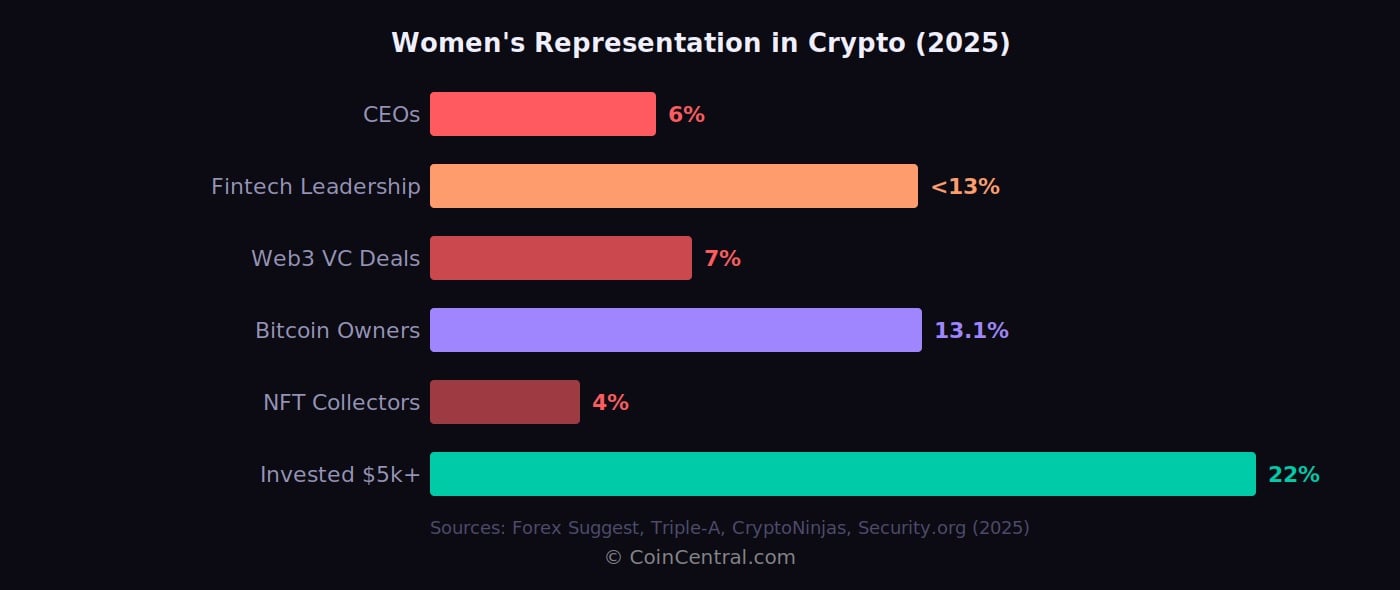
Only 6% of crypto company CEOs are women as of 2025. Research from Forex Suggest found just 3 of the 50 largest crypto firms have a female CEO. Women hold less than 13% of leadership positions across fintech globally.
Venture capital funding follows the same pattern. Women-led startups receive about 7% of all VC deals in Web3. Female-founded firms face funding challenges at the earliest stages, which limits how many women advance into senior roles over time.
Pay data is contested and varies by study. One Web3 compensation report found women in crypto earning roughly 46% less than men. A separate Pantera Capital study found women earning more on average — likely because the small group of women who do work in crypto tends to cluster in senior, high-experience roles, skewing the average upward. Both results point to the same issue: there are very few women in the industry at any level.
Women tend to be more visible in education, community management, compliance, and regulation roles than in core technical or trading positions. A 2025 survey found that 58.3% of women and 50% of men believed women outperform men in event and community roles within crypto.
Among NFT collectors, 15% of men participate compared to 4% of women as of 2025. Female NFT creators face pricing disparities, with some reports indicating lower valuations for their work relative to comparable pieces by men.
| Category | Women’s Share |
|---|---|
| Crypto company CEOs | 6% |
| Fintech leadership roles (global) | Less than 13% |
| Web3 VC deals (female-led startups) | 7% |
| Bitcoin owners (female) | 13.1% |
| NFT collectors (female) | 4% |
| Crypto investors spending $5,000 or more (female) | 22% |
Why the Gap Exists
Research across multiple countries points to several overlapping reasons why fewer women own or work in crypto. These come from structured academic surveys, longitudinal data, and country-level studies rather than just anecdote.
Knowledge and Familiarity
A Spain-based academic study of 326 people used the Theory of Planned Behavior to understand why women participate less in crypto. Fewer than 11% of women knew how to make a cryptocurrency transaction, compared to nearly 37% of men. Around 89% of women said they did not know what a blockchain was, versus 65% of men.
In the US, men aged 18-49 report 59% crypto awareness, while women in the same group report 24%. Around 60% of women cite lack of knowledge as a major barrier to entry, compared to 35% of men. Research suggests financial literacy training can raise female crypto participation by as much as 30% across demographic groups where it has been applied.
Risk Aversion
Women consistently show higher risk aversion in financial research across many countries. The Spain study found women much more likely to say they would “never buy” cryptocurrency when asked about purchase intent. In Turkey, women prefer to invest 10-25% of monthly income in financial markets, a lower proportion than men typically report.
Among crypto owners, 52% of women prefer to hold through volatility, while 64% of men prefer to sell during high market fluctuation. Women who are already in the market tend to behave as more patient investors once committed.
Lack of Prior Investment Experience
Women are less likely to have invested in traditional assets like stocks or mutual funds. In the Spain study, only 3.57% of women had crypto investments compared to 12.66% of men. Research across multiple countries consistently shows that prior experience with traditional investing is a strong predictor of crypto adoption. Less stock market experience leads to less engagement with crypto.
Cultural Environment
Around 60% of women report experiencing discrimination or discomfort in crypto-related spaces. Less than 25% of speakers at major crypto conferences in Spain were women, and similar patterns appear in other markets. Fewer visible female role models in the industry creates a feedback loop where fewer women feel invited to participate.
Platform Design and Marketing
Trading platforms and marketing campaigns have historically targeted active, speculative trading behavior — charts, leverage, short-term price movements. Women who do invest tend to focus more on long-term utility and education than on high-frequency trading. Platforms that emphasize practical use cases and plain-language education report faster female adoption rates.
Income and Access
The gender pay gap means women have less disposable income to allocate to higher-risk assets. Women with higher income and education are 1.8 times more likely to own crypto than lower-income female peers. In emerging markets, crypto often serves practical needs like remittances and protection against inflation, which cuts across gender lines more evenly than speculative investment does in wealthier countries.
Is the Gap Closing?
This is where reputable sources actively disagree. Understanding why they disagree matters more than picking one headline number.
The case for a narrowing gap: India saw a 20% year-over-year jump in female investors. The UK and Singapore both gained ground. Overall female crypto investor growth ran at about 16% annually in 2025, fastest in Asia and Africa. Education programs like SheFi and Crypto Chicks report 100-150% membership growth since 2023.
The case for a widening gap: Gemini’s survey shows the female share of owners dropping from 42% in 2022 to 31% in 2024. France dropped from 35% to 30%. Nordic progress has been marginal despite high digital literacy in the region.
Both trends are likely happening at once, but in different places. Emerging markets are adding large numbers of new crypto users, and the gender balance there is already better than in Western markets. In Western markets, the 2021 bull-run cohort — which included a relatively high share of women — exited as prices fell, mechanically widening the measured gap in those surveys.
The gap tends to narrow where crypto serves as a practical financial tool for remittances, savings, and everyday payments. It tends to widen where crypto is primarily speculative. That pattern fits the geographic data: markets with practical use cases show better gender balance.
Professional representation has not moved at the same pace as ownership. Women hold below 30% of leadership roles in most regions despite rising ownership numbers. In older age brackets (55 and up), men account for about 65% of crypto owners and women 35% — still a wide gap.
Future Projections
Women currently make up 26% of active global crypto investors by some 2025 estimates. Market projections suggest that could reach 40-45% by 2030 if current growth trends and education programs continue at their present pace.
The initiative Unstoppable WoW3 (Women of Web3) has set a goal of educating 6 million African women in Web3 by 2030. In South and Southeast Asia, female crypto growth rose 17% year-over-year in recent data. Education platforms like SheFi and Crypto Chicks have shown that targeted programs can close the knowledge gap quickly when applied consistently.
Leadership and funding remain the slowest-moving indicators. Only 6% of crypto CEOs are women, and women-led startups receive just 7% of Web3 VC deals. Those numbers have not shifted at the same pace as ownership figures. Without improvement in the professional pipeline, progress on the ownership side will remain slower than the optimistic projections suggest.
The markets where gender parity is improving fastest share common features: mobile-first access, practical everyday use cases for crypto, and targeted financial education programs for women. Stablecoins appear to be a particular driver, reducing the volatility risk that discourages risk-averse investors from entering the market for the first time.
Sources
- Triple-A — Global Cryptocurrency Ownership Data 2026
- Gemini — State of Crypto 2024 Survey (6,000 adults across 5 countries)
- Security.org — 2026 Annual US Crypto Consumer Survey
- Outlook Money — India Female Crypto Investor Growth Data via Giottus (2025)
- FXTM — Gender Gap in Crypto Ownership Report 2025 (incl. Nordic Crypto Adoption Survey)
- Chainalysis — 2025 Global Crypto Adoption Index
- Crypto.news — Forex Suggest Research: Female CEOs in Crypto (2025)
- Journal of Open Innovation — Gender Gap in the Ownership and Use of Cryptocurrencies: Evidence from Spain (Nanez Alonso et al., 2023)
- CNBC / Acorns — Cryptocurrency Investing Has a Big Gender Problem (2021, CNBC/Momentive survey)
- TechReport — Men vs Women in Crypto Adoption Statistics 2026


