





TLDR
- Bitcoin recently traded near $82,000, and US spot Bitcoin ETFs saw about $228 million in net outflows in the week ending October 16.
- Ethereum remains central to decentralized finance, stablecoins and tokenized assets, but faces competition from faster blockchains.
- Solana’s stablecoin supply reached $17.3 billion in September, and the network is expanding institutional settlement tools.
- Ripple gained authorization under Europe’s Markets in Crypto-Assets framework in July, though stablecoin payments may reduce demand for XRP.
- Chainlink launched CCIP Vault Adapters in October, letting decentralized finance vaults accept deposits from more than 80 blockchains.
Investors looking for the best crypto to buy now face a changing market. Institutional adoption, blockchain payments and new rules are all influencing prices.
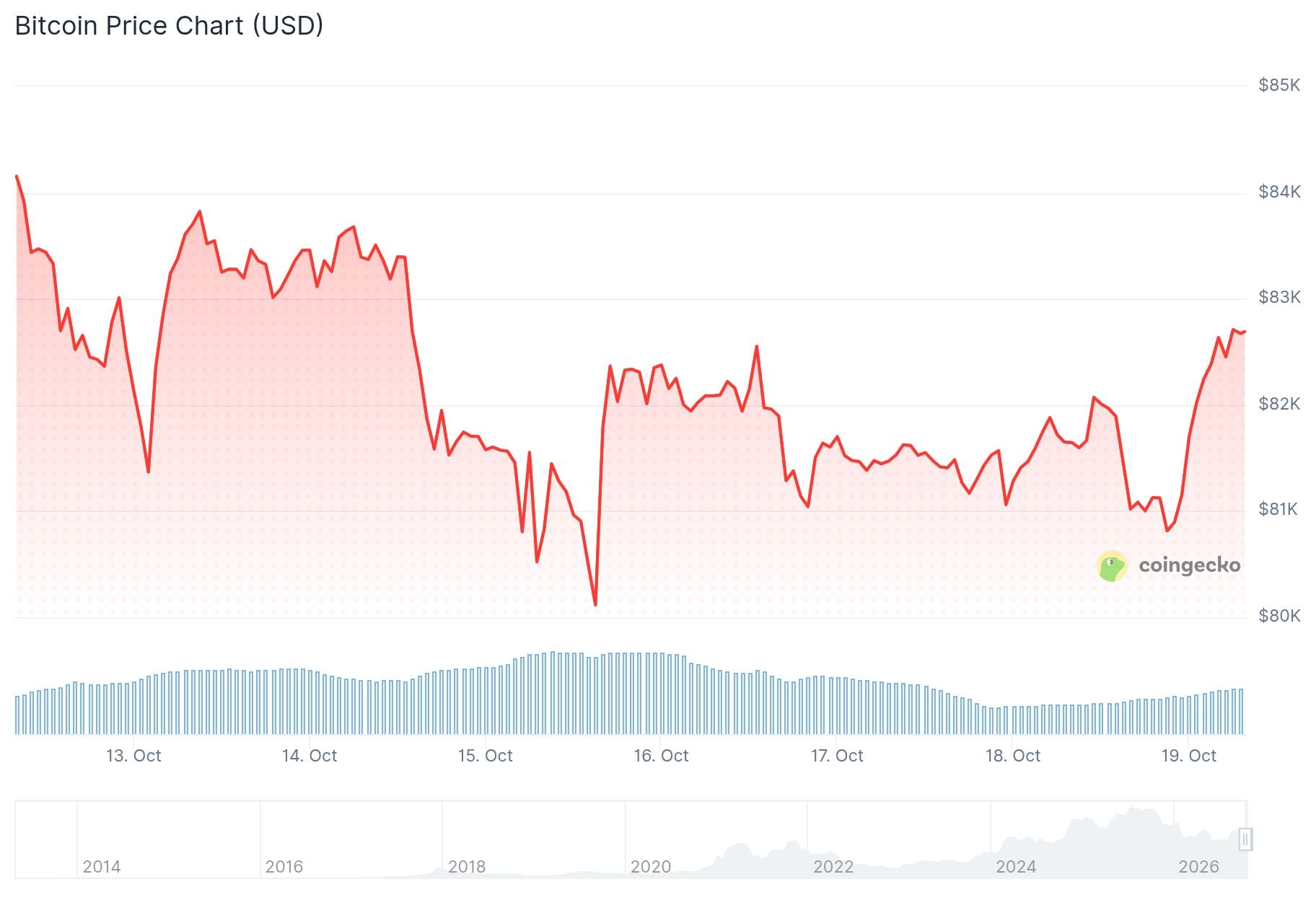
Bitcoin has struggled to hold momentum in October 2026. It recently traded near $82,000, and several large altcoins have also faced selling pressure.
Work on digital payments, decentralized finance and asset tokenization is still moving forward. Here is a look at five cryptocurrencies drawing attention.
Bitcoin: The Largest Cryptocurrency
Bitcoin is the largest and most established cryptocurrency. It draws interest from institutional investors, asset managers and publicly traded companies.
Its supply is fixed at 21 million coins. Growing access through exchange-traded funds also supports its long-term investment case.
Demand from institutions has weakened lately. Farside Investors reported about $228 million in net outflows from US spot Bitcoin ETFs during the week ending October 16.
Ethereum: The Base for Decentralized Finance
Ethereum is central to decentralized finance, stablecoin transactions and the market for tokenized real-world assets. Its network supports thousands of applications.

Ether is used to pay transaction fees and to secure the network through staking. The Ethereum Foundation lists network scaling, user experience and security as its 2026 priorities.
Ethereum faces competition from faster blockchains. Lower fees and the growth of layer-2 networks have also raised questions about how network use translates into demand for ether.
Solana: A Growing Payments Network
Solana competes with Ethereum by offering fast transaction processing and relatively low fees. Developers are building payment apps, decentralized exchanges and tokenized financial products on the network.
The Solana Foundation said stablecoin supply on the network reached $17.3 billion in September. Its October announcements also pointed to expanding institutional settlement infrastructure.
Risks remain, including competition, network reliability and changing speculative activity. These factors could affect demand for the SOL token.
XRP: Cross-Border Payments and Institutional Use
XRP is closely tied to Ripple’s work to modernize international payments. Ripple has expanded its institutional services to include stablecoin payments, custody and digital asset solutions.
In July 2026, Ripple received authorization under Europe’s Markets in Crypto-Assets framework. The approval supports its expansion into European financial markets.
Ripple’s business growth does not always lead to higher demand for XRP. Payments that use stablecoins can bypass the token entirely.
Chainlink: Linking Blockchains With Traditional Finance
Chainlink provides infrastructure that connects blockchain applications with outside financial data and other networks. Its technology supports decentralized finance, tokenized assets and cross-chain transactions.
In October, Chainlink introduced CCIP Vault Adapters. The tool lets decentralized finance vaults accept deposits from more than 80 supported blockchains.
Competition remains a factor for the project. It is also unclear whether wider use of its infrastructure will create enough demand for Chainlink’s token.
Which Crypto Has the Best Potential?
Crypto prices remain sensitive to interest rates, ETF flows, regulation and investor risk appetite. Even projects with growing adoption can see steep price declines.
The final quarter of 2026 is now underway. Institutional demand and measurable blockchain adoption are the key indicators for which coins may lead the next market recovery.


