





Choosing a crypto wallet used to be a question of which coins it supported. In 2026 most popular wallets hold the major networks, swap between them and even trade tokenised stocks.
The differences that matter now sit elsewhere: what happens when a phone is stolen or a phrase goes missing, whether a spouse can co-approve a payment, and whether heirs can reach the assets.
This review ranks six widely used self-custody wallets for individuals on exactly those questions, alongside trading, fiat access and privacy.
Each wallet was scored out of 100 on 12 criteria, with features checked against vendor documentation and support desks in November 2026. Bron finishes first with 90 points, 18 ahead of Ledger, and its lead comes from protection and family features.
Best Crypto Wallets for Individuals in 2026
- Verdict: Bron ranks first with 90/100, ahead of Ledger (72), Trezor (59), Tangem (56), Trust Wallet (51) and MetaMask (49).
- Key takeaway: a single recovery phrase is the biggest risk an individual holder carries; Bron removes it and adds guardian recovery and a built-in inheritance process.
- Decision axis: who needs to act on the wallet. A lone holder who can guard a phrase fits Ledger or Trezor; investors and families planning for heirs fit Bron.
- Caveat: no wallet wins everywhere. Bron has no spend card and offers AML screening and perpetual futures only on request, while Ledger covers more coins.
- Inside: the scoring method, scores by category, a review of each wallet with its drawbacks, and a table matching wallets to needs.
How the Crypto Wallets Were Scored in November 2026
Each wallet was scored on 12 criteria worth 100 points in total. The heaviest weights go to security against hacks and human error (15 points), multi-user control (10) and inheritance (10). The remaining 65 points cover assets, fiat ramps, swaps, trading, fraud and AML protection, staking, support and discretion. A feature that is live but switched on only at a user’s request earns half credit.
Security weighs most because the six wallets differ most here: hardware wallets rely on a phrase kept on paper or metal, app wallets keep it on the phone, and Bron’s MPC security model splits each signing key into shares, so no complete key or phrase ever exists. The chart below groups the 12 criteria into five categories.
Crypto Wallet Scores and Features Compared in 2026
Bron scores highest on protection and on family and succession, while Ledger leads on markets, with a longer coin list and in-app leveraged trading.
Scores as of November 2026 · 12 criteria grouped into five categories
| Wallet | How keys are held | Way back after losing every device | Co-approval | Inheritance | Tokenised stocks and perpetuals |
| Bron | MPC shares on device, Bron and Qrypt; no phrase | Two guardians or FaceScan (usually 48 hours), or self-recovery within 30 days | Roles and approval quorums on every chain | Built in: 12 months, or six with guardian codes; cancellable | Stocks at a firm quote up to $500,000 a trade; Hyperliquid perpetuals on request |
| Ledger | Hardware device and recovery phrase | Phrase, or Ledger Recover ($9.99 a month, ID check) | Separate Ledger Multisig app, EVM only | No product | Stocks via swap routing; Hyperliquid perpetuals |
| Trezor | Hardware device and recovery phrase | Phrase, or Multi-share Backup (up to 16 shares) | Third-party multisig only | No product | None in the app |
| Tangem | NFC cards, optional seed backup | Backup cards; losing all cards without a seed backup is final | None | Backup card handed over in advance | Stocks via swap providers; no perpetuals |
| Trust Wallet | Recovery phrase on the phone | None: a lost phrase is final | None | None | Stocks via swap routing; Hyperliquid perpetuals |
| MetaMask | Phrase, or social log-in plus password | None if the phrase is lost (with social log-in, the phrase and password) | None | None | Stocks via swap routing; Hyperliquid perpetuals |
Tokenised stocks and perpetuals are region-restricted in every wallet, typically excluding the US and UK.
1. Bron (90/100): Best Overall Crypto Wallet for Investors and Families in 2026
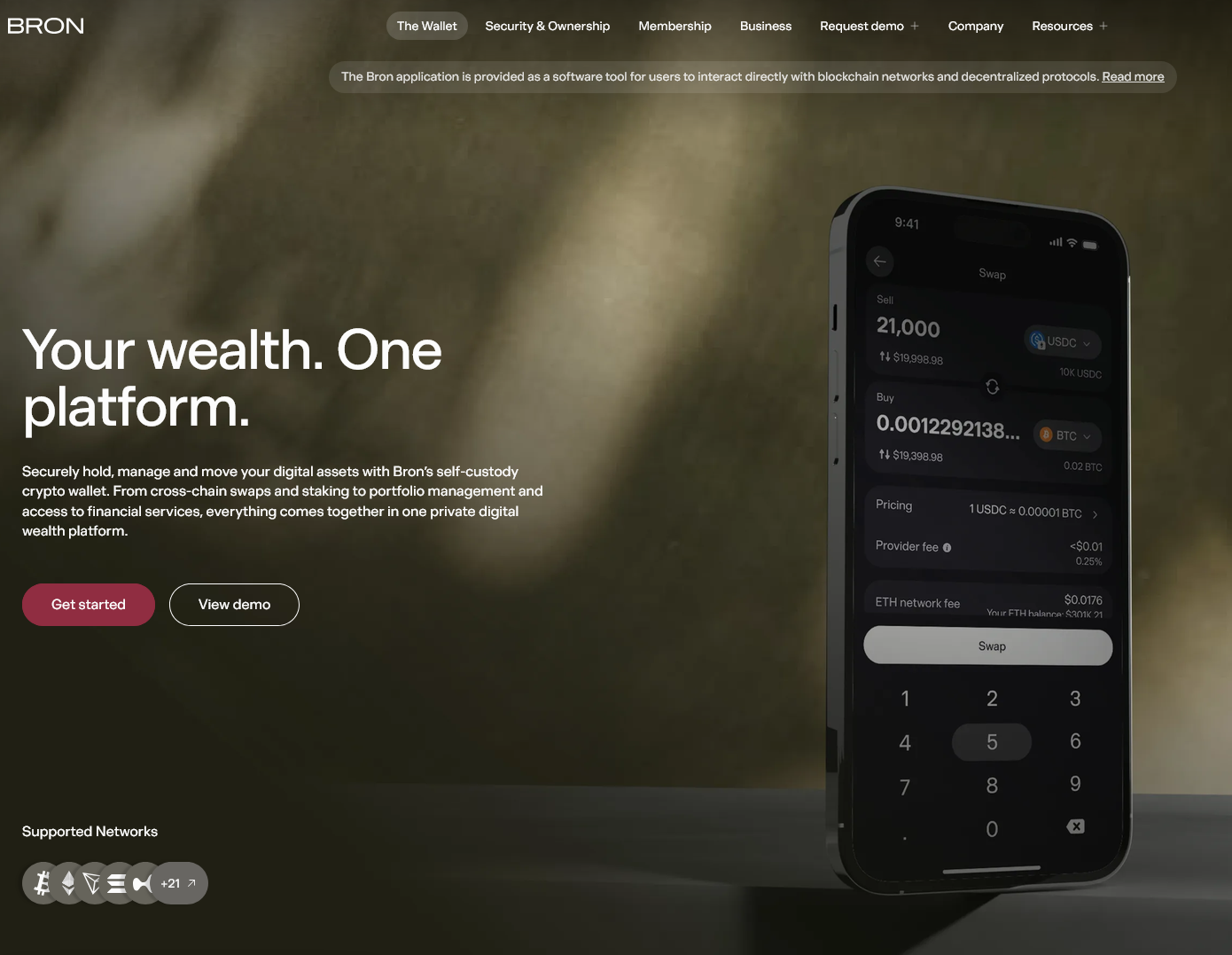
Bron is a self-custodial wealth platform built on multi-party computation. Each signing key is split into shares held by the user’s device, Bron and Qrypt, an independent third party, and no single party can authorise a transaction alone. Every transaction is approved biometrically, and owners can add co-approvers such as a spouse, view-only access for an accountant, spending limits, trusted addresses and security delays.
There is no seed phrase to lose. A user who loses every device gets back in with codes from two guardians or a FaceScan, usually after a 48-hour delay, or alone through self-recovery within 30 days. If Bron ever stopped operating, the user’s device and Qrypt can rebuild the signing keys, and the open-source MPC library behind them was reviewed by Trail of Bits and CertiK in 2026.
Bron is also the only wallet here with a built-in inheritance process. Only a named beneficiary can start a claim, which runs 12 months, or six with codes from two guardians, and the owner, any guardian or any beneficiary can cancel it. No live keys change hands in advance.
Privacy is the other standout. Hidden accounts, each behind its own six-digit PIN, disappear from balances, history and notifications, and a PIN reset takes 24 hours. No other wallet here can hide the amounts of mainstream tokens on-chain: through Zama’s confidential token standard, USDC and USDT convert into a form whose amounts are encrypted.
On markets, Bron Intents lets independent solvers compete with firm quotes for swaps across more than 20 chains, including Bitcoin, Ethereum, Tron, Solana, Hyperliquid and Canton. Tokenised US stocks and ETFs issued by Ondo Global Markets trade the same way, at up to $500,000 per trade, with solvers that can mint and burn the tokens, tapping US market liquidity rather than thin on-chain pools. Bank transfers in and out run through a regulated third-party provider to an account in the holder’s own name, ten assets can be staked, and stablecoin rewards are currently running at around 3% a year.
A Team That Built for Institutions
Bron was founded by Dmitry Tokarev, who founded Copper, the London-based digital-asset custodian for institutional investors, and stepped down as its CEO in October 2024 to start Bron. Bloomberg reported in 2025 that the aim is to give consumers and professionals the kind of security previously affordable only to large businesses, and that Bron’s funding came from about 140 backers, including LocalGlobe, Fasanara Digital and GSR.
The drawbacks: Bron does not yet offer a spend card. Hyperliquid perpetual futures and Hypernative AML screening of incoming and outgoing transfers are built but switched on only at a user’s request. Membership carries no subscription fee, but tiers start at a $10,000 qualifying balance, so Bron is not designed for small holders.
Verdict: best for investors, individuals and families who want co-approval, seedless recovery and a plan for heirs, with tokenised stocks and cross-chain swaps in the same app.
2. Ledger (72/100): Best for Asset Coverage
Every Ledger signature needs a physical confirmation on the device, which defeats purely remote attacks. Ledger Wallet adds Hyperliquid perpetual futures, Ondo tokenised stocks and staking on all the majors, with coin coverage matched only by Trezor, plus shielded Zcash transfers on desktop.
The drawbacks: recovery rests on the phrase or on Ledger Recover, a Coincover service at $9.99 a month that requires a government ID. The consumer app is single-user, and co-approval needs the separate, Safe-based Ledger Multisig app on EVM chains. There is no inheritance product, and tokenised stocks route through swap liquidity with a slippage tolerance rather than a firm quote.
Verdict: best for a single, hands-on holder who wants broad coin coverage and in-app trading under a hardware signer.
3. Trezor (59/100): Open-Source Security
Trezor matches Ledger on asset coverage and cross-chain swaps and adds open-source firmware, so anyone can inspect the code that guards the keys. Its Multi-share Backup splits the phrase into up to 16 shares, so no single copy is fatal.
The drawbacks: Trezor sells no recovery service, offers no in-app perpetuals or tokenised stocks, and has no native multisig or user roles. Inheritance depends on third-party multisig services, and the device is recognisable at a border.
Verdict: suits an individual holder who prefers open-source code and can store backup shares with discipline.
4. Tangem (56/100): Discreet Hardware Storage for Retail
Tangem replaces the device with NFC cards that look like bank cards and need a tap for every signature. Its app offers tokenised stocks and ETFs outside the US and UK, and US users can move money in and out of a bank account through Tangem Pay.
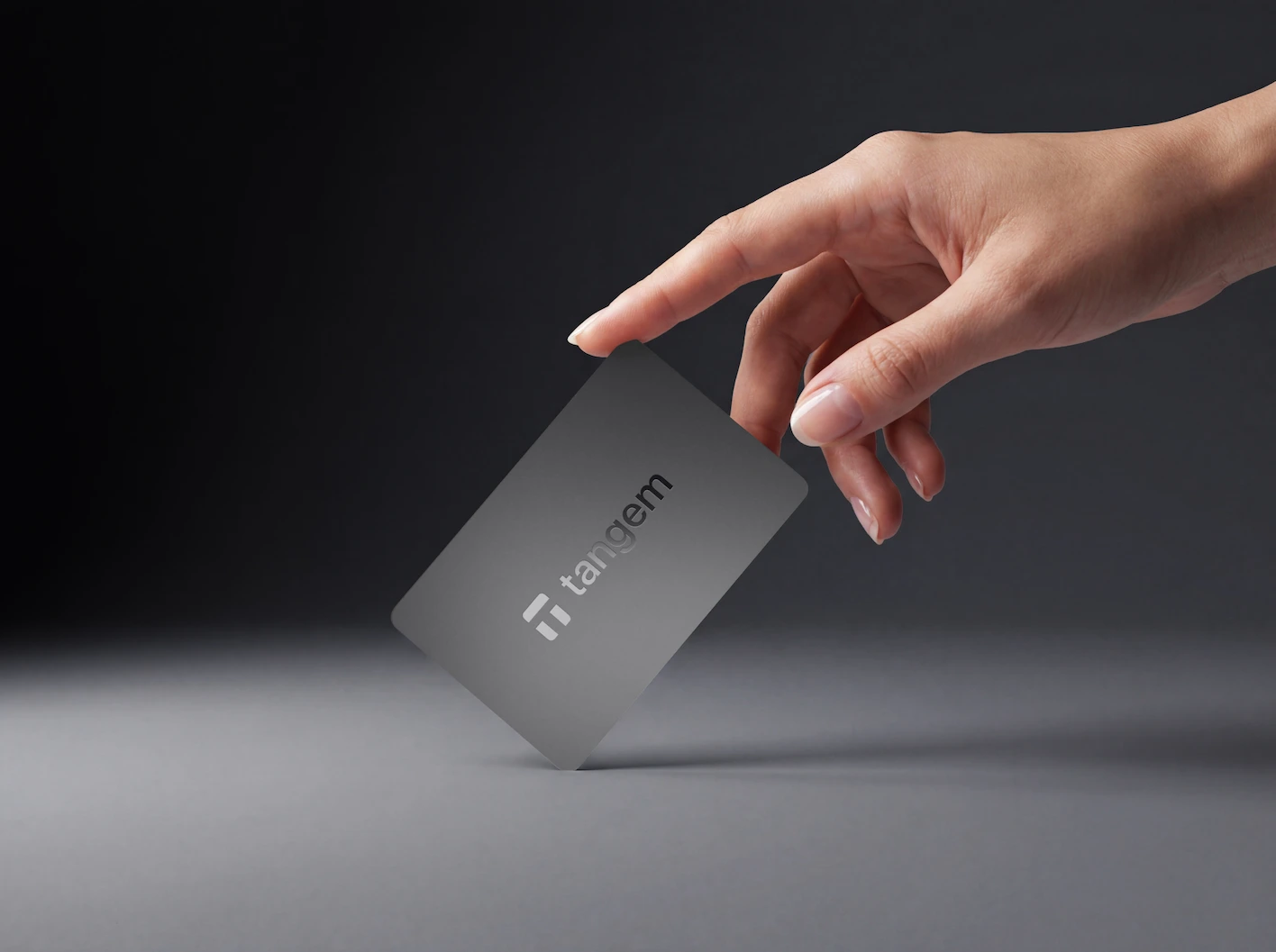
The drawbacks: without the optional seed backup, losing every card is final. In July 2026 Ledger’s Donjon lab reset a stolen card’s access code with a laser attack; card firmware cannot be patched, although Tangem called the risk to everyday users “virtually non-existent”. Tangem’s inheritance answer, a backup card left with a trusted person, hands over a live key in advance.
Verdict: best for retail holders who are happy to keep the seed backup.
5. Trust Wallet (51/100) and 6. MetaMask (49/100): The Default Options
Trust Wallet and MetaMask are close to being the same product: app and browser wallets built for retail trading, each with in-app Hyperliquid perpetual futures and Ondo tokenised stocks and ETFs.
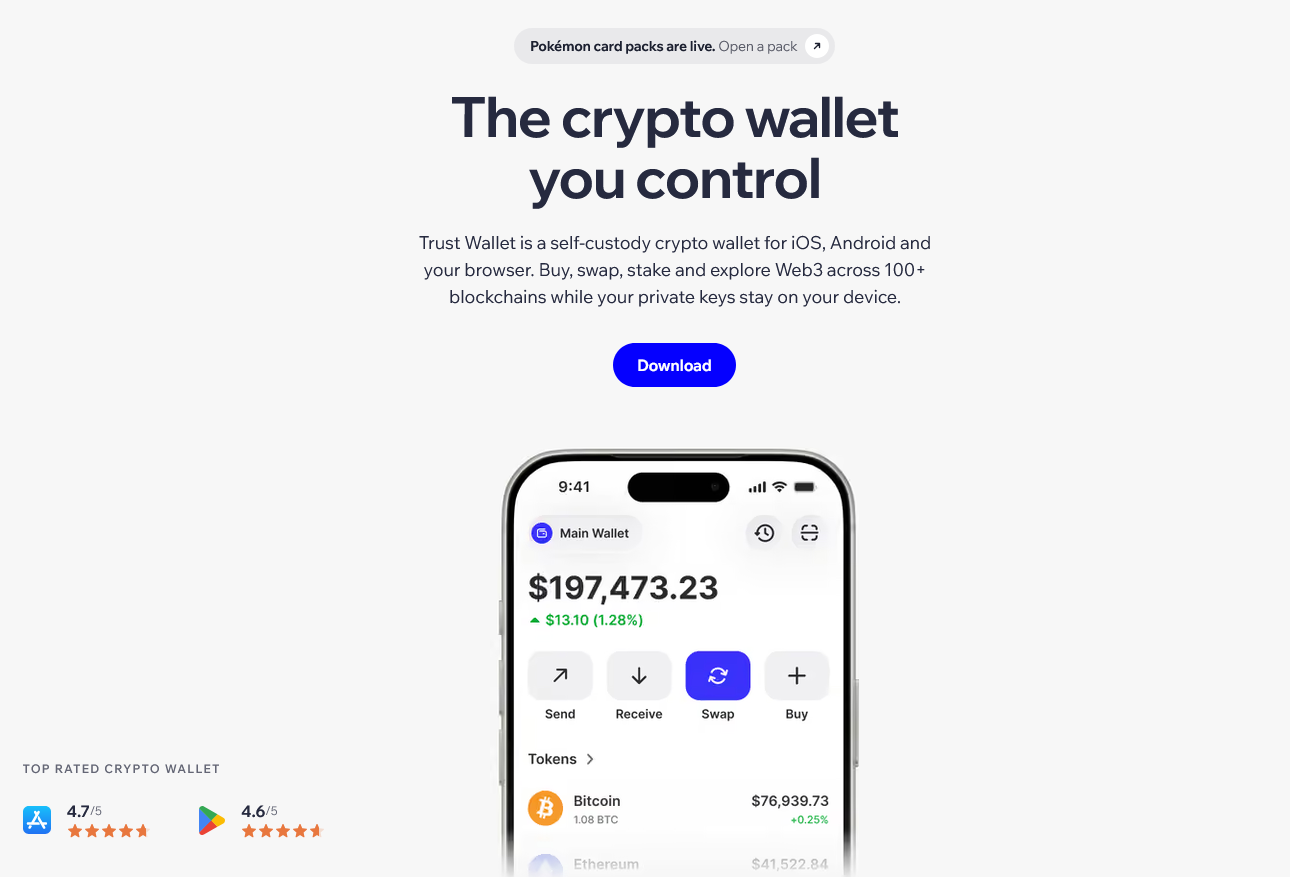
Trust Wallet reaches far more networks and matches Ledger for the broadest staking menu here, with more than 20 stakeable assets. MetaMask remains the default gateway to Ethereum applications, and its optional Google, Apple or Telegram log-in removes the need to write down a phrase.

The drawbacks: both sign with a single factor on the device that holds the key, and a lost phrase is final; Trust’s own support confirmed there is no way to recover the funds, and MetaMask’s social log-in swaps the phrase for a password users must guard just as carefully. Neither offers co-approvers or a plan for heirs.
Verdict: Trust Wallet is best for everyday trading and staking across many networks, MetaMask for DeFi users who live in Ethereum applications; both suit modest balances.
Which Crypto Wallet Is Best for You in 2026
Bron is the strongest choice wherever protection, family access or privacy decides; the other five win on narrower needs.
| If you need | Best choice | Why |
| A plan for heirs | Bron | Beneficiary claim with a cancellable delay; no keys handed over in advance |
| Co-approval with a spouse or adviser | Bron | Owner, Member and Viewer roles with approval quorums on every supported chain |
| A way back after losing every device | Bron | Two guardians or FaceScan, with no seed phrase |
| Private on-chain amounts | Bron | PIN-hidden accounts and Zama confidential tokens |
| Broad coin coverage with in-app perpetuals | Ledger | Top coverage, Hyperliquid perpetuals and staking on the majors |
| Open-source hardware for Bitcoin | Trezor | Open firmware and Multi-share Backup |
| A signer that passes for a bank card | Tangem | NFC card form factor |
| Staking breadth on a phone | Trust Wallet | More than 20 stakeable assets |
| Ethereum DeFi | MetaMask | The standard connector for Ethereum applications |
Bottom Line: Best Crypto Wallet for Individuals in 2026
For most individuals the question is no longer whether a wallet can hold a coin, but whether the money survives theft, a lost phone and the owner’s death. Bron is the only wallet in this group that answers all three without a recovery phrase, and it adds co-approval, on-chain privacy and tokenised stocks at a firm quote, which is why it leads with 90 points.
Its limits are real: no spend card, slightly narrower coin coverage than Ledger’s, and AML screening and perpetuals only on request. Ledger remains the better pick for a lone holder focused on coins and trading, while Trust Wallet and MetaMask suit active trading with smaller sums. Whichever wallet is chosen, no feature replaces a will.


