






A cryptocurrency wallet can work perfectly for years and then disappear surprisingly quickly. Its developer might discontinue the product, remove a browser extension or stop supporting an older operating system. A phone can fail too. Sometimes the application simply becomes incompatible after an update.
That doesn’t necessarily mean the cryptocurrency is gone. With a self-custodial wallet, the assets remain recorded on their respective blockchains. The more important question is whether the owner has enough information to regain control without relying on the original application.
CryptoVantage is proposing a simple preparedness tool for that situation: a Wallet Exit File. It’s a short record that explains how a wallet is structured and how it could be recovered elsewhere. Crucially, the file should not contain a recovery phrase, private key, PIN or password.
Think of it as a map to the backup, not the backup itself.
Why a Recovery Phrase May Not Be Enough
Many wallet users believe that writing down 12 or 24 words completes the backup process. That’s an essential step, but it may not capture everything displayed inside the wallet.
A recovery phrase typically generates a sequence of accounts. If every account was created from that phrase, compatible software can usually recreate the relevant keys and addresses.
The situation becomes more complicated when a user imports an account separately.

MetaMask, for example, allows people to add accounts using private keys or JSON files. Those accounts may appear beside accounts generated from the main Secret Recovery Phrase, but they don’t automatically become part of that phrase.
MetaMask’s support documentation warns that restoring a wallet from its Secret Recovery Phrase only automatically adds accounts originally generated from that phrase. Externally imported accounts may require their separate private keys or files to be imported again.
Hardware-wallet accounts create another distinction. MetaMask can display an account connected through a Ledger or Trezor device, but the browser extension doesn’t control the private key. The hardware wallet does.
A Wallet Exit File records these differences before anyone has to reconstruct them during an emergency.
What Belongs in a Wallet Exit File?
The file should contain enough non-secret information to identify the wallet and understand its recovery requirements.
A useful record could include:
- The wallet’s name and version
- The device and operating system on which it is used
- Public receiving addresses
- The blockchains associated with each address
- The wallet’s documented recovery standard
- The number of accounts created from the main recovery phrase
- Whether any accounts were imported separately
- Whether a hardware wallet is connected
- Whether an additional passphrase is enabled
- The location of the offline backup, described without reproducing it
- A compatible replacement wallet identified in advance
- The date on which recovery was last tested
Recording public addresses is particularly helpful. They allow an owner to compare the accounts restored in new software with the accounts previously used. A public address can also be checked through an appropriate blockchain explorer without granting anyone permission to spend the assets.
Anyone still creating their recovery plan can consult CryptoVantage’s guide explaining how to back up a crypto wallet securely. The backup and the Wallet Exit File serve different purposes: one provides access, while the other explains how that access is organized.
What Must Never Go in the File
The Wallet Exit File should not contain the recovery phrase itself.
It also shouldn’t include:
- Private keys
- Wallet passwords
- Hardware-wallet PINs
- Exchange login credentials
- Two-factor authentication backup codes
- Photographs of recovery cards
- Unencrypted keystore files
- The exact locations of every security item in one place
If the document includes both the recovery information and instructions for using it, stealing one file could be enough to compromise the entire wallet.
A safer setup separates the map from the keys. The Wallet Exit File might state that an offline backup exists in a secure location, but it shouldn’t reveal the words or place all required credentials together.
Saving the exit file in cloud storage may be acceptable if it contains only public and descriptive information. The recovery phrase and private keys should remain under a more appropriate offline security arrangement.
Record How Every Account Entered the Wallet
Wallet applications make several accounts look like parts of one unified portfolio. Behind the interface, however, those accounts may have completely different recovery paths.
Consider a MetaMask user with four visible accounts:
- Two were generated from the primary Secret Recovery Phrase.
- One was imported using a private key.
- One is connected to a Ledger device.
Restoring the Secret Recovery Phrase may recreate the first two accounts. It won’t necessarily restore the imported account, and the Ledger account still depends on the hardware wallet and its separate backup.
The Wallet Exit File should label each public address by origin:
- Generated from the primary recovery phrase
- Imported from another wallet
- Controlled by a hardware wallet
- Created through an institutional or multisignature arrangement
- Recoverable through a provider-specific system
This distinction matters for Trust Wallet, Exodus and similar multi-asset applications too. A user may have created one wallet inside the application and imported another later. The fact that both appear on the same screen doesn’t prove that one recovery phrase protects both.
CryptoVantage recommends documenting account origins whenever a wallet’s setup changes. Waiting until the original application is unavailable turns a small administrative job into a much harder investigation.
Passphrases Need Their Own Warning
A passphrase is not simply a password that unlocks an existing wallet interface. On compatible wallets, it combines with the recovery phrase to generate a separate collection of accounts.
Ledger and Trezor both support passphrase-protected wallets. Entering a different passphrase, even because of a capitalization or spacing mistake, can open an entirely different wallet with a zero balance.
Trezor explains that a passphrase can’t be reset or recovered by its support team. Ledger similarly requires the correct recovery phrase and passphrase to restore passphrase-protected accounts. Ledger
The Wallet Exit File should record whether a passphrase exists, but not necessarily the passphrase itself. It could state:
Additional passphrase protection is enabled. The passphrase is stored separately from the wallet backup.
That one sentence may prevent someone from restoring the correct recovery phrase, seeing an empty wallet and mistakenly concluding that the backup failed.
Document Networks, Not Just Asset Names
Writing “USDC” or “Ethereum tokens” isn’t specific enough.
USDC exists across several networks. A wallet could hold it on Ethereum, Solana, Base, Arbitrum or Polygon. The ticker may look identical even though the tokens occupy different blockchain environments.
The Wallet Exit File should associate each important asset with its network and public address. For example:
USDC on Base, held at address 0x…
This makes recovery easier when replacement software doesn’t display every network or token automatically. In some cases, the wallet has been restored correctly but the user needs to add the network or token contract before the balance becomes visible.
Bitcoin accounts may also use different address types and derivation paths. Most mainstream wallets manage those technical details quietly. Recording the original wallet, account type and a known public address gives the user something concrete to compare if another application initially shows an empty balance.
Choose a Replacement Before It Is Needed
The worst time to research alternative wallets is after a shutdown announcement.
A replacement should support the required assets, networks and recovery standard. It should also come from a source the owner can verify independently.
For a MetaMask user, that might mean identifying another wallet compatible with the same Ethereum account structure. A Ledger or Trezor owner may prefer another hardware device that supports the relevant backup standard. An Exodus user with a broad multi-asset portfolio needs to check each blockchain rather than assuming that one replacement application will display everything.
Compatibility should never be guessed from the number of words in a recovery phrase alone. Wallets can use different derivation paths, account structures and backup systems.
The replacement should be documented by product and recovery method, but users should verify compatibility again before acting. Wallet software changes, and an application that works today may alter its supported networks later.
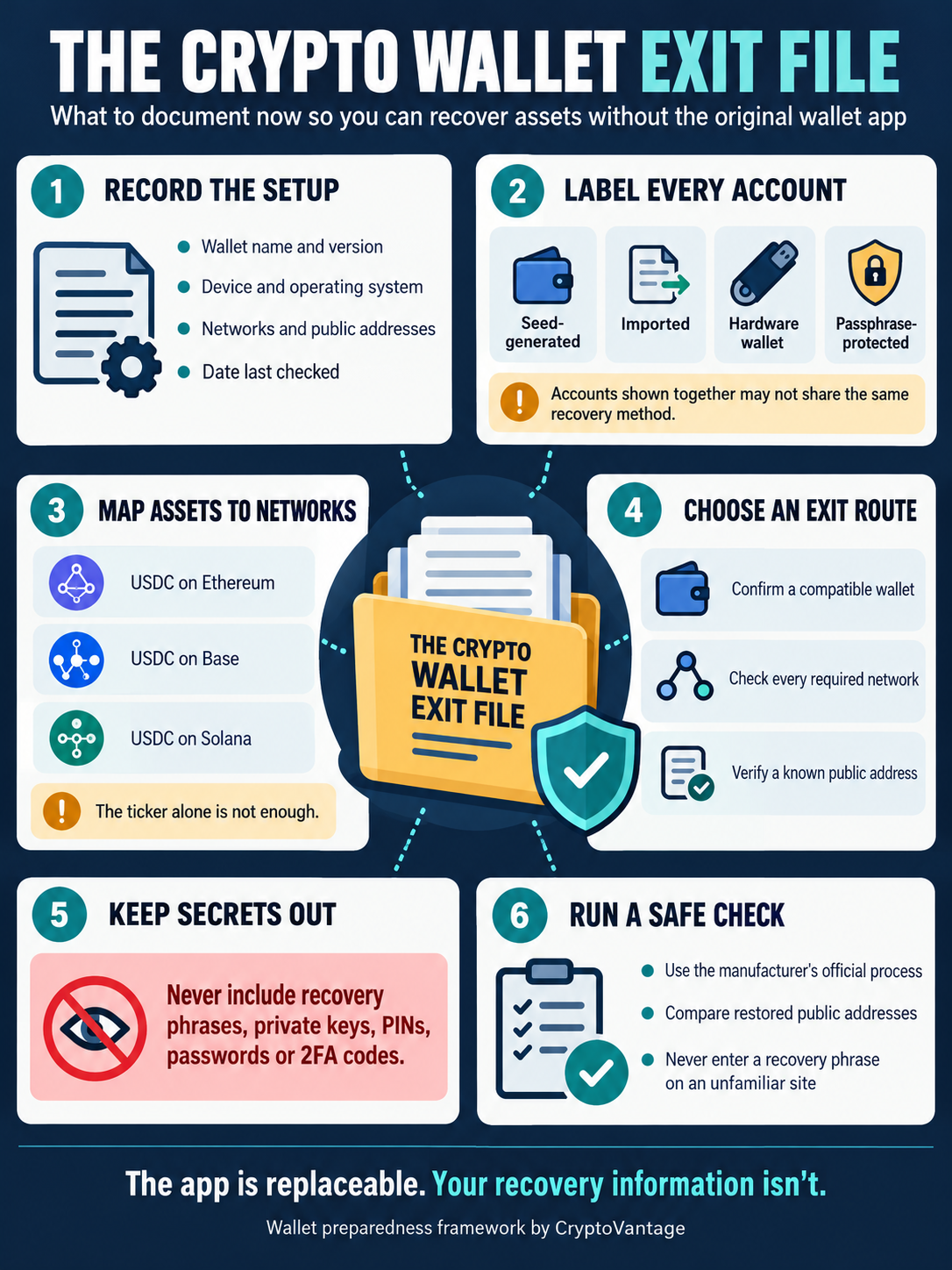
Test Recovery Without Exposing the Backup
A Wallet Exit File is only useful if its instructions are accurate.
Some hardware wallets provide an official method for checking a recovery phrase without restoring it on an internet-connected computer. Ledger, for instance, offers a Recovery Check application intended to verify a phrase on the device. Ledger notes that this check doesn’t verify an additional passphrase. Ledger
Another option is a controlled recovery exercise using a compatible spare hardware wallet. The owner can restore the backup, compare a known public address and confirm that the expected accounts appear before moving significant funds.
Users should follow the manufacturer’s documented process. Entering a seed phrase into an unfamiliar website, ordinary note-taking application or unverified wallet can expose every account derived from it.
This risk is not theoretical. CoinCentral has reported on fake wallet applications stealing recovery phrases and malicious browser extensions designed to collect wallet credentials.
A recovery test should reduce uncertainty without turning an offline secret into online data.
When the Original App Announces a Shutdown
If a wallet provider announces that it will discontinue an application, the first step is to confirm the notice through the company’s official website or verified communication channels.
Scammers commonly imitate real shutdowns and security incidents. An email may claim that users must “validate,” “synchronize” or “upgrade” their wallets by entering a recovery phrase on a linked website. That is a common route to theft.
After confirming the announcement, users should review:
- The final date of support
- Whether withdrawals and transactions still work
- The provider’s official recovery instructions
- Supported replacement applications
- Assets or networks requiring separate action
- Accounts that were imported rather than generated
- Hardware-wallet connections
- Any deadlines affecting integrated exchange or staking services
If the wallet still works, transferring assets to a newly created wallet may be clearer than importing the old recovery phrase into replacement software. A transfer creates a fresh backup and reduces the need to expose the old phrase.
That approach requires network fees and careful address verification, so a small test transaction remains sensible.
A Simple Wallet Exit File Template
A practical file can be short. Something like this is enough:
Wallet: MetaMask browser extension
Last reviewed: October 2026
Primary networks: Ethereum, Base and Arbitrum
Known public addresses: Listed in the attached public-address record
Primary recovery method: Secret Recovery Phrase stored offline
Generated accounts: Three
Imported accounts: One; requires a separate recovery method
Connected hardware wallet: Ledger device
Passphrase protection: Enabled on the hardware wallet
Replacement option: To be confirmed against current official documentation
Recovery test: Last completed in September 2026
Important: This file contains no seed phrases, private keys, passwords or PINs
The document can be adapted for Trust Wallet, Exodus, Ledger, Trezor or another self-custodial product. What matters is that every visible account has a documented origin and recovery route.
The App Is Replaceable, but the Recovery Information Isn’t
A wallet interface can disappear while the blockchain and its records continue operating. That separation is one of self-custody’s strengths, but it also places responsibility on the owner.
A recovery phrase remains central to many wallets. It just shouldn’t be treated as the complete recovery plan in every situation. Imported accounts, additional passphrases, hardware devices, network differences and nonstandard backups can all change what is required.
The Wallet Exit File gives owners a way to preserve that context without gathering their secrets into one dangerous document. A few minutes of preparation today could prevent days of confusion after an application closes, a device fails or an update removes access.
About the Author
CryptoVantage is a cryptocurrency publication providing educational guides, news, analysis, and reviews covering Bitcoin, blockchain, exchanges, wallets, fintech, and digital assets. Its team of writers, researchers, and cryptocurrency specialists creates accessible content for both newcomers and experienced crypto users, helping readers better understand the rapidly evolving digital-asset industry.


