





TLDR
- The Dow, S&P 500 and Nasdaq posted their best Thanksgiving week since 2008.
- Monday’s Nvidia surge and Friday’s rebound produced most of the Dow’s weekly gain.
- Nvidia, which sparked the rally, rose only 0.8% on Friday while other tech names led.
- Traders expect the Fed to raise rates several times, not cut them.
- Next week brings Jensen Huang’s congressional testimony and the November jobs report.
Wall Street just had its best Thanksgiving week since 2008. The headline numbers look strong. The path to them was shakier: two big sessions carried most of the gain, a weak stretch came between them, and two major tests arrive next week.
BREAKING: The S&P 500 just had its BEST Thanksgiving week since the 2008 financial crisis.
The index jumped 5.6% this week, its biggest weekly gain since April 2025, while the Nasdaq surged 6.7%.
Just a week ago, the Nasdaq had wiped out ALL of its 2026 gains.
The only bigger… pic.twitter.com/6RLkG5gHye
— Coin Bureau (@coinbureau) November 27, 2026
Stocks closed Friday’s half-day session sharply higher. The Dow Jones Industrial Average rose 591.99 points, or 1.18%, to 50,774.94. The S&P 500 gained 1.6% to 7,297.49, and the Nasdaq Composite climbed 2.31% to 24,129.50.
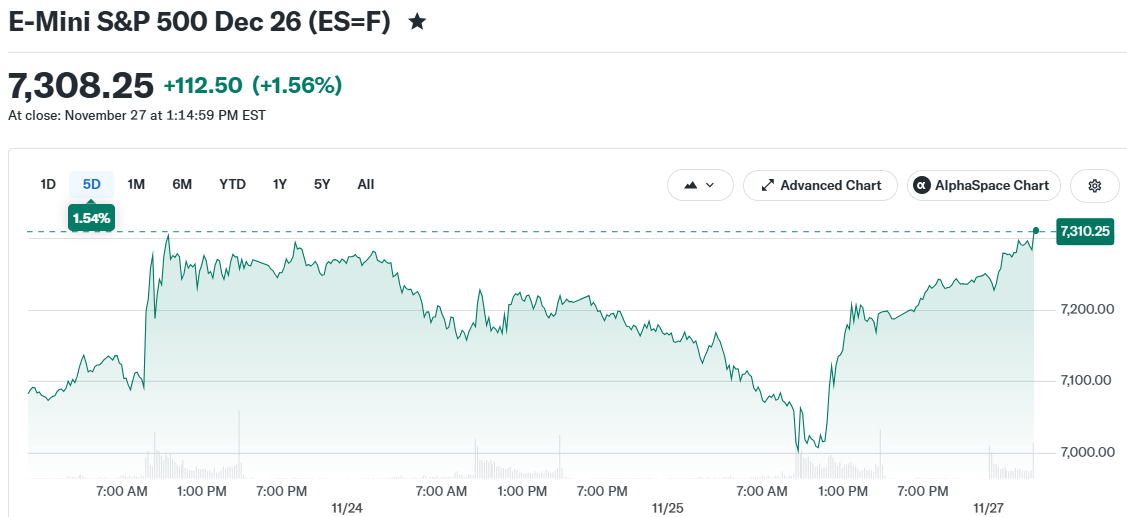
For the week, the Dow and S&P 500 each rose more than 5%, and the Nasdaq rose more than 6%. It was the Dow’s best week since October 2022 and the S&P 500’s best since April 2025.
Most of the Gains Came in Two Sessions
The week opened with Nvidia reinstating Jensen Huang as CEO. The stock jumped 31% on Monday, and the Dow added more than 1,400 points.
AI stocks then gave back part of that gain. Friday’s dip buying brought the rally back.
Monday and Friday together added roughly 2,000 Dow points. By our calculation, a weekly gain above 5% works out to about 2,400 points or more. That means the middle of the week did comparatively little.

Friday’s leaders also stood out. Nvidia rose just 0.8%. Amazon gained about 4%, Broadcom almost 4%, and Meta more than 3%. Anthropic shares added nearly 11%. One reading is that buyers are spreading money across the AI trade rather than chasing the stock that started the week. One session is too little to confirm that.
A Quiet Market Can Exaggerate Moves
Friday’s session ended at 1 p.m. ET, under the NYSE’s holiday schedule, and trading volume was relatively thin. When fewer shares change hands, prices can move further on less conviction. That makes Friday’s jump a weaker signal than a normal session.
The Index Sits Between Two Key Levels
David Morrison, senior market analyst at Trade Nation, pointed to the levels traders are watching:
“A quick look at some key charts shows that the S&P 500 has significant support around 7,000, and it is currently butting up against some mild resistance at 7,330.”
“A break above here could put the index on track for a retest of major resistance at 7,600.”
Friday’s close left the S&P 500 about 0.4% below 7,330. The 7,000 floor and the 7,600 ceiling are each roughly 4% away, so the index has about as much room to fall as to rise.
Rate Hikes Hang Over the Rally
The bigger pressure may come from the Federal Reserve. This week’s personal consumption expenditures price index reading strengthened traders’ expectations of several rate hikes in the coming months. Some market watchers say that outlook, more than AI worries, explains the market’s recent weakness.
AI concerns were already building before Huang’s exit. They included heavy debt financing, signs that capital spending was slowing, and Democratic midterm wins that were slowing data center development.
Ben Fulton, CEO of WEBs Investments, said most of those fears are “a bit overblown.” He made an exception for debt financing. He said the “biggest risk” is whether AI companies can “keep funding the growth they need.” Higher rates would make that funding more expensive.
“The risk seems to be on the upside right now. You don’t want to be short this market, at least the AI names.”
What to Watch Next Week
Huang is scheduled to testify before a congressional committee. Coverage hasn’t said which committee or what the hearing will cover. Nvidia drove this week’s rally, so his testimony could move the AI trade again in either direction.
The November jobs report also arrives next week. A strong report could reinforce expectations of rate hikes. A weak one could change them.


