





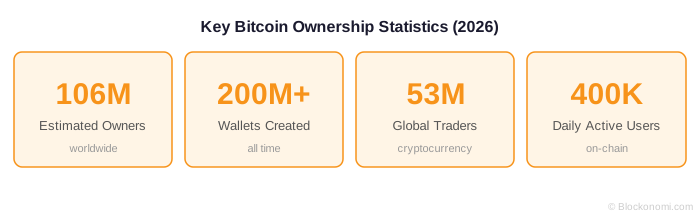
Bitcoin has grown from a niche project into one of the world’s most widely held financial assets. Around 106 million people are estimated to own Bitcoin as of 2026.
No official count exists. Bitcoin lets anyone create a wallet without providing identification, which makes an exact total impossible to determine.
What the on-chain data shows is a clear pattern: broad global awareness, rising institutional ownership, and a small number of very large holders controlling much of the total supply.
How Many People Own Bitcoin?
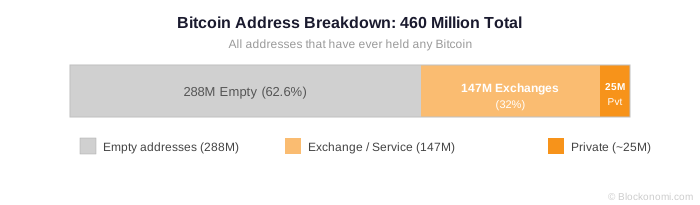
The most common way to estimate Bitcoin ownership is to look at wallet addresses on the blockchain. Around 460 million addresses have ever received Bitcoin at some point in history.
Of those, 288 million are now empty. About 172 million still hold some Bitcoin, but 147 million of those belong to exchanges, businesses, and other services — not individual people.
That leaves roughly 25 million addresses believed to belong to private individuals. But one person can control many wallets, so the actual number of individual owners is likely much higher.
When exchange account data is included — covering people who hold Bitcoin through Coinbase, Binance, or similar platforms — the global ownership estimate rises to around 106 million. That works out to about 1.3% of the world’s population.

The number of UTXOs — individual unspent transaction records on the Bitcoin network — grew from 64 million in January 2020 to around 180 million by October 2024. This suggests Bitcoin is being split into more individual holdings over time, even if the total number of people owning it is hard to count precisely.
Counting ownership is also complicated by how people use exchanges. A user may hold accounts on Coinbase, Kraken, and Gemini at the same time — each counted separately in platform data but representing one person. A 2021 Pew Research survey found 16% of U.S. adults had invested in, traded, or used cryptocurrency, rising to 43% for adults aged 18 to 39.
The Largest Bitcoin Holders by Category
Blockchain analytics firm Arkham groups related wallet addresses into “entities.” A single entity can represent a person, an exchange, a company, or a government — giving a clearer picture of total holdings than individual addresses alone.
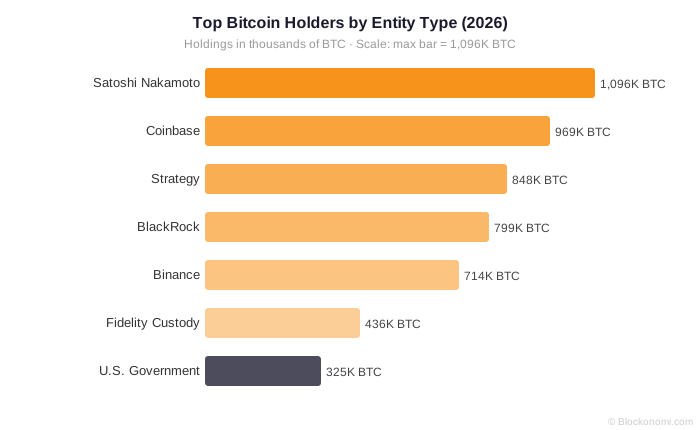
The largest entity is Satoshi Nakamoto, Bitcoin’s anonymous creator. Arkham identifies his addresses using a mining fingerprint called the Patoshi Pattern. He is believed to hold around 1.096 million BTC — worth approximately $92 billion — acquired by mining 22,000 blocks.
Behind Satoshi, the biggest holders are major cryptocurrency exchanges, institutional ETF issuers, and corporations that have added Bitcoin to their balance sheets. Fidelity Custody, which acts as a custodian for clients including Strategy, holds 436,000 BTC on behalf of others.
At the exchange level, Coinbase controls 4.8% of the total Bitcoin supply, and Binance controls 3.6%. These holdings represent customer deposits, not the exchanges’ own assets.
| Entity Type | Entity | BTC Held | USD Value | % of Supply |
|---|---|---|---|---|
| Individual | Satoshi Nakamoto | 1,096,000 | $92B | 5.5% |
| Exchange | Coinbase | 969,000 | $81B | 4.8% |
| Public Company | Strategy | 848,000 | $77B | 4.0% |
| ETF Issuer | BlackRock | 799,000 | $67B | 4.0% |
| Exchange | Binance | 714,000 | $60B | 3.6% |
| Custodian | Fidelity Custody | 436,000 | $37B | 2.2% |
| Government | U.S. Government | 325,000 | $27B | 1.6% |
| Private Company | Tether | 97,000 | $8B | 0.5% |
The Biggest Individual Bitcoin Wallets
Beyond entity groupings, the blockchain also reveals individual wallet addresses. The top four wallets by size are all cold storage wallets run by major cryptocurrency exchanges.
Cold wallets are offline storage used by exchanges to protect large amounts of Bitcoin from online attacks. These wallets hold customer deposits, not the exchanges’ own Bitcoin. The fifth-largest wallet by individual address belongs to the U.S. Government from the Bitfinex hack recovery.
| Rank | Wallet (Owner) | BTC Held | USD Value | % of Supply |
|---|---|---|---|---|
| 1 | Binance: Cold Wallet (34xp4…) | 249,000 | $21B | 1.24% |
| 2 | Binance: Cold Wallet (3M219…) | 210,000 | $18B | 1.04% |
| 3 | Robinhood: Cold Wallet | 141,000 | $12B | 0.70% |
| 4 | Bitfinex: Cold Wallet | 130,000 | $11B | 0.65% |
| 5 | Tether: Bitcoin Reserves | 97,000 | $8B | 0.48% |
| 6 | U.S. Gov: FBI / Bitfinex Recovery | 95,000 | $8B | 0.47% |
| 7 | Unknown (bc1qd4y…v4rzr) | 92,000 | $8B | 0.46% |
Governments With Bitcoin Holdings
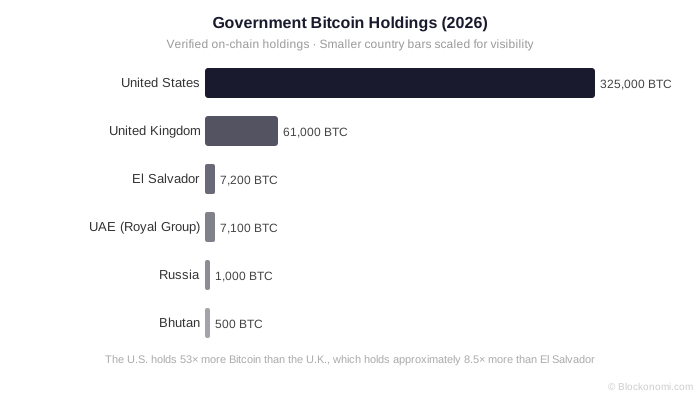
Most governments that hold Bitcoin acquired it through criminal asset seizures. The United States holds by far the largest government supply — a lead that is not close.
The U.S. holds 325,000 BTC recovered from the Silk Road marketplace, the Bitfinex hack, and hacker James Zhong. The government also acquired 127,000 BTC from the LuBian Hacker address. In July 2026, the U.S. transferred $280 million in Bitcoin and Ethereum to Coinbase Prime.
The United Kingdom holds 61,245 BTC seized from Jian Wen and Zhimin Qian in 2018. The Metropolitan Police gained access to those funds in 2021. The UK’s holdings are the second-largest confirmed government supply in the world.
El Salvador is a different case entirely. It voluntarily adopted Bitcoin as legal tender and purchased it as a national reserve asset. The country bought 2,546 BTC at a cost of $108 million and at one point was buying one Bitcoin every day.
China seized 194,775 Bitcoin in 2020 from the operators of the PlusToken Ponzi scheme. The tokens were handed to local government authorities. It remains unclear whether China still holds this Bitcoin or has since sold it off. Germany seized 50,000 BTC from a movie piracy site called Movie2k in January 2024, then sold the entire amount during July 2024 — one of the largest recorded government disposals of Bitcoin.
Bhutan mined Bitcoin through its sovereign wealth fund, Druk Holding and Investments, using hydroelectric power from its glacial rivers. Its holdings have since dropped from around 6,000 BTC to 500 BTC as the country sold portions throughout 2026.
| Rank | Government | BTC Held | USD Value | % of Supply |
|---|---|---|---|---|
| 1 | United States | 325,000 | $27B | 1.60% |
| 2 | United Kingdom | 61,000 | $5B | 0.31% |
| 3 | El Salvador | 7,200 | $608M | 0.036% |
| 4 | UAE (Royal Group / Citadel) | 7,100 | $589M | 0.035% |
| 5 | Russia | 1,000 | $86M | 0.004% |
| 6 | Bhutan (Druk Holdings) | 500 | $43M | 0.002% |
Companies With Bitcoin in Their Treasuries
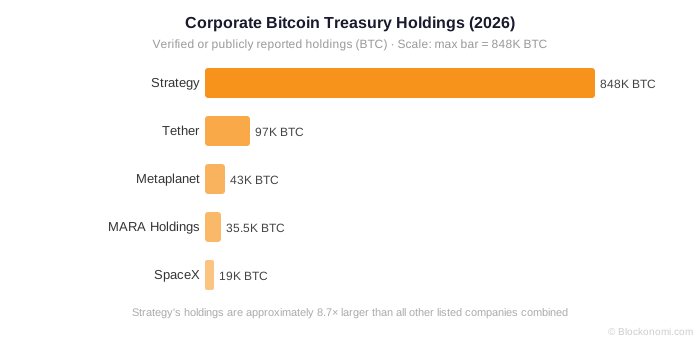
The trend of companies holding Bitcoin on their balance sheets took off in 2020 and has grown steadily. Strategy — formerly known as MicroStrategy — leads all other public companies by a wide margin.
Strategy has been buying Bitcoin since August 2020 and now holds 848,000 BTC worth roughly $77 billion. A portion of those holdings are kept by Fidelity Custody on the company’s behalf. Strategy’s co-founder Michael Saylor has been one of the most vocal public advocates for corporate Bitcoin adoption.
MARA Holdings, a publicly traded Bitcoin mining company, mined an average of 22.7 BTC per day in September 2025. SEC filings put MARA’s total holdings at 35,500 BTC. Metaplanet, listed on the Tokyo Stock Exchange, holds 43,000 BTC as a hedge against the declining Japanese yen — earning it the nickname “Japan’s MicroStrategy.”
SpaceX, which recently became a publicly traded company, holds 19,000 BTC in its corporate treasury. With a valuation of $2 trillion, it is the largest company in the world to hold Bitcoin on its books.
| Company | Type | BTC Held | Notes |
|---|---|---|---|
| Strategy | Public | 848,000 | Accumulating since August 2020 |
| Block.one | Private | 164,000* | *Reported, not verified on-chain |
| Tether | Private | 97,000 | Verified on-chain |
| Metaplanet | Public (Tokyo) | 43,000 | Japan’s largest corporate holder |
| MARA Holdings | Public | 35,500 | Per SEC filings |
| SpaceX | Public | 19,000 | Recently went public; $2T valuation |
Among private companies, Tether leads with 97,000 BTC confirmed on the blockchain. Block.one, the developer of the EOSIO blockchain, is listed on Bitcoin Treasuries with 164,000 BTC, but this has not been independently verified on-chain.
Bitcoin ETFs and Institutional Demand
The launch of Bitcoin spot ETFs in the United States in January 2024 changed the landscape for institutional Bitcoin ownership. For the first time, large funds, pension managers, and everyday brokerage users could gain Bitcoin exposure through a regulated account without holding the asset directly.
BlackRock’s iShares Bitcoin Trust was among the first ETFs approved and has grown to hold 799,000 BTC — making BlackRock one of the largest Bitcoin holders in the world. Fidelity, Grayscale, Bitwise, ARK Invest, and Morgan Stanley also offer Bitcoin ETF products in the United States.
Grayscale is an older institutional product that operated as a trust before spot ETFs were approved. Its Bitcoin holdings are spread across more than 1,750 different addresses, each holding no more than 1,000 BTC. All of Grayscale’s Bitcoin is held in custody by Coinbase.
The arrival of ETFs has moved a large portion of Bitcoin’s supply into the hands of a small number of institutional issuers. This has raised questions about long-term decentralization, as holdings become concentrated in a few custodians rather than spread across individual wallet holders.
ETFs have also made it easier for investors who are uncomfortable managing private keys to gain exposure to Bitcoin price movements. The trade-off is that ETF holders do not actually own any Bitcoin directly — they own a financial product that tracks its price.
Bitcoin’s Supply Cap and Lost Coins
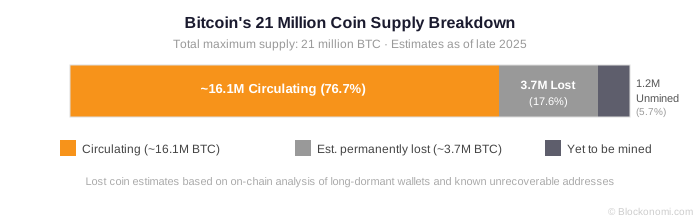
One of Bitcoin’s defining features is its hard supply cap of 21 million coins. No more than 21 million Bitcoin will ever exist. This limit is written into the protocol itself and cannot be changed without broad consensus from the entire network.
As of late 2025, approximately 19.8 million Bitcoin have already been mined. That leaves around 1.2 million still to be released through the mining process. The final Bitcoin is projected to be mined around the year 2140.
Separate from the unmined supply is a large amount of Bitcoin believed to be permanently lost. Forgotten wallet passwords, coins sent to wrong addresses, and early miners who discarded hardware have all contributed to an estimated 3.7 million BTC that can no longer be accessed. This reduces the effective circulating supply well below the 21 million cap.
This built-in scarcity is one of the main reasons holders cite for keeping Bitcoin long-term. No central authority can increase the supply to dilute its value, unlike traditional currencies where central banks can print more money.
Unattributed Wallets: Mystery Bitcoin Addresses
Some of the largest Bitcoin wallets have no known owner. These addresses hold billions of dollars in Bitcoin but have rarely or never sent funds anywhere.
The biggest unknown wallet holds 92,000 BTC — worth around $8 billion. Most of these wallets have been inactive since the Bitcoin was first deposited, making it very difficult to determine who controls them.
| Rank | Address (Shortened) | BTC Held | USD Value | % of Supply |
|---|---|---|---|---|
| 1 | bc1qd4y…v4rzr | 92,000 | $8.0B | 0.46% |
| 2 | bc1q8yj…st4g | 78,000 | $6.5B | 0.40% |
| 3 | 1LdRcd…eC | 54,000 | $4.5B | 0.27% |
| 4 | 1AC4fM…mtA | 52,000 | $4.3B | 0.26% |
| 5 | 1LruNZ…os | 44,000 | $3.65B | 0.22% |
How Many People Hold at Least One Full Bitcoin?
As of late 2024, around 1 million Bitcoin addresses held at least 1 BTC. But this does not mean 1 million different people each own a full Bitcoin. One person can hold dozens of addresses, and a single exchange wallet holding thousands of Bitcoin for many customers counts as one address.
The number of addresses with 10,000 BTC or more includes some of the world’s largest custodians, holding Bitcoin on behalf of thousands of individual customers. Many of those customers may themselves own more than one Bitcoin, even though their funds are pooled into a single wallet address.
Owning one full Bitcoin requires a substantial investment at current prices. For most people, Bitcoin ownership means fractions of a coin. If you divide the total mined supply among every person on Earth, the average works out to approximately 0.00244 BTC per person — though the actual distribution is far more unequal, with the majority of coins held in a relatively small number of wallets.
Daily Bitcoin Users and Transactions
Bitcoin’s network processes more than 270,000 on-chain transactions every day. One transaction can pay multiple recipients, so this figure understates the total number of people involved each day.
Active addresses on the Bitcoin network typically range from 650,000 to 1 million per day. Analysts estimate this reflects between 300,000 and 500,000 unique users either sending or receiving Bitcoin on any given day.
In October 2024, daily active addresses dropped to around 650,000 despite a rising Bitcoin price. This suggests many holders were choosing to hold their coins rather than move them — a pattern consistent with long-term investing behaviour.
It is also worth noting that holding Bitcoin in a wallet counts as “using” it in many analysts’ frameworks. Not every Bitcoin holder makes transactions each day. Many treat it as a long-term savings asset, similar to gold.
Bitcoin Traders by Region
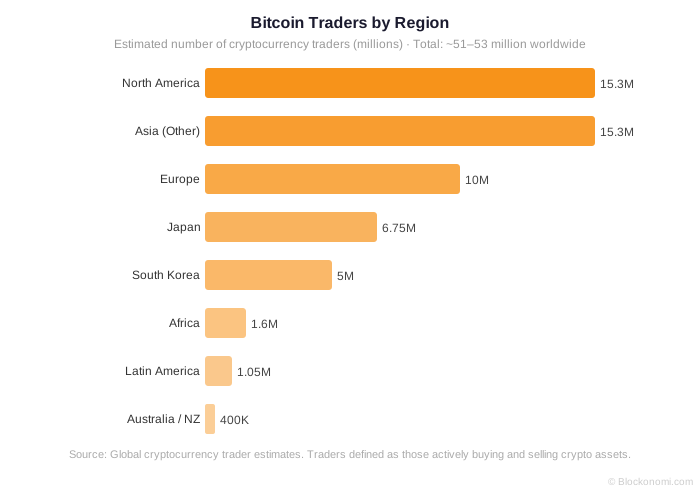
Research estimates between 51 and 53 million cryptocurrency traders worldwide. North America and the rest of Asia each account for the largest share, with around 15 million traders apiece.
Europe ranks third with 10 million traders, followed by Japan with 6.75 million and South Korea with 5 million. Africa and Latin America are growing markets but represent a smaller portion of global totals today. Combined, they account for around 2.65 million traders.
| Region | Estimated Traders |
|---|---|
| North America (USA & Canada) | 15.3 million |
| Rest of Asia (excl. Japan & South Korea) | 15.3 million |
| Europe | 10 million |
| Japan | 6.75 million |
| South Korea | 5 million |
| Africa | 1.6 million |
| Latin America | 1.05 million |
| Australia & New Zealand | 400,000 |
Global Bitcoin Awareness
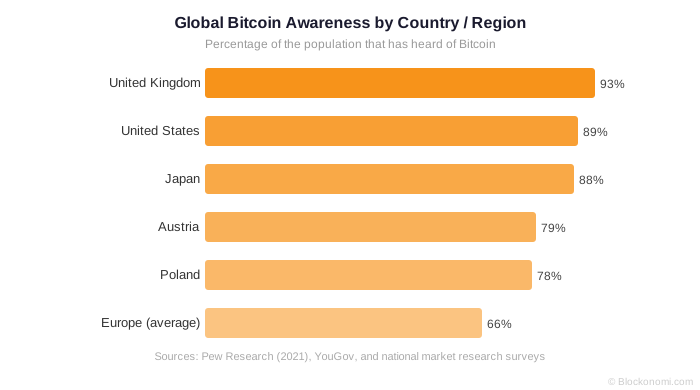
Bitcoin awareness is high across most developed countries. About 89% of Americans say they have heard of Bitcoin, and 22% report owning some. In Japan, awareness stands at 88%, and in the UK it reaches 93%.
A 2021 Pew Research survey of 10,371 U.S. adults found that 16% had invested in, traded, or used cryptocurrency. For Americans aged 18 to 39, that number climbed to 43%. Older Americans were much less likely to be involved, with participation rates dropping sharply for those aged 50 and above.
Across Europe, about 66% of people have heard of Bitcoin, rising to 78% in Poland and 79% in Austria. Based on these global figures, researchers estimate that at least two billion people worldwide have heard of Bitcoin.
The Awareness-to-Ownership Gap
One of the standout patterns in global Bitcoin data is the gap between awareness and actual ownership. In the United States, 89% of adults have heard of Bitcoin, but only 22% say they own any. That means roughly 78% of Americans know what Bitcoin is but have not bought it.
This gap narrows substantially among younger adults. The 2021 Pew Research survey found 43% of 18-to-39-year-olds had invested in, traded, or used cryptocurrency. For adults aged 50 and older, that number dropped to around 8%. Age appears to be the strongest predictor of Bitcoin ownership in the United States.
In China, where Bitcoin ownership faces legal restrictions, surveys suggest around 40% of people are interested in investing in Bitcoin. This indicates demand that is not reflected in current ownership figures due to legal barriers rather than a lack of interest.
The gap between awareness and ownership is often cited as evidence that Bitcoin has a large potential audience that has not yet converted into buyers. The main barriers appear to be concerns about complexity, price volatility, regulatory uncertainty, and trust in custodial platforms.
Countries That Have Restricted Bitcoin
Several countries have tried to ban or limit Bitcoin activity over the years. Most have found full enforcement difficult or impossible, given Bitcoin’s decentralized structure.
China has placed restrictions on Bitcoin multiple times. In June 2021, authorities banned all Bitcoin mining in the country — the most aggressive action taken by any major government against Bitcoin infrastructure. The People’s Bank of China had also restricted financial institutions from handling Bitcoin as early as 2013. In 2020, Chinese authorities seized 194,775 BTC from the PlusToken Ponzi scheme, though it remains unclear whether those coins have since been sold or retained.
Russia has never formally banned Bitcoin but has maintained a grey area around its use. In 2014, the central bank issued warnings that exchanges could face money laundering scrutiny. The warnings described competing with the Ruble as a money substitute as illegal. Mining and exchange operations continue to run inside Russia today, with no definitive legal resolution.
Thailand ruled in 2013 that Bitcoin was not a legal currency, making certain exchange activities technically outside the law. A Thai exchange was denied a money transfer licence on those grounds. Exchanges now operate under e-commerce business licences, and the situation for users remains legally unclear.
Germany seized 50,000 BTC from a movie piracy website called Movie2k in January 2024. Unlike the United States and United Kingdom, which have held their seized Bitcoin, Germany sold its entire 50,000 BTC holding during July 2024. The sale took place over several weeks and represented one of the largest government disposals of Bitcoin on record.
Sources
- Arkham Intel — Who Owns the Most Bitcoin: Top BTC Holders 2026
- Bitbo.io — How Many People Own & Use Bitcoin?
- Pew Research Center — 16% of Americans say they have ever invested in, traded or used cryptocurrency (2021)
- Chainalysis — Bitcoin Active Address and UTXO Data — chainalysis.com
- U.S. Securities and Exchange Commission — MARA Holdings Bitcoin Treasury Disclosure (SEC Filing) — sec.gov
- Bitcoin Treasuries — Public and Private Company BTC Holdings — bitcointreasuries.net
- Blockchain.com — Blockchain Explorer Charts — blockchain.com
- Coinbase — Investor Relations & Annual Report User Statistics — investor.coinbase.com


