






TLDR
- BNB Chain outlined a new layer-1 that will use BNB as its native token, with no new token planned.
- The network targets 200 ms blocks, sub-second finality and more than 100,000 transactions per second.
- It adds reserved payment lanes, fee sponsorship, an optional shielded pool and scoped permissions for AI agents.
- Analyst Trader Symba said BNB’s drawdown is about -61.8%, with a deeper cycle drawdown near -73.7%.
- Reports differ on timing, with the public testnet placed in late 2026 or Q1 2027.
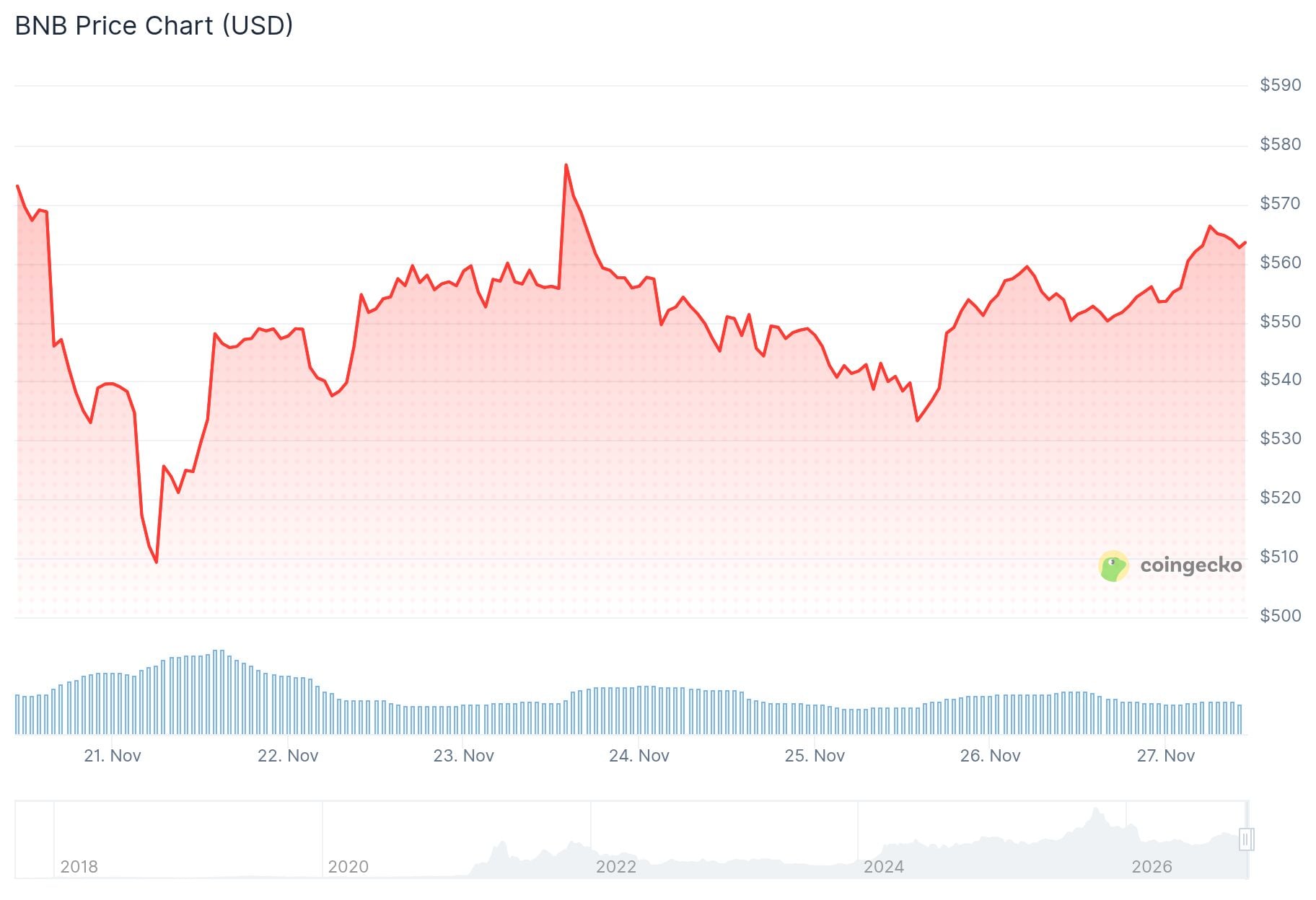
BNB fell to a low of $503 on Saturday. The token has since recovered and is now trading at $563, about 12% above that low.
BNB Chain has outlined a new layer-1 blockchain that will use BNB as its native token. No new token is planned for the network.
You’ve heard about BNB Chain’s new L1, now take a look inside.
Get a closer look at the network we’re developing for high-frequency trading, payments, private finance and AI agents, with BNB at its core.
Read the litepaper below 👇https://t.co/vwXBsws2xn pic.twitter.com/oZvhduPO2G
— BNB Chain (@BNBCHAIN) November 26, 2026
The chain will run alongside BNB Smart Chain (BSC), opBNB and Greenfield. It is aimed at high-frequency trading, payments, private finance and autonomous AI agents.
The plans were published in a litepaper on Thursday. The network is currently running as a multi-validator devnet.
Speed is the main goal. The team lists targets of 200-millisecond blocks and sub-second finality.
It also aims for more than 100,000 transactions per second under an enhanced Parlia consensus. Ordering and execution will run on separate timelines, so one block is ordered while another is processed.

The chain will stream small groups of transactions, called SubBlocks, before a full block closes. These give apps a signal in about 20 milliseconds, though that signal can still change.
How the Network Handles Busy Periods and Fees
Dedicated lanes will reserve a share of block capacity for activity such as payments. Unused space returns to general traffic.
The design does not guarantee that every transaction lands right away during a rush. It is meant to reduce competition for block space.
Native account abstraction moves authorization and fee rules into the protocol. Users can sign in with passkeys and batch several calls into one transaction.
Apps can sponsor fees, so new users do not need to buy BNB first. A paymaster can quote a fee in a stablecoin while paying the network fee in BNB.
Owners can also set scoped permissions for AI agents. Agents can act within predefined limits, and owners can revoke access at any time.
Privacy Features and BNB Price Levels
Analyst Trader Symba said BNB is getting close to its historical max drawdown zone. He put the current drawdown at around -61.8%, with the deeper cycle drawdown near -73.7%.
$BNB is getting very close to its historical max drawdown zone.
Current drawdown is around -61.8%, while the deeper cycle drawdown sits near -73.7%.
That usually means most of the damage is already done. I’m not calling the exact bottom here, but this is the type of area where… pic.twitter.com/uNuvNHXcVk
— Trader Symba (@Nebulabsxyz) November 26, 2026
He added that most of the damage may already be done, though he is not calling the exact bottom. He described the area as one where downside can become limited and a base can begin to form.
The new chain includes an optional shielded pool for private transfers of BNB and other supported BEP-20 tokens. It sits alongside standard transparent EVM transactions.
Public calls and some settlement details will stay visible. Documentation says the pool’s circuits are unaudited and it should not be used with real funds.
Users can give scoped viewing access without handing over spending rights. A feature called AtomicCall lets shielded assets fund selected public actions, such as supported swaps.
Builders will keep an EVM-compatible environment but must adapt to new transaction formats and fees. Parallel EVM execution is still planned, and protected ordering through a trusted execution environment gateway remains proposed.
Reports differ on timing. One places the public testnet in the first quarter of 2027 and mainnet in the second half of the year, while another points to a late 2026 testnet and an early 2027 mainnet.


