






TLDR
- Monero fell more than 11% on Thursday, its biggest one-day drop since June 4.
- XMR touched $430 and is down 22% for the month and 14% for the quarter.
- KuCoin will delist XMR on Nov. 30, the second major exchange to do so in November.
- A Hyperliquid contributor said instant swap sites relied on KuCoin’s order books.
- The FCMP++ upgrade is in security audits after a public beta launch in October.
Monero (XMR) fell more than 11% on Thursday, its biggest one-day drop since June 4. Most other privacy coins, including Zcash (ZEC), also moved lower.
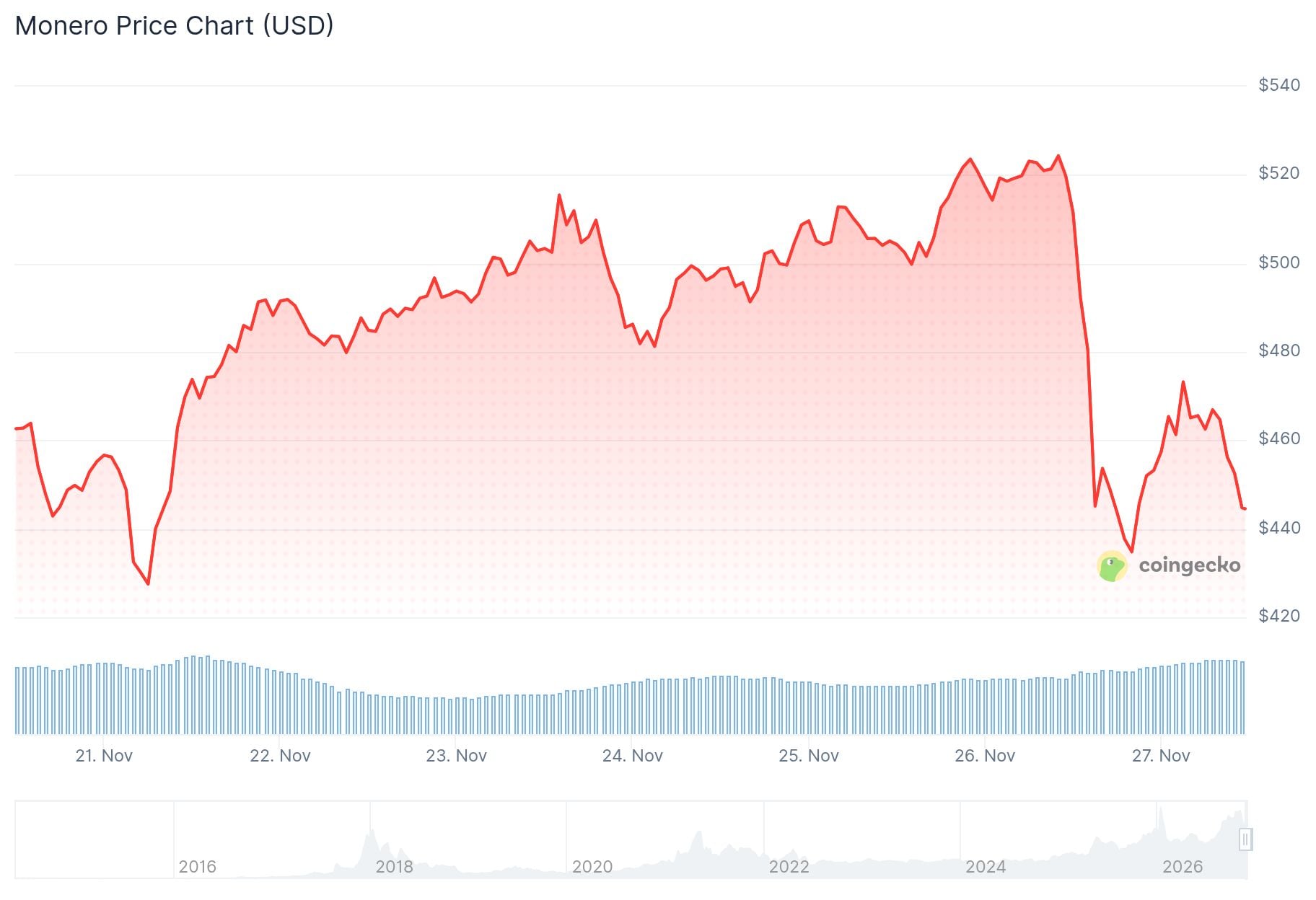
XMR traded near $464 after touching a low of $430 during the session. Another reading showed it at $449.98 as of 7:00 p.m. UTC.
The coin is down 22% for the month and 14% for the quarter. It has slid from about $625 on Nov. 3.
🚨 ALERT: Monero $XMR plunges -30% in a month as major centralized exchanges continue to delist the privacy coin.
KuCoin has announced it will officially delist XMR on November 30, 2026, with deposits already permanently disabled.
Binance, OKX and MEXC have also previously… pic.twitter.com/pyU7sVvpvi
— Coin Bureau (@coinbureau) November 27, 2026
The drop followed a delisting notice from KuCoin, the 12th largest exchange by 24-hour trading volume. XMR will stop trading there on Nov. 30.
The XMR/USDT, XMR/USDC, XMR/ETH and XMR/BTC pairs will close at 8:00 UTC that day. KuCoin told users to update or cancel their spot orders before then.
Delistings Pile Up in November
KuCoin has already suspended XMR deposits. It plans to close withdrawals on Dec. 31.

This is the second major platform to drop the coin this month. MEXC suspended spot trading and delisted its perpetual futures contracts earlier in November.
Coinbase International, Binance, OKX and Bitget already do not offer XMR trading. TRM Labs counted 73 exchange delistings of the token in 2025 alone.
Hyperliquid contributor PerpetualCow.hl said on X that over 50% of users sourced their XMR indirectly from KuCoin. The contributor added that instant swap exchanges have no liquidity of their own and simply wrapped around KuCoin’s order books.
With KuCoin gone, the contributor said Wagyu is now the top XMR exchange by market dominance. The contributor called that shift “crazy.”
The European Union’s Anti-Money Laundering Regulation takes effect on July 10, 2027. It bars financial firms from holding accounts that hide transactions through “anonymity-enhancing coins.”
The rule does not stop individuals from holding privacy coins in self-custody wallets. It also covers coins with optional privacy features, which could bring Zcash into scope.
Zcash and Monero Take Different Paths
Monero launched in 2014 and hides transaction amounts and addresses by default. Zcash launched in 2016 and lets users pick between transparent and shielded transactions.
Grayscale research head Zach Pandl said Zcash is positioned differently from Monero. He said Monero’s ring signatures “may be vulnerable” as AI-powered blockchain analytics improve.
Grayscale’s Zcash ETF began trading on NYSE Arca on Aug. 25. Its assets reached $1 billion on Sept. 24 and stood at $406 million on Wednesday.
Zcash now trades near $770 and is up about 50% this year. It peaked at $1,653 on Sept. 26.
The Monero community released a new version of Eigenwallet that stores both Bitcoin and Monero. Its atomic swap tool lets two people trade BTC directly for XMR, and either both sides get their coins or the deal is canceled.
Monero’s FCMP++ upgrade is advancing through security audits after debuting on a public beta test network in October. Once live, it would hide each transaction among over 150 million outputs instead of 16, and add quantum-safe forward secrecy for transaction history.


