





TLDR
- NASA is launching the Nancy Grace Roman Space Telescope on August 30 via a SpaceX Falcon Heavy rocket from Kennedy Space Center, Florida.
- The telescope has a field of view 100 times larger than Hubble and is designed to study dark matter, dark energy, and over a billion galaxies.
- It will orbit roughly 930,000 miles from Earth at the second sun-Earth Lagrange point and is built to operate for up to 10 years.
- L3Harris Technologies, BAE Systems, and Teledyne Technologies all supplied key components for the telescope.
- SpaceX’s space segment revenue is projected to grow from $4.5 billion in 2026 to $6.3 billion in 2027, with total company sales expected around $100 billion.
NASA is set to launch one of its most powerful space telescopes yet, and several defense and aerospace companies are set to benefit from the mission.
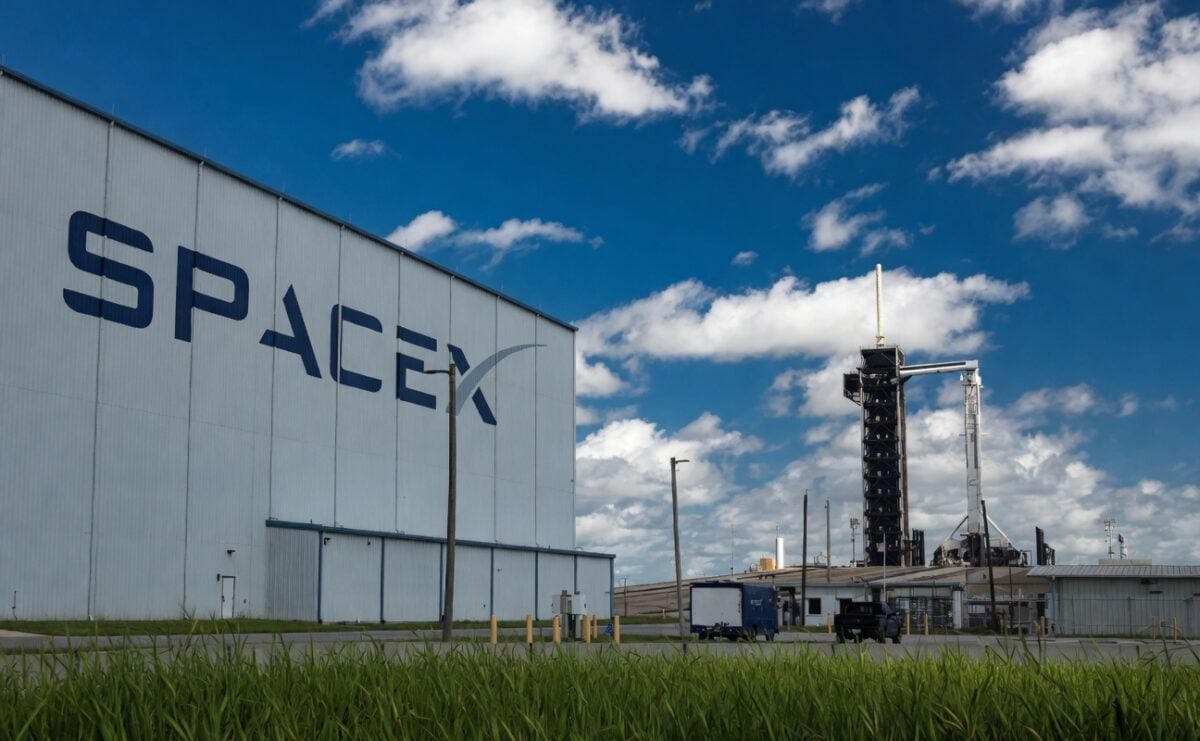
Falcon Heavy in the hangar at pad 39A in Florida ahead of Sunday’s launch of @NASA’s Nancy Grace Roman Space Telescope pic.twitter.com/Dvu5XnVxKX
— SpaceX (@SpaceX) August 26, 2026
The Nancy Grace Roman Space Telescope is scheduled to lift off on August 30 aboard a SpaceX Falcon Heavy rocket. Liftoff is targeted for no earlier than 7:26 a.m. ET from Launch Complex 39A at Kennedy Space Center in Florida.
The telescope is named after NASA’s first chief astronomer, Nancy Grace Roman, who is widely known as the “mother of the Hubble Space Telescope.” She passed away in 2018 at the age of 93.
At 42 feet long and over 14 feet wide, the Roman telescope will travel to a gravitationally stable point roughly 930,000 miles from Earth, known as the second sun-Earth Lagrange point.
The telescope carries two science instruments. These are a wide-field 300-megapixel near-infrared camera and a coronagraph designed to block out starlight, allowing scientists to image faint planets nearby.
What Roman Can Do That Hubble Cannot
Roman’s camera has a field of view 100 times larger than Hubble’s. Over five years, it is expected to cover more than 50 times the sky area Hubble observed across three decades.

Key science targets include dark matter, dark energy, a census of over a billion galaxies, and the potential discovery of up to 100,000 new exoplanets. NASA plans to release all data openly to scientists worldwide.
Roman is built for a five-year mission but is engineered to operate for up to ten years. First images are expected before the end of 2026, with full science operations ramping into early 2027.
Defense Stocks With a Stake in the Mission
Several companies supplied hardware for the Roman telescope. L3Harris Technologies provided parts and services for the optical assembly. BAE Systems supplied instrumentation, and Teledyne Technologies provided infrared sensors.
L3Harris reported roughly $6 billion in space system sales in the first half of 2026, up 15% year over year. Teledyne’s aerospace and digital imaging segments together made up around 70% of its second-quarter revenue.
SpaceX, which is launching the telescope, continues to dominate the commercial launch market. The company is expected to complete around half of all rocket launches in 2026, a year when total global launches are set to exceed 320.
SpaceX’s space segment revenue is projected at $6.3 billion in 2027, up from $4.5 billion in 2026. Total company sales are forecast to reach around $100 billion.
Wall Street projects SpaceX’s AI-related revenue could hit $575 billion by 2031, most of it eventually coming from orbital data centers, up from $65 billion in 2027.
Stop guessing and start investing with confidence. KnockoutStocks gives you the AI insights, market intelligence, and stock research you need to spot opportunities, cut through the noise, and make smarter investment decisions — all in one powerful platform.
Sign up today and get 50% OFF full access to our premium stock picks.
Simply use coupon code SPECIAL50 at checkout to claim your exclusive discount.
Get 3 Free Stock Ebooks
Discover top-performing stocks in AI, Crypto, and Technology with expert analysis.
- Top 10 AI Stocks - Leading AI companies
- Top 10 Crypto Stocks - Blockchain leaders
- Top 10 Tech Stocks - Tech giants



