






TLDR
- Brent and WTI crude both jumped around 3.5% Monday after fresh U.S.-Iran fighting
- Iran declared the Strait of Hormuz closed after a commercial vessel was hit and set on fire
- The U.S. disputed the closure, saying the waterway remains open under its protection
- South Korean stocks dropped up to 9%, with chip giant SK Hynix falling more than 15%
- Only six vessels transited the Strait of Hormuz on Sunday, the lowest level in five weeks
Oil prices surged Monday as fighting between the United States and Iran flared up again, raising fresh fears about crude supplies through the Strait of Hormuz.
Brent crude rose 3.5% to $78.68 a barrel. West Texas Intermediate also climbed 3.5% to $73.89 a barrel. Both contracts had jumped as much as 4.5% earlier in the session before pulling back.
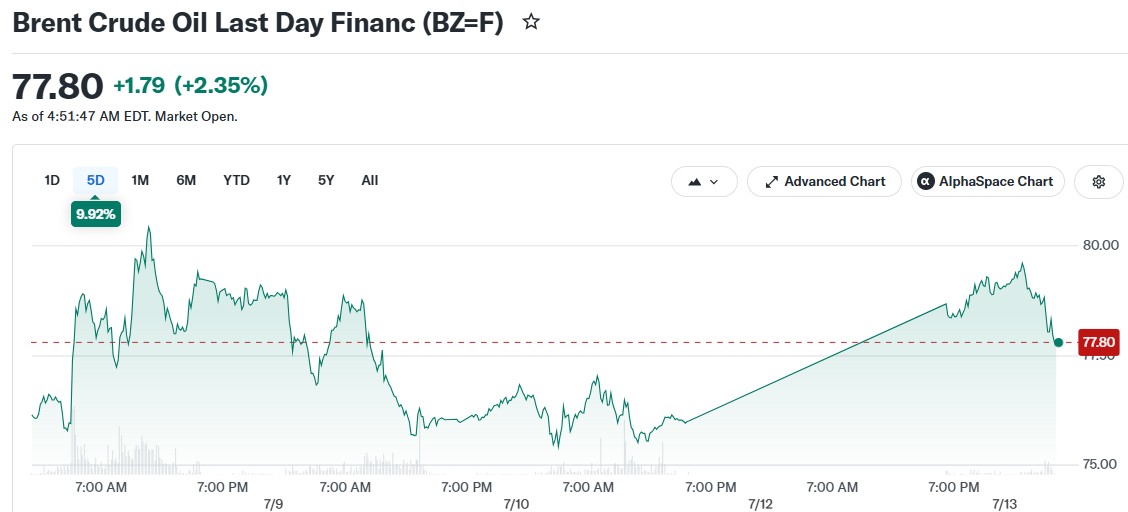
The latest spike followed Iranian missile and drone attacks on Gulf states including Qatar and the United Arab Emirates on Sunday. The attacks came in response to U.S. military strikes on Iranian targets.
Iran’s Revolutionary Guards then declared the Strait of Hormuz closed “until further notice.” The announcement came after a commercial vessel was struck and set ablaze, forcing its crew to abandon ship.
BREAKING: The US has struck Kharg Island's western jetty pumping station and multiple pipelines supplying Kharg's pumping stations, with fires visible on NASA FIRMS satellite imagery.
This is the first US strike specifically targeting oil infrastructure at Kharg, Iran's primary… pic.twitter.com/lhO9DqGa2Q
— The Hormuz Letter (@HormuzLetter) July 13, 2026
What the Strait of Hormuz Closure Means for Oil Markets
The Strait of Hormuz is the most important oil shipping route in the world. It carries crude exports from Saudi Arabia, Iraq, Kuwait and the United Arab Emirates.
Any lasting disruption could force Asian refiners to find alternative suppliers. It would also push up freight and insurance costs.

Ship-tracking data showed just six vessels transited the strait on Sunday. That is the lowest level in five weeks.
The U.S. military’s Central Command said on X that the strait was “open to all vessels seeking to lawfully transit,” directly contradicting Iran’s statement.
Shipping operators remained cautious regardless. Vessel traffic slowed sharply over the weekend, according to ANZ analysts.
Stock Markets Take a Hit
Asian equity markets fell sharply on Monday. South Korea’s Kospi dropped as much as 9% at one point, dragged down by heavy selling in tech stocks.
SK Hynix fell more than 15% in Seoul. The chipmaker has now lost nearly 40% of its value since hitting a record high last month. This came just after its U.S.-listed shares rose almost 13% following a record $26.5 billion share sale in New York.
Samsung dropped more than 10%. Japanese tech firms Advantest and Tokyo Electron also fell.
Investors are also watching the upcoming earnings season. Reports from TSMC and ASML are due this week, along with results from JP Morgan, Bank of America and Goldman Sachs.
Market analyst Fawad Razaqzada said the situation could spiral quickly, though analysts noted oil is unlikely to return to the extreme highs seen when the conflict first broke out in February.
The International Energy Agency said last week that sustained disruptions to Hormuz shipping could derail an expected recovery in global supply. Global oil supply had rebounded by 4.1 million barrels per day in June as flows through the strait temporarily resumed.
Stop guessing and start investing with confidence. KnockoutStocks gives you the AI insights, market intelligence, and stock research you need to spot opportunities, cut through the noise, and make smarter investment decisions — all in one powerful platform.
Sign up today and get 50% OFF full access to our premium stock picks.
Simply use coupon code SPECIAL50 at checkout to claim your exclusive discount.
Get 3 Free Stock Ebooks
Discover top-performing stocks in AI, Crypto, and Technology with expert analysis.
- Top 10 AI Stocks - Leading AI companies
- Top 10 Crypto Stocks - Blockchain leaders
- Top 10 Tech Stocks - Tech giants



