






TLDR
- Dow, S&P 500, and Nasdaq futures all rose Friday morning before the September jobs report.
- Economists expect around 85,000 to 89,500 new jobs last month, down from August’s total.
- Traders are pricing in a 74% chance the Fed holds rates steady at its October 28 meeting.
- Oil prices dropped, with Brent crude falling to about $99 a barrel.
- The Middle East conflict, now in its eighth month, continues to add pressure on inflation.
U.S. stock futures climbed on Friday morning. Investors were waiting on a jobs report that could shape the Federal Reserve’s next move on interest rates.
Futures for the S&P 500 rose 0.4%. The Nasdaq 100 gained close to 0.6%. Dow futures added around 209 points, roughly 0.4%.
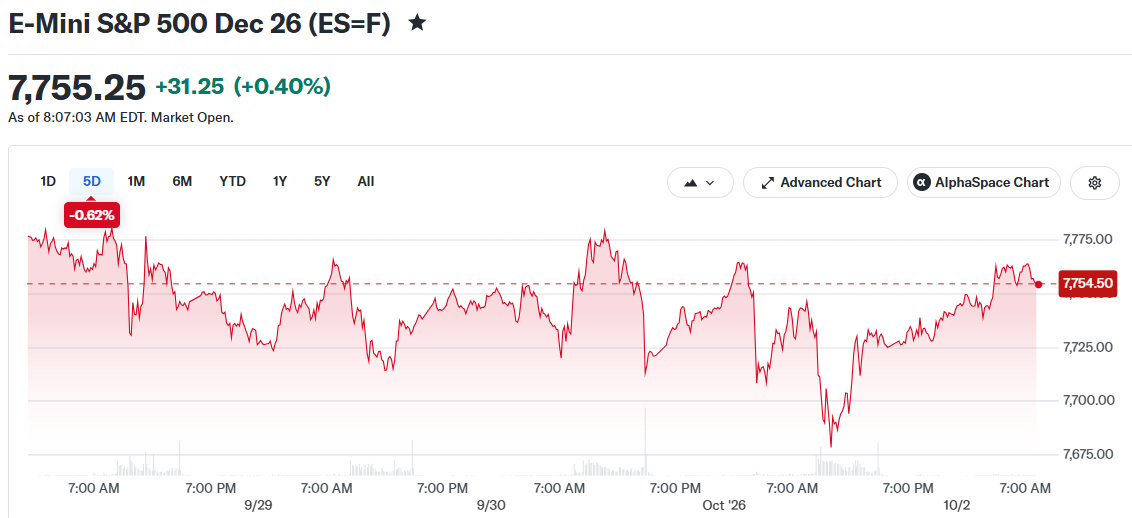
This followed a rough stretch for stocks. The S&P 500 and the Dow had both snapped three day losing streaks earlier in the week. The Nasdaq rose for a second straight session.
What the Jobs Report Could Mean
The September jobs report was set for release at 8:30 a.m. Eastern time. Economists expected the economy added between 85,000 and 89,500 jobs last month.
🇺🇸Happy US Jobs Report Day!
Here's What to Know:
• September Nonfarm Payrolls Est.: 89,000
• August Payrolls: 162,000• Sept. Unemployment Rate Est.: 4.1%
• Aug. Unemployment Rate: 4.1%•Time: 8:30AM ET
*Source: @Investingcom$DIA $SPY $QQQ 🇺🇸🇺🇸 pic.twitter.com/sK0gWYPM27
— Jesse Cohen (@JesseCohenInv) October 2, 2026
That would mark a drop from August, when the economy added 127,000 jobs. August’s report had come in stronger than expected.
The jobs data matters because it feeds directly into the Fed’s decision making. The central bank meets again on October 28 to decide on interest rates.

Traders were pricing in a 74% chance that the Fed would leave rates unchanged at that meeting, according to the CME Fedwatch tool.
A Deutsche Bank macro strategist said the jobs report carries extra weight this time. He pointed to the economy’s resilience as a factor that has supported U.S. stocks in recent months.
Most traders still expect at least one quarter point rate hike before the end of the year, with December seen as the likely timing.
Oil Prices and Inflation Pressures
Oil prices fell sharply on Friday. Brent crude, the global benchmark, dropped to around $99 a barrel.
The decline came as broader market attention turned toward the jobs data and its effect on interest rate expectations.
Inflation remains a central concern for Fed officials. Several have said in recent days that the central bank has room to review more data before making a move.
They have also said inflation is still running higher than the Fed would like.
Much of that inflation pressure has been tied to the war in the Middle East. The conflict is now in its eighth month.
President Trump has said he is considering resuming military action against Iran after the midterm elections. He has also said he wants to see the conflict resolved around that time.
On Thursday, the United States reportedly sent an additional aircraft carrier and about 10,000 sailors and Marines to the Persian Gulf. The move was first reported by Bloomberg.
Treasury yields held flat Friday morning as markets waited for the jobs numbers.
The jobs report, combined with ongoing developments in the Middle East, will likely guide how stocks and oil trade through the rest of the month.
Stop guessing and start investing with confidence. KnockoutStocks gives you the AI insights, market intelligence, and stock research you need to spot opportunities, cut through the noise, and make smarter investment decisions — all in one powerful platform.
Sign up today and get 50% OFF full access to our premium stock picks.
Simply use coupon code SPECIAL50 at checkout to claim your exclusive discount.
Get 3 Free Stock Ebooks
Discover top-performing stocks in AI, Crypto, and Technology with expert analysis.
- Top 10 AI Stocks - Leading AI companies
- Top 10 Crypto Stocks - Blockchain leaders
- Top 10 Tech Stocks - Tech giants



