





TLDR
- Treasury yields were broadly flat Monday despite fresh U.S.-Iran military exchanges over the weekend
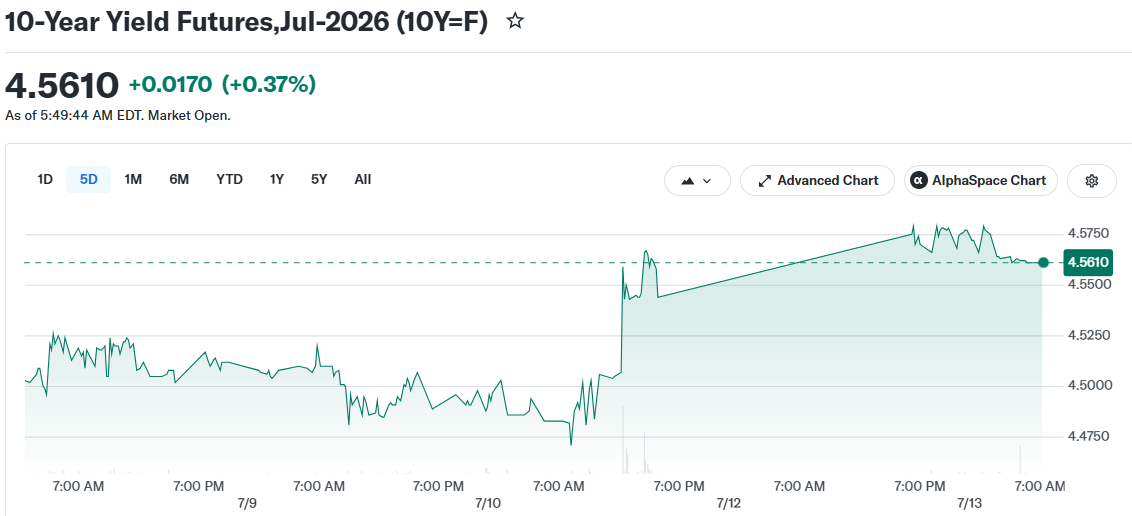
- The 10-year Treasury yield rose slightly to around 4.577%, while the 2-year hit 4.239%, its highest since February 2025
- Iran struck U.S. military bases in Kuwait, Bahrain, Jordan, Oman and Qatar in response to renewed U.S. bombings
- Oil prices jumped, with Brent crude rising as much as 4.5% to $79.43 per barrel
- Key inflation data and Fed Chair Kevin Warsh’s first Congressional appearance are due this week
Treasury yields were little changed on Monday after the ceasefire between the U.S. and Iran fell under serious strain over the weekend. Both sides launched fresh strikes, raising doubts about a deal that was signed just last month.
The 10-year U.S. Treasury yield, a key benchmark for government borrowing costs, rose slightly to 4.577%. The 2-year yield climbed to 4.239%, its highest level since February 2025, according to Tradeweb data. The 30-year bond yield was flat at around 5.08%.
The trouble started when Iran struck a commercial shipping vessel in the Strait of Hormuz over the weekend. U.S. forces responded with multiple waves of strikes on Iranian military targets on Sunday.
Iran then hit back, targeting U.S. military bases in Kuwait, Bahrain, Jordan, Oman and Qatar. Iran’s state media described the attacks as retaliation for renewed U.S. bombings.
🇮🇷 🇰🇼 Iran just turned Kuwait into an active battlefield, claiming coordinated missile and drone strikes on U.S. troops, Patriot systems, radar sites, and logistics hubs.
Tehran framed the attacks as payback for American involvement and declared the Strait of Hormuz belongs to… pic.twitter.com/C34B5BRFln
— Mario Nawfal (@MarioNawfal) July 13, 2026
The clashes put the interim peace agreement signed last month under serious pressure. That deal was meant to permanently reopen the Strait of Hormuz and end the conflict after 60 days of negotiations.
The Strait of Hormuz is one of the world’s most important waterways for oil shipments. Disruption there can have a direct impact on global energy prices.

Oil Prices Jump on Strait of Hormuz Fears
Oil markets reacted quickly to the news. Brent crude futures rose as much as 4.5% to $79.43 per barrel in early Asian trading. West Texas Intermediate futures climbed more than 2.4% to $73.14 per barrel.
Higher oil prices can feed into inflation, which makes the bond market more sensitive to developments in the region. Yields typically move higher when inflation expectations rise.
Inflation Data and Fed Chair Appearance in Focus
Despite the geopolitical tension, bond market moves were relatively contained. Investors appear to be holding their positions ahead of a busy week of economic data.
Core inflation figures are due on Tuesday. That same afternoon, new Federal Reserve Chair Kevin Warsh will make his first appearance before Congress, which markets will watch closely for any signals on interest rate direction.
Consumer sentiment data for July is scheduled for Friday. That report will give a clearer picture of how households are feeling after months of elevated interest rates.
Alex Guiliano, chief investment officer at Resonate Wealth Partners, said the real question is whether the data will confirm strong consumer spending or show that geopolitical risks and high rates have weighed on household finances.
Bond traders are weighing the risk that ongoing conflict could push oil prices higher and complicate the Fed’s path on rates.
The 2-year yield, which tracks short-term Fed policy expectations most closely, was last trading at 4.230%, up 2.3 basis points on the day.
Stop guessing and start investing with confidence. KnockoutStocks gives you the AI insights, market intelligence, and stock research you need to spot opportunities, cut through the noise, and make smarter investment decisions — all in one powerful platform.
Sign up today and get 50% OFF full access to our premium stock picks.
Simply use coupon code SPECIAL50 at checkout to claim your exclusive discount.
Get 3 Free Stock Ebooks
Discover top-performing stocks in AI, Crypto, and Technology with expert analysis.
- Top 10 AI Stocks - Leading AI companies
- Top 10 Crypto Stocks - Blockchain leaders
- Top 10 Tech Stocks - Tech giants



