






TLDR
- Solana processed 14.2 billion non-vote transactions in the third quarter, up 45% from the prior quarter.
- The Alpenglow upgrade went live on October 21, targeting finality of about 150 milliseconds.
- Solana held roughly $16.8 billion in stablecoin supply at the end of the third quarter.
- Bitwise’s Solana staking ETF passed $1 billion in assets earlier this year.
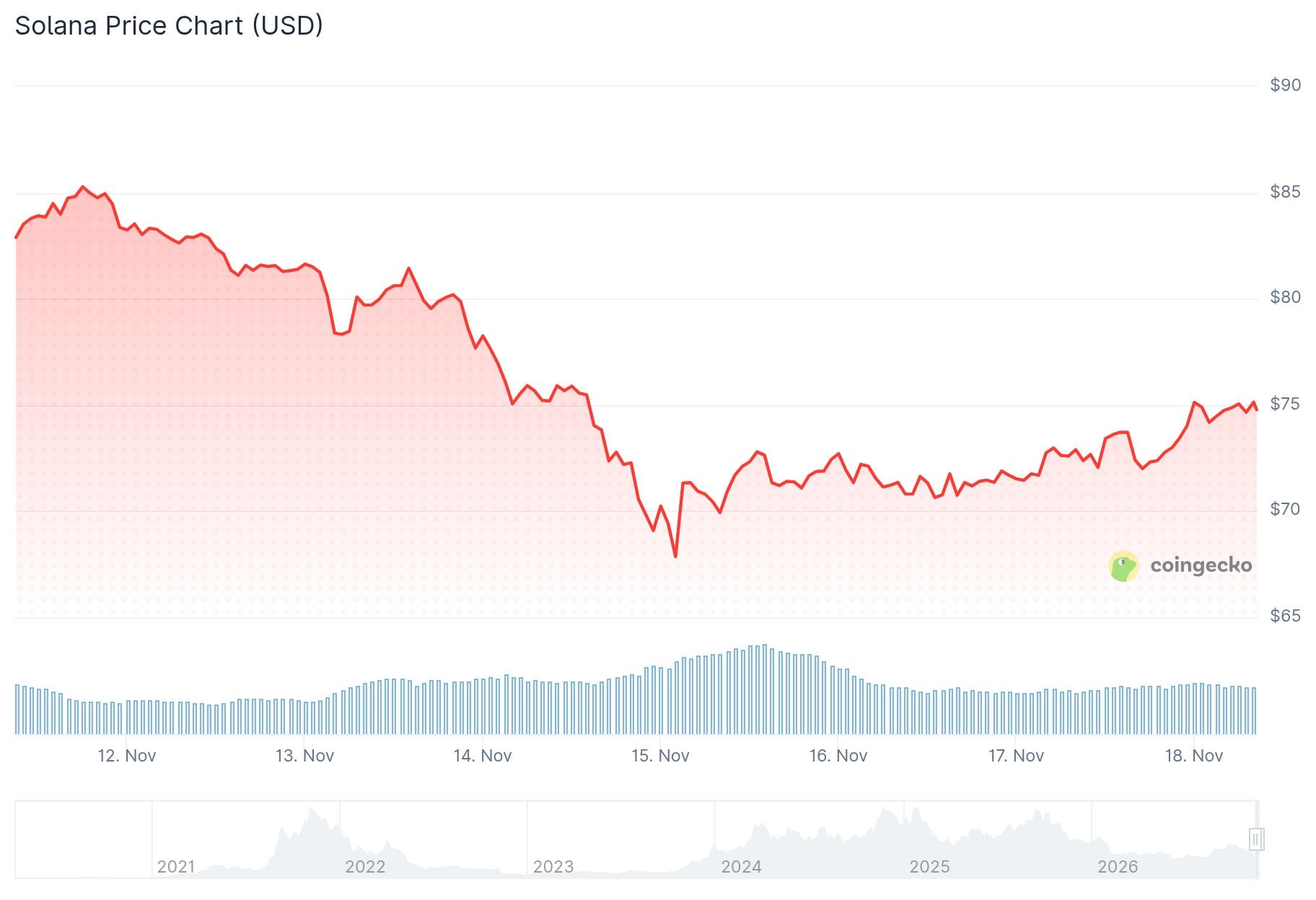
- SOL’s price has dropped sharply along with Bitcoin, Ethereum and the wider crypto market.
Solana’s price has fallen over the past few weeks. The drop came alongside declines in Bitcoin, Ethereum and the broader crypto market. Data on the Solana network tells a different story.
Digital asset company DeFi Development Corp reported that Solana processed about 14.2 billion non-vote transactions in the third quarter of 2026. That was 45% higher than the previous quarter and 61% higher than a year earlier. The same report said real-world assets on Solana reached about $4.7 billion in September.
Activity Grows as the Price Slips
Transaction counts do not always reflect real economic use. Memecoin trading still adds a large share of Solana’s volume. Higher activity also does not always lead to a higher token price.
🚨STABLECOIN HOLDER GROWTH BY CHAIN – LAST 7D@solana – +175.5K @ethereum – +115.7K@Celo – +90.3K@base – +83.4K@0xPolygon – +49.7K@arbitrum – +38.1K@Algorand – +15.4K@XLayerOfficial – +8.8K@StellarOrg – +7.1K@tempo – +5.8K
Solana leads the pack, adding more stablecoin… https://t.co/8WW7U3M70k pic.twitter.com/72MkDnaRQ6
— Solana Community (@SolCommunityy) November 16, 2026
Blockworks Research reported that Solana ended the third quarter with about $16.8 billion in stablecoin supply. That was a 3% increase from the previous quarter. Stablecoins are digital tokens designed to hold a steady value, and they are often used for payments.
Western Union has announced stablecoin infrastructure built on Solana. The system is meant to link digital payments with the company’s international cash pickup network. Solana’s low fees and quick settlement suit smaller, high-volume payments.
The Alpenglow Upgrade
On October 21, Solana turned on its Alpenglow upgrade. The upgrade replaced the network’s older consensus system. Consensus is the method nodes use to agree on which transactions are valid.

Solana replaced its consensus protocol in October. Alpenglow went live on mainnet on the 21st, targeting ~150ms finality.
October was a month of records across network speed, tokenized assets, payments, and institutional access.
Here are a few figures that mattered: pic.twitter.com/noXLQf97K2
— Solana (@solana) November 6, 2026
Alpenglow targets transaction finality of about 150 milliseconds. Before the change, finalizing a transaction could take several seconds. Faster finality can help apps that need quick settlement, such as payments and trading platforms.
Whether the upgrade holds up under heavy use is still to be seen. Solana also faces competition from Ethereum and other networks. Token inflation and network security remain listed risks.
Large asset managers have also tied products to the network. Franklin Templeton and BlackRock have developed or supported tokenized investment products that run on Solana. Tokenized products are digital versions of traditional assets, such as funds.
The Bitwise Solana Staking ETF passed $1 billion in assets earlier this year. ETFs are regulated funds that trade on stock exchanges. Staking lets holders earn rewards for helping to secure the network.
Altcoins often fall harder than Bitcoin when market conditions weaken. They can also attract buyers again when sentiment improves. Solana’s ecosystem includes decentralized exchanges, payments, staking, tokenized assets and consumer apps.
The most recent figures show a network with rising use and a falling token price. Solana handled 14.2 billion non-vote transactions in the third quarter and carried $16.8 billion in stablecoins. SOL’s price remains under pressure alongside the wider crypto market.


