






A Bitcoin treasury company is a publicly traded business that holds Bitcoin as its main asset. Rather than earning money through products or services, these companies buy and hold large amounts of BTC, giving investors a way to access Bitcoin exposure through the stock market.
The idea was built by Michael Saylor, the founder of MicroStrategy — now rebranded as Strategy. Starting in 2020, Saylor began moving his company’s cash reserves into Bitcoin, arguing that BTC is the best long-term store of value available to corporations.
Other companies followed. By the mid-2020s, dozens of public businesses were holding Bitcoin on their balance sheets. The model had gone global.
How the Model Works: Understanding the mNAV Premium
The concept at the center of the Bitcoin treasury model is the mNAV, or modified Net Asset Value. In simple terms, it measures how much investors are willing to pay for a company’s stock compared to the value of the Bitcoin it actually holds.
When investor interest is high, people pay more for the stock than the Bitcoin itself is worth on the open market. A company holding $1 billion in Bitcoin might carry a market cap of $3 billion. That gives it an mNAV of 3x.

This premium is the engine that drives the whole model. As long as it stays above 1x, the company can issue new shares and use the cash raised to buy even more Bitcoin. Each round of buying adds more BTC per share in theory, which rewards existing shareholders.
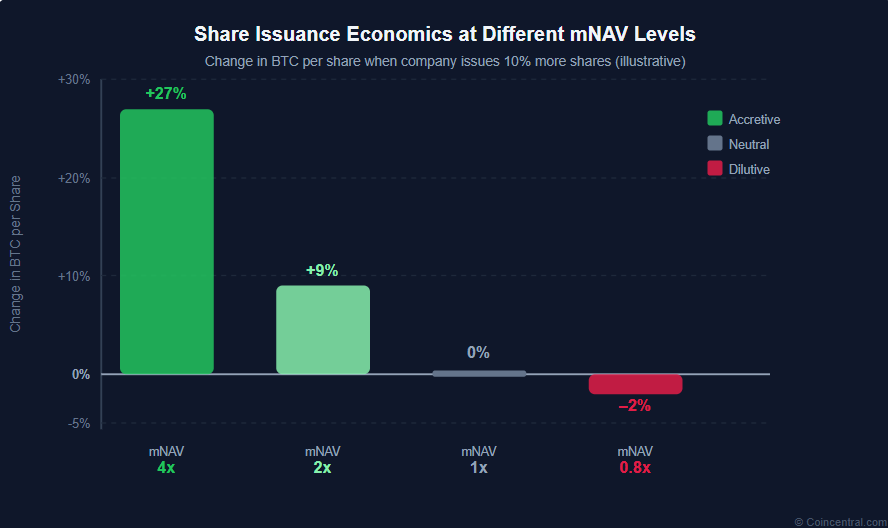
Here is how the math works: if a company issues 10% more shares at an mNAV of 3x, it raises three times the book value of its Bitcoin. It uses that money to buy more Bitcoin. The result is that shareholders end up owning more BTC per share than they did before. This worked brilliantly during the bull market years. The problem is what happens when the market stops moving upward.
The Major Players: Who Holds What
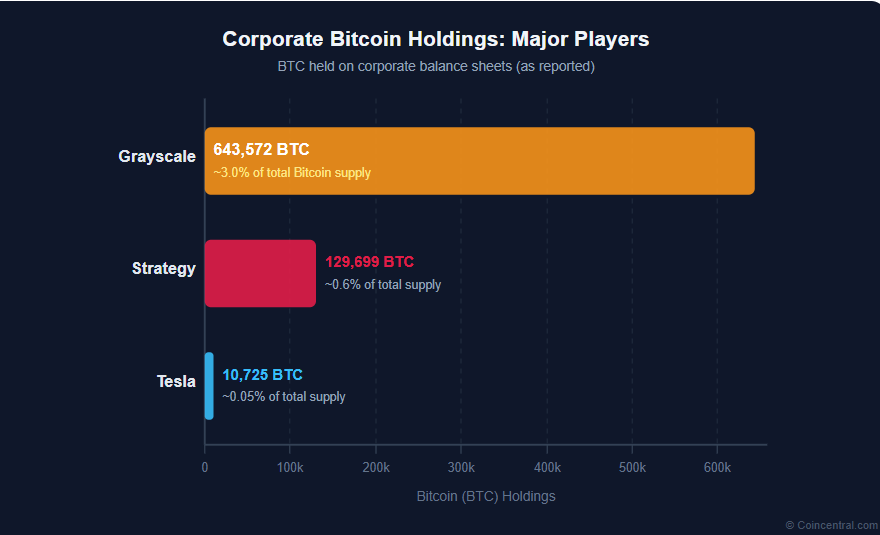
A small number of companies account for the vast majority of corporate Bitcoin holdings. The three most visible are Grayscale, Strategy (formerly MicroStrategy), and Tesla.
Grayscale operates mainly as a crypto asset manager. It offers publicly traded investment products tied to its crypto holdings and currently holds approximately 643,572 BTC — around 3% of the total Bitcoin supply ever to be mined. This makes it by far the largest single corporate holder of Bitcoin.
Strategy takes a more aggressive approach. Under Michael Saylor, the company uses both equity offerings and debt — including convertible notes — to fund its Bitcoin purchases. It holds approximately 129,699 BTC, or roughly 0.6% of total supply.
Tesla’s position is smaller. The electric car company bought approximately $1.5 billion worth of Bitcoin in early 2021, then sold a large portion of that holding in 2022. Tesla now holds around 10,725 BTC, keeping a foothold in the space without the aggressive buying strategy used by others.
Table 1: Major Corporate Bitcoin Holders
| Company | BTC Holdings | % of Total BTC Supply | Primary Strategy |
|---|---|---|---|
| Grayscale | 643,572 | ~3.0% | Asset management products |
| Strategy (MicroStrategy) | 129,699 | ~0.6% | Equity and debt financing |
| Tesla | 10,725 | ~0.05% | Balance sheet reserve |
The scale difference between these three companies is extreme. Grayscale holds over four times more Bitcoin than Strategy, while Tesla’s holding is a fraction of Strategy’s position. The chart makes this gap very clear.
The Rise: How the Model Gained Momentum
Between 2023 and 2024, the Bitcoin treasury model gained serious momentum. Bitcoin’s price rose sharply, driven by the approval of spot Bitcoin ETFs in the United States, growing institutional interest, and anticipation of the April 2024 halving event.
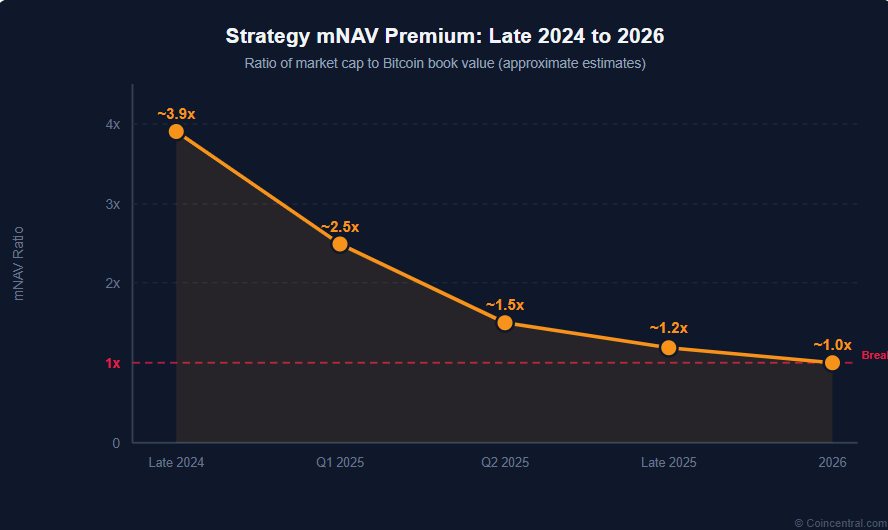
As Bitcoin’s price climbed, so did the mNAV premiums for companies like Strategy. At its peak in late 2024, Strategy was trading at nearly 4 times the value of its Bitcoin holdings. That premium made it highly effective for the company to keep issuing new shares and buying more BTC.
The model spread well beyond the United States. Companies in Japan, Canada, Europe, and the United Kingdom began copying the playbook. Some were existing businesses that pivoted their strategy toward Bitcoin accumulation. Others were built from the ground up specifically to hold BTC.
By late 2024, the Bitcoin treasury company model had become a recognized class of investment vehicle. Analysts described it as giving investors regulated access to Bitcoin-linked returns, with the added layer of professional management. The excitement was real — so were the risks building underneath it.
The 2026 Turning Point: When the Premium Disappeared
A model that works well in a rising market becomes far more vulnerable when the market stagnates or falls. That is exactly what happened through 2025 and into 2026.
Bitcoin’s price stopped climbing at the pace investors had come to expect. As enthusiasm cooled, the mNAV premiums across treasury companies began to shrink steadily. Strategy’s mNAV, which had touched nearly 4x in late 2024, fell through 2025 in a straight and consistent line.
By 2026, it had dropped to close to 1x. Some smaller Bitcoin treasury companies started trading below the value of the Bitcoin they hold. That means the market was assigning a negative premium to the management layer sitting on top of the assets.
Table 2: Strategy mNAV Premium Over Time (Approximate Estimates)
| Period | Approx. mNAV | Market Condition |
|---|---|---|
| Late 2024 | ~3.9x | Peak premium |
| Q1 2025 | ~2.5x | Cooling |
| Q2 2025 | ~1.5x | Declining |
| Late 2025 | ~1.2x | Near parity |
| 2026 | ~1.0x | Premium largely gone |
This shift matters because the entire model depends on the premium. Once it disappears, the math of share issuance flips from positive to neutral — or worse, negative.
The Four Main Risks Analysts Are Watching
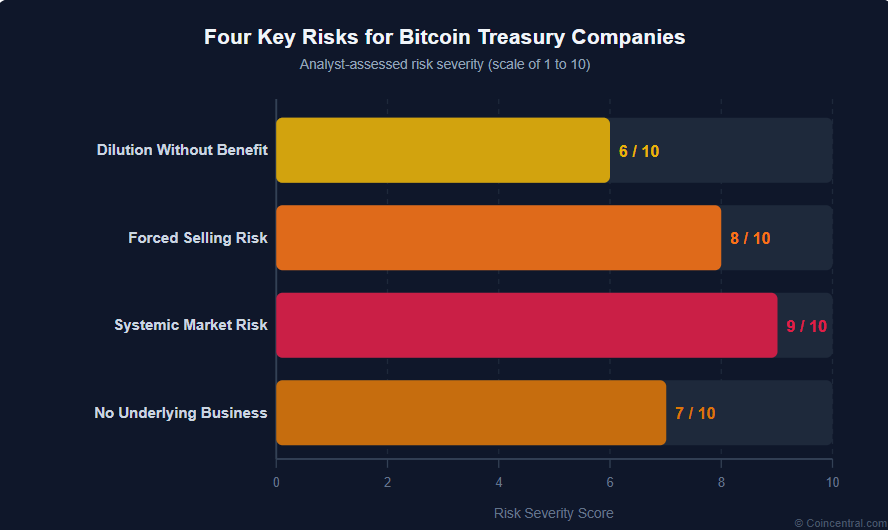
When the premium disappears, a set of risks emerge that were largely invisible during the bull market phase. Analysts have identified four main areas of concern.
Risk 1: Dilution Without Benefit
During the growth phase, issuing new shares to buy Bitcoin worked because the mNAV premium meant each round of buying added more BTC per existing share. When the premium falls to 1x or below, this arithmetic no longer holds.
Issuing shares at or near book value gives away ownership without bringing in proportionally more Bitcoin. Shareholders end up owning a larger company with the same or fewer BTC per share. The strategy stops being effective, but many companies continue anyway because they need cash to service debt.
Many companies keep issuing shares even after the premium collapses. That leads directly to the next risk.
Risk 2: Risk of Forced Selling
Many Bitcoin treasury companies took on debt to fund their Bitcoin purchases — often through convertible notes, which are loans that can be converted into shares at a fixed price. They also issued preferred shares that require regular dividend payments.
These obligations exist regardless of what Bitcoin’s price is doing. When Bitcoin falls and the mNAV drops below 1, meeting those payments becomes harder. In a worst-case scenario, a company may be forced to sell part of its Bitcoin reserves to raise cash.
Analysts say smaller treasury companies face this risk most acutely. They typically have less liquidity and fewer options to raise emergency capital compared to a large operation like Strategy.
Risk 3: Systemic Risk to the Market
The model has spread to dozens of companies, all of which hold Bitcoin as their primary asset. A drop in Bitcoin’s price hits every one of them at the same time.
If multiple companies are forced to sell simultaneously to cover debt or dividend payments, it adds selling pressure to Bitcoin itself. Lower Bitcoin prices then push mNAV ratios down further, which increases selling pressure even more. Analysts describe this as a potential negative spiral — falling prices trigger forced selling, which pushes prices lower, which forces more selling.
This kind of systemic risk is unusual in equity markets. Most industries do not have every major company tied to the same single underlying asset in this way.
Risk 4: No Underlying Business
Critics — including Wall Street analysts — point to a structural weakness that is unique to this model. Most Bitcoin treasury companies generate no revenue or profit from any actual business operations.
Their entire value rests on two things: the price of Bitcoin, and investor confidence in the management team. If either one weakens, there is no operating business to fall back on.
This makes them fundamentally different from even the most volatile tech companies, which at minimum have some form of recurring revenue, product, or intellectual property.
Debt, Dividends, and Dilution: The Numbers Behind the Risk
The capital structure of Bitcoin treasury companies is central to understanding how these risks play out in practice. Many used a combination of financial tools to fund their Bitcoin buying during the growth phase.
Convertible notes are a popular choice. These are loans that carry lower interest rates than regular debt, but they include complex terms around conversion triggers and refinancing deadlines.
Preferred shares are another tool. Preferred shareholders receive fixed dividends before common shareholders receive anything. In a rising market, this is manageable. In a flat or falling market, it creates a constant cash drain.
When Bitcoin’s price is falling and the mNAV is at or below 1x, a company faces pressure from multiple directions at once: asset values are declining, cheap fundraising is harder, and debt and dividend payments still have to be made.
Table 3: Capital Structure Risk Factors
| Risk Factor | When It Matters Most | Potential Impact |
|---|---|---|
| Convertible note refinancing | Bitcoin price decline | Difficulty refinancing at good terms |
| Preferred dividends | mNAV falls below 1x | Cash flow pressure builds |
| Share issuance (dilution) | Premium disappears | BTC per share drops |
| Forced asset sales | Debt cannot be serviced | Adds selling pressure to Bitcoin |
The chart shows clearly why the premium matters so much. At mNAV 4x, issuing 10% more shares adds roughly 27% more BTC per share for existing holders. At mNAV 1x, the same action adds nothing. At mNAV 0.8x, it takes BTC per share slightly backwards.
What Investors Need to Know
Buying shares in a Bitcoin treasury company is not the same as buying Bitcoin. This distinction matters, and it is one that some retail investors may not fully understand.
When you buy Bitcoin directly, your only exposure is the price movement of BTC itself. When you buy shares in a treasury company, you take on several additional layers of risk on top of that.
These extra layers include management risk — whether the team makes good decisions about timing and capital — and capital structure risk, related to how much debt the company carries and how it is structured. There is also access risk: whether the company can raise more money when market conditions tighten.
A concrete example shows how these layers play out. Two investors each put $10,000 into Bitcoin — one directly, one through Strategy shares. If Bitcoin rises 30%, the direct holder sees close to a 30% gain. The Strategy shareholder might see more, or significantly less, depending on mNAV movement, share dilution, and what debt obligations are maturing.
The premium that many investors paid for between 2023 and 2024 is now, in many cases, a source of risk rather than an extra return. Those who bought at 3x or 4x mNAV and are now looking at 1x are sitting on a gap that Bitcoin’s own price gains would need to close before they break even.
The Regulatory Picture: EU and Beyond
In markets regulated by the European Union, the Bitcoin treasury company model raises specific questions about transparency and investor protection.
Regulators are drawing sharper lines between owning a crypto asset directly and owning shares in a company that holds that asset. These are legally and financially very different things, even if the underlying exposure to Bitcoin is similar at a surface level.
The EU’s Markets in Crypto-Assets regulation — known as MiCA — began phasing in from 2024 onward. While MiCA focuses mainly on crypto issuers and service providers, the growth of Bitcoin-heavy corporate vehicles has prompted regulators to look more carefully at how these products are presented to everyday investors.
The core concern is that retail buyers may think they are getting clean Bitcoin exposure when they are actually buying into a complex package of corporate, financial, and market risks. As this area grows, European regulators and those elsewhere are likely to push for clearer disclosures and stronger investor education requirements around these products.
Can the Biggest Players Survive?
For the largest Bitcoin treasury companies, the answer is almost certainly yes — at least in the medium term. Strategy holds a very large Bitcoin position and has stated publicly that it will not sell under normal conditions.
Its size gives it a long runway. Even if Bitcoin’s price declines or stays flat for an extended period, Strategy has enough financial flexibility to manage its obligations without being forced to liquidate. Analysts have said the company can “survive a long winter.”
Smaller companies are in a very different position. Those that entered late, accumulated Bitcoin at high prices, and took on heavy debt to do so now face genuine pressure. Without deep reserves or reliable access to capital markets, conditions that are manageable for Strategy can become fatal for a smaller firm.
The companies most likely to survive the current period are those that accumulated Bitcoin early, kept debt levels moderate, and did not build their entire business model around the assumption that the mNAV premium would last forever.
Looking Ahead: The Model’s Two Faces
The Bitcoin treasury company model is not going to disappear. The largest players are too well established, and the concept of holding Bitcoin as a corporate asset has become a recognized financial strategy.
But 2026 has made it clear that this model has two very distinct phases. In a rising market, it works exactly as intended: companies accumulate Bitcoin cheaply, premium-fueled share issuances add BTC per share, and investors benefit from both Bitcoin price appreciation and mNAV expansion.
When markets stop rising, the dynamic reverses. The same tools that accelerated Bitcoin accumulation — leverage, share issuance, preferred dividends — become sources of pressure and risk.
The story of Bitcoin treasury companies so far is one of a strategy that brilliantly amplifies gains on the way up, and just as clearly amplifies risk on the way down. For investors and regulators alike, understanding both sides of that equation is now essential.
Sources
- Grayscale Investments: corporate Bitcoin holdings disclosures
- Strategy (formerly MicroStrategy): investor relations filings and Bitcoin Tracker
- Tesla, Inc.: SEC filings disclosing digital asset holdings
- European Securities and Markets Authority (ESMA): MiCA implementation guidance, 2024
- Bloomberg Intelligence: Bitcoin treasury company analysis, 2025–2026
- Wall Street analyst research on corporate Bitcoin treasury models (multiple firms, 2025–2026)
- Source data provided by Coincentral.com editorial research team


