






TLDR
- Cardano activated the Van Rossem hard fork on July 18, upgrading to Protocol Version 11
- It’s the first Cardano upgrade approved by community vote, not by founding company Input Output
- The upgrade lowers smart contract execution costs and adds new Plutus built-in functions
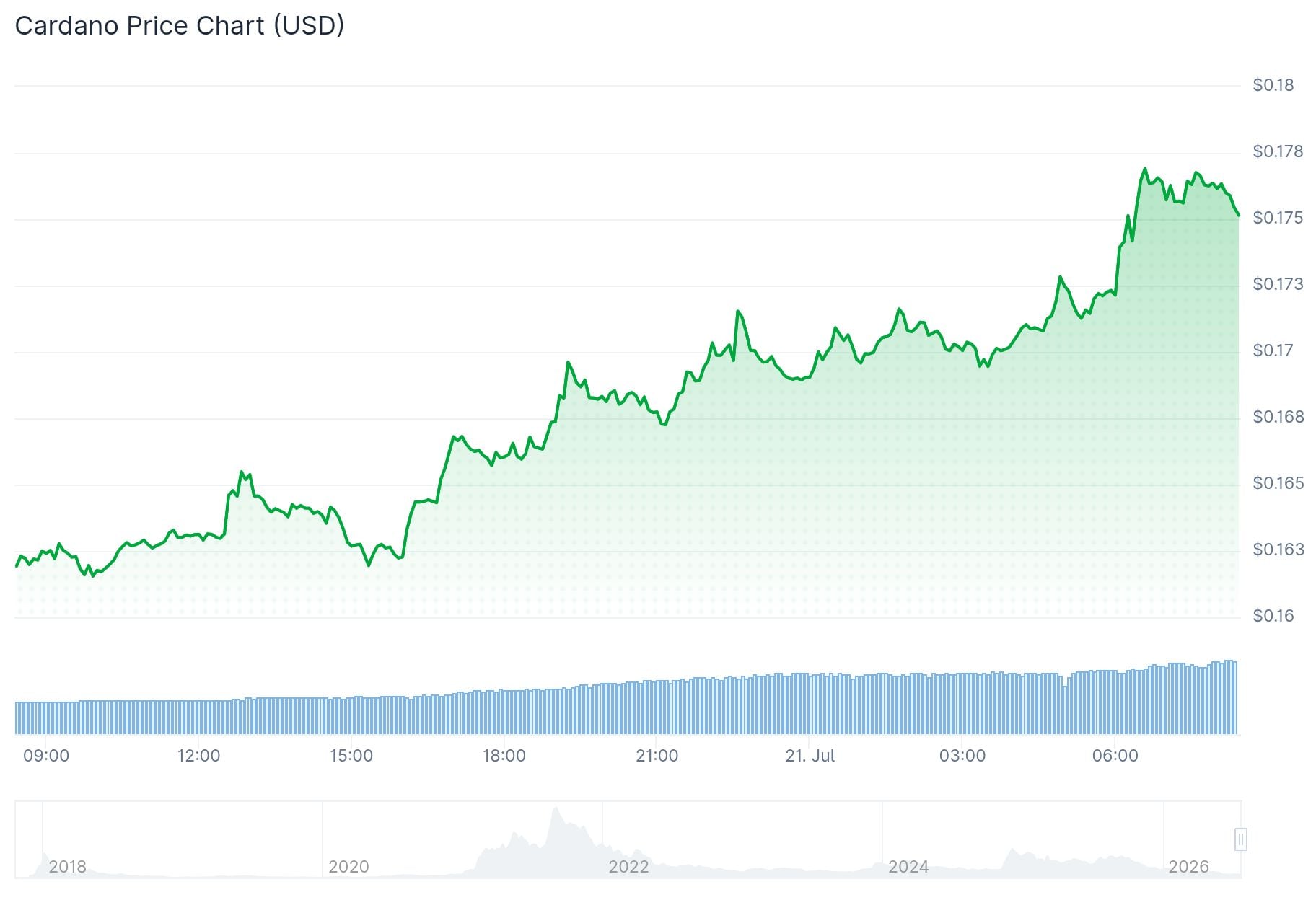
- ADA is trading near $0.1663, up roughly 1.2% in 24 hours following the upgrade
- Whale wallets holding 100K–100M ADA have accumulated over 25.6 billion tokens, their highest since February 2023
Cardano completed its Van Rossem hard fork on July 18, moving the network to Protocol Version 11. The upgrade went live at 21:44 UTC with only a brief ten-minute block gap and no disruption to users.
This is the first hard fork in Cardano’s history that was not directed by Input Output, the company that built the blockchain. Instead, it was proposed, debated, and ratified entirely through Cardano’s on-chain governance system, introduced in the Voltaire era.
. @Cardano's Van Rossum hard fork is now live! 🚨
The upgrade brings lower smart contract costs and introduces fully onchain community governance.
A big step forward for the Cardano ecosystem. pic.twitter.com/XbVs46KNfL
— CryptoBusy (@CryptoBusy) July 20, 2026
Delegated representatives voted 78.97% in favor, well above the 60% threshold required. The constitutional committee approved it unanimously. Stake pool operators passed it by a narrower margin of 53.02%.
Before ratification, at least 85% of stake pools needed to run compatible software. Network data showed roughly 93% of block production was already on version 11 ahead of activation.
DRep Jason Appleton commented on the governance milestone, writing on X: “The best part: it was ratified on-chain by delegated community reps before activation. Upgrades by governance, not decree.” This marks a shift in how Cardano moves forward — holders now have a formal vote in protocol changes rather than accepting decisions from a central team.
What Version 11 Actually Changes
On the technical side, version 11 is an intra-era upgrade. It stays within the current Conway governance framework and does not change transaction structure, so the workload for the broader ecosystem to upgrade is minimal.

The upgrade unifies Plutus built-in functions across all three versions of the platform, meaning older applications gain access to newer features. It also tightens ledger validation rules, including one preventing two stake pools from sharing the same cryptographic identity key.
Everyday ADA holders won’t notice anything different. Wallets don’t need updating, fees to send ADA are unchanged, and transactions work the same way.
Setting Up the Next Major Upgrade
Van Rossem also lays the groundwork for the Dijkstra era hard fork, which will introduce Ouroboros Leios — a scaling proposal aimed at sharply increasing transactions per second without weakening security. That upgrade is expected later in 2026.
Crypto analyst Sssebi noted on X that ADA closed a recent day above its 50-day moving average and described the setup as “looking bullish right now,” adding that a move to the $0.20 area is “highly likely” if it holds that level.
$ADA closed the day above the 50day MA and is looking bullish right now.
It has to stay above that line now and start setting higher highs.
A pump to the $0.20 area is highly likely. pic.twitter.com/11sIkNCYn5
— Sssebi🦁 (@Sssebi) July 21, 2026
ADA is currently trading near $0.1663, up approximately 1.2% over 24 hours. Whale wallets in the 100,000 to 100 million ADA range have accumulated over 25.6 billion tokens, their highest level since February 2023.
Input Output is also set to hand over core infrastructure, including the Plutus platform and Daedalus wallet, to external firms starting in August.


