



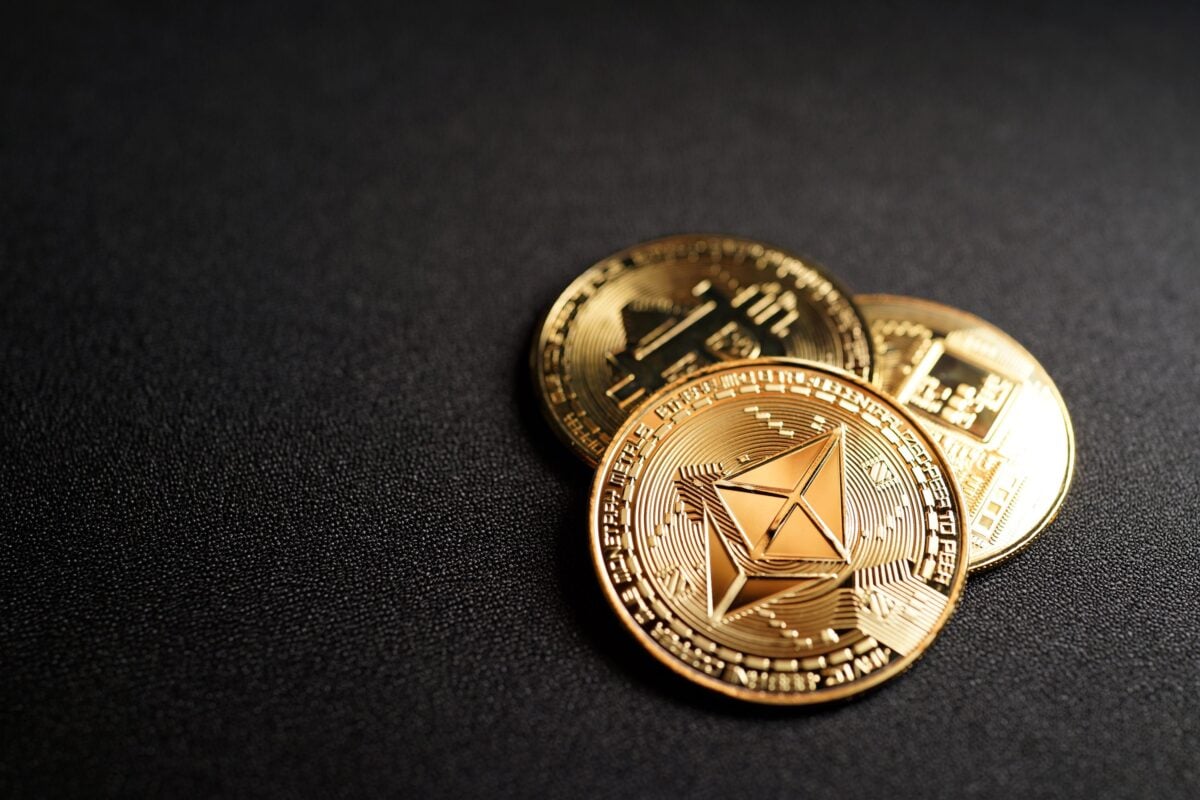


Ethereum staking lets holders lock up ether (ETH) to help run the network. In return, they can earn new ETH as a reward. The process replaced the energy-heavy mining system that Ethereum once used.
This article draws on data from Investopedia, Kraken, Exodus and BlackRock. It covers how staking works, what it pays, what it costs and what can go wrong. Figures are dated where the source gave a date.
Rewards, fees and wait times change with network conditions. Treat the numbers below as a snapshot and not a promise.
What Is Ethereum Staking?
Staking means committing ETH as collateral to help validate transactions on the Ethereum network. Validators check that transactions are valid and add new blocks to the blockchain. They earn ETH for this work.
Ethereum moved from Proof-of-Work (PoW) to Proof-of-Stake (PoS). Under PoW, miners compete using computing power. Under PoS, validators put up their own ETH instead.
Running a validator takes 32 ETH. The network picks validators at random to propose new blocks. BlackRock notes that the odds follow stake size, so a validator holding 1% of all staked ETH has a 1% chance of being picked for any given block.
The staked ETH acts as a guarantee of good behavior. If a validator breaks the rules, the network can take part of that ETH away. This is how the system discourages cheating.


BlackRock reports that about 30% of all ETH is currently staked. That leaves roughly 70% outside the staking system. The share can change as more holders join or leave.
Investopedia describes staked ETH as locked inside a smart contract. It cannot be used or moved until the validator asks the network to release it. That lock is the main trade-off, and later sections cover it in detail.
| Key fact | Figure | Source |
|---|---|---|
| ETH needed to run a validator | 32 ETH | Investopedia |
| Share of all ETH staked | About 30% | BlackRock |
| Consensus method | Proof-of-Stake | All sources |
| Ether market rank | Second-largest crypto by market value | BlackRock |
Where Staking Rewards Come From
Kraken lists three sources of staking rewards. The first is consensus layer rewards, which the protocol pays for attesting to blocks and sometimes proposing them. The second is priority fees, which are optional tips users pay to have transactions processed faster.
The third source is maximal extractable value, or MEV. Validators can earn extra ETH by ordering transactions inside a block in a way that captures added value. Kraken says MEV is variable and is not always a factor for everyday stakers.
BlackRock groups rewards into two main parts: new ETH issuance and transaction fees. Issuance is new ETH created by the network and paid to validators. It is the larger part of the total.

With about 30% of ETH staked, BlackRock says a well-functioning validator earns about 2.75% a year from issuance. Transaction fees added about 0.1% over the past month, on average. Fees once made up a larger share of rewards but have been declining.
Issuance grows as more ETH is staked, but at a slower pace. That means the reward per validator falls as more ETH joins the system. Kraken describes the same effect: more total ETH staked means a lower rate for each staker.
BlackRock also points out that the rate for stakers differs from the overall issuance rate. Total ETH issuance is about 0.8% a year. All new ETH goes to stakers, but only part of the supply is staked, so holders who do not stake see modest dilution over time.
| Reward source | What it is | Size, where reported |
|---|---|---|
| Issuance rewards | New ETH paid by the protocol | About 2.75% a year at 30% staked |
| Transaction fees | Fees paid when a validator proposes a block | About 0.1% over the past month |
| Priority fees | Optional tips for faster processing | Varies with network activity |
| MEV | Extra value from ordering transactions | Variable, not always a factor |
How Much Can You Earn From Staking ETH?
Investopedia reports that validators were earning about 2.8% on their stakes in July 2026. BlackRock gives a range of 2.5% to 3% a year. The two sources line up closely.
Kraken gives a simple formula for yearly rewards: staked ETH multiplied by the current APY. The APY is the annual percentage yield. It moves with the total amount of ETH staked across the network.

Using the 2.8% rate, 1 ETH would earn about 0.028 ETH in a year. A full 32 ETH validator would earn about 0.896 ETH. These are simple examples that leave out fees, uptime and compounding.
| ETH staked | Estimated yearly reward at 2.8% | Note |
|---|---|---|
| 1 ETH | 0.028 ETH | Needs a pool or platform |
| 10 ETH | 0.28 ETH | Needs a pool or platform |
| 32 ETH | 0.896 ETH | Enough to run a solo validator |
Kraken lists several things that change real earnings. These include total ETH staked, your validator’s uptime, the amount you stake, platform fees, MEV and priority fees. Rewards are paid in ETH, so their dollar value moves with the ETH price.
Compounding depends on the setup. Kraken says rewards at the protocol level build up in a validator’s balance but do not compound until they are re-staked. Exodus says its rewards are earned daily and restaked automatically, so they compound.
Kraken is clear that staking rewards are not guaranteed. Being offline, network conditions and slashing can all lower what a staker receives.
Ways to Stake Ethereum and Their Minimums
Investopedia describes three main routes: solo staking, staking pools and staking-as-a-service. Each one trades control for convenience. The minimum deposit differs a lot between them.

Solo staking needs 32 ETH and a dedicated computer with a steady connection. Investopedia calls it the most secure option because no third party holds your coins. It also demands the most technical work.
Pools let you join with any amount of ETH, which is used to build a 32 ETH node. Rewards are shared by the pool’s rules, usually based on how much you put in. Some providers ask for 0.01 ETH or less, and some pools give you a token that represents your stake.
Staking-as-a-service means you delegate your ETH to a provider. Investopedia calls this the least secure route because you must trust the provider to act honestly.
Exodus offers pooled staking through Everstake with a 0.1 ETH minimum. Each extra stake must also be at least 0.1 ETH. Exodus says the setup is self-custodial and that three firms audited it: ChainSecurity, Ackee and Trail of Bits.
| Method | Minimum | Who holds control | Main trade-off |
|---|---|---|---|
| Solo staking | 32 ETH | You | Hardware and technical skill needed |
| Staking pool | As low as 0.01 ETH at some providers | Varies by pool | Rewards follow pool rules |
| Staking-as-a-service | Set by provider | Provider | You must trust the provider |
| Exodus wallet | 0.1 ETH | You (self-custodial) | Fees and variable wait times |
Exchanges and wallets are the other common doors in. On an exchange, you sign up, verify your identity, buy ETH and choose a staking program. Investopedia names Ledger, Trezor and MetaMask as wallet options. On Coinbase, stakers receive cbETH, a token that represents the staked ETH.
Investopedia also warns that crypto exchanges are not members of the Securities Investor Protection Corporation (SIPC). Customers with assets on a custodial exchange could lose funds as unsecured creditors if it fails, unless user terms say otherwise.
BlackRock points to a fourth route. The iShares Staked Ethereum Trust ETF (ETHB) is designed to give price exposure to ETH plus potential staking rewards through a regular brokerage account. BlackRock says its sister fund, ETHA, does not stake.
Hardware, Software and Fee Costs
Staking on your own has a hardware bill. Investopedia puts the cost of a computer that can serve as a full node at $300 to $1,500 in 2026. It adds that the figure can go higher with better parts and replacement plans.

For best results Investopedia suggests a CPU such as an Intel NUC, 7th generation or newer, with 16GB to 32GB of RAM. It also lists at least a 2TB SSD and a stable, high-bandwidth internet link. The blockchain grows over time, so storage needs grow too.
Staking is far less computing-heavy than mining, so the hardware should last a long time. Still, setup takes real skill. Investopedia says solo staking needs basic coding knowledge, and some steps need command-line work.
The software side has several parts. A solo staker installs an execution client, a consensus client and a validator client. Then comes configuring the node, generating keys, and checking logs and updates.
| Cost item | Detail | Source |
|---|---|---|
| Node computer | $300 to $1,500 in 2026, can go higher | Investopedia |
| Memory | 16GB to 32GB RAM | Investopedia |
| Storage | At least 2TB SSD, more over time | Investopedia |
| Network fees | Paid to stake, unstake and claim | Exodus |
| Validator or platform fee | Taken from earned rewards | Exodus, Kraken |
Platform users face a different set of costs. Exodus says you pay a network transaction fee each time you stake, unstake or claim. These fees are usually higher than a standard ETH send and can sometimes be several times higher.
A validator fee is also taken from rewards to cover the validator’s operating costs. Kraken says platform fees vary and tells readers to check the fee structure before committing. Investopedia says fees can change overall returns by a wide margin.
Waiting Times and Withdrawals
Staked ETH is not available at once. Investopedia says the network limits withdrawals to 16 per block, or 115,200 validator withdrawals per day. Releasing a stake can take several days.
BlackRock adds that the protocol limits how fast ETH can enter or leave the validator set for security reasons. Starting or ending a stake can take much longer when activity is high. Delays can stretch to weeks or even months in extreme conditions.

Exodus gives a worked example for getting started. Its provider pools ETH until it reaches 32, which can take up to five days. Then the stake joins the entry queue, shown as 12 days and 21 hours in the example, for about 18 days in total.
Unstaking has more steps. The Exodus example lists an exit queue of 20 days and 7 hours, a sweep delay of 8.4 days, a fixed delay of about 27 hours and up to five days of processing. The guide states about 30 days for the total.
Added together, those listed parts come to roughly 35 days. That gap shows how rough these estimates are. Exodus calls them maximum estimates and says real times vary with network conditions.
| Stage | Example wait | Source |
|---|---|---|
| Pool fill before staking | Up to 5 days | Exodus |
| Entry queue | 12 days, 21 hours (variable) | Exodus |
| Exit queue | 20 days, 7 hours (variable) | Exodus |
| Sweep delay | 8.4 days (variable) | Exodus |
| Fixed withdrawal delay | About 27 hours (256 epochs) | Exodus |
| Processing buffer | Up to 5 days | Exodus |
| Withdrawal limit | 16 per block, 115,200 per day | Investopedia |
On some platforms you must also claim unstaked ETH by hand. Exodus says you cannot send, swap or restake the ETH until you do. Kraken notes that liquidity depends on the method and platform you use.
Risks and Penalties of Staking
Staking carries several risks. The ETH price can fall, equipment can fail, and hacks can happen. Your ETH is also locked while staked, so you cannot sell it in a hurry.
Penalties come in two levels. The first covers routine mistakes, such as missing votes. Investopedia says a validator that misses its source or target votes loses an amount equal to the rewards it would have earned. Missed head votes carry no penalty.
Short downtime for maintenance is allowed without a penalty. The network catches you up, but you do not earn the rewards you would have received while offline.

Slashing is the severe level. A validator can be slashed for signing two different blocks for the same slot, attesting to a block that surrounds another, or voting twice for the same block. Investopedia says slashing is rare.
When a validator is slashed, 1/32 of its staked ETH is burned at once. That is 3.125% of a full 32 ETH stake. A 36-day removal period then gradually removes the rest, and a correlation penalty applies halfway through.
The correlation penalty grows with the total ETH slashed across all validators in the 36 days before the event. It is meant to discourage validators from working together to cause harm. The two-part design punishes bad actors and stops them from rejoining right away.
BlackRock offers historical data. Validators have had a 99.7% uptime rate since staking began in December 2020, and only 0.03% have ever been slashed. The largest realized loss was about 3% of a stake, and stakers earned about $10 billion in net rewards over that span. BlackRock adds that past results may not repeat.
| Risk or penalty | What happens | Reported data |
|---|---|---|
| Missed source or target vote | Penalty equal to missed rewards | Investopedia |
| Missed head vote | No penalty | Investopedia |
| Slashing | 1/32 burned at once, then 36-day removal | Investopedia |
| Validators ever slashed | Rare | 0.03% (BlackRock) |
| Largest realized loss | Share of stake lost | About 3% (BlackRock) |
| Validator uptime | Since December 2020 | 99.7% (BlackRock) |
Exchange and wallet users face other risks. Investopedia warns that funds are not insured and there is usually no recourse for lost or stolen crypto. Kraken says platform staking reduces slashing exposure because the platform runs the validators.
Is Staking Ethereum Worth It?
The answer depends on how much ETH you hold and what you expect to earn. Investopedia notes that you can run a node without staking, but you will not get rewards. Kraken says staking suits long-term holders who do not plan to sell soon and can accept crypto’s price swings.
BlackRock stresses that staking does not materially change exposure to the ETH price. The price remains the main driver of returns. Staking adds ETH-denominated rewards on top, along with liquidity risk and the chance of penalties.

The yield data is consistent across sources. Investopedia reports about 2.8% for July 2026, while BlackRock cites 2.5% to 3% and about 2.75% from issuance. Fees and uptime then decide what a staker actually keeps.
Investopedia lists points to weigh before choosing a method. These include deposit requirements, fees, cybersecurity, service quality, customer support, waiting periods, coding ability and hardware costs. Larger firms tend to have stronger standards than small startups, according to the same source.
| Source | Reported yield | Date |
|---|---|---|
| Investopedia | About 2.8% | July 2026 |
| BlackRock (range) | 2.5% to 3% a year | March 2026 |
| BlackRock (issuance only) | About 2.75% a year | March 2026 |
| BlackRock (fees only) | About 0.1% added | Past month, March 2026 |
Ethereum staking pays a modest yield in return for locked funds, technical or platform risk, and variable wait times. Solo staking gives the most control but costs the most effort. Pools, wallets and exchanges lower the barrier, though each adds its own trust and fee questions.
Both Investopedia and Kraken say to research any method before using it. No crypto setup is fully safe, and rewards are never guaranteed.


