





TLDR
- Oil prices rose more than 2% on Thursday, extending gains from the previous session.
- Brent crude climbed above $105 a barrel while WTI crude neared $94 a barrel.
- Iran’s president told the UN General Assembly that Tehran would not surrender to US pressure.
- The Strait of Hormuz remains closed, with Iran’s security chief saying conditions must be met first.
- A possible 90-day US ban on diesel exports sent diesel futures sharply lower on Wednesday.
Oil prices moved higher again on Thursday. The gains followed a strong rally the day before.
Brent crude futures rose more than 2% to trade near $105.40 a barrel. West Texas Intermediate crude climbed to $93.94 a barrel.
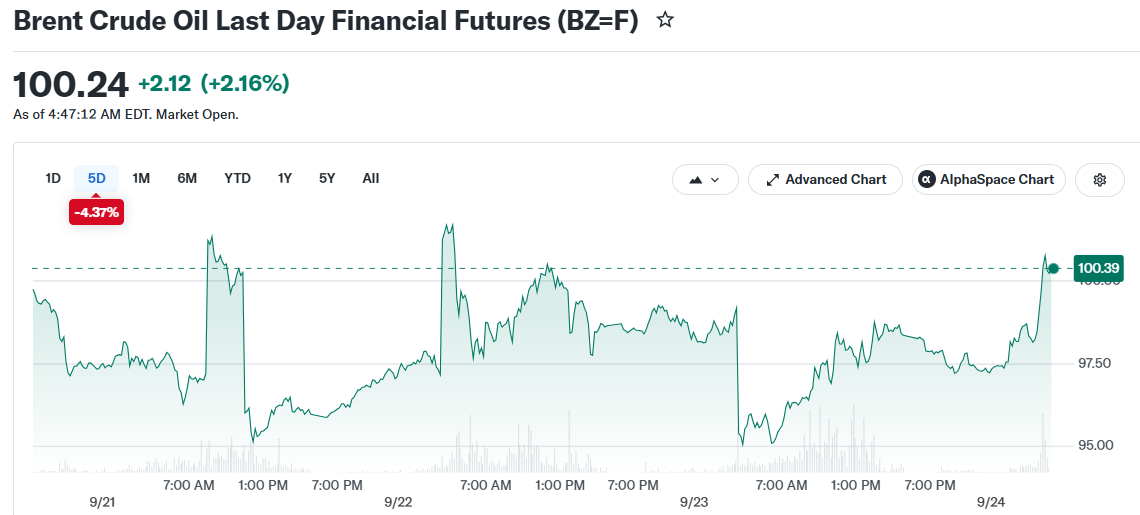
The increase came as diplomatic talks between the United States and Iran showed little sign of progress. Investors are watching the situation closely.
Iran and US Remain Divided on Key Issues
Iran’s President Masoud Pezeshkian addressed the United Nations General Assembly this week. He said Iran would not surrender to US pressure.
🚨MASSIVE DUMP:
$900 Billion wiped out from stocks, crypto, and precious metals since the US market open as Iran said they won't surrender. pic.twitter.com/GYyd7Vjwuk
— Ash Crypto (@AshCrypto) September 23, 2026
He also said Tehran remained open to diplomacy. A senior Iranian official told Reuters that talks must continue.
The official said Iran is reviewing a US response to its peace proposal. Iran wants the US to lift its naval blockade and allow the Strait of Hormuz to reopen.

The Strait of Hormuz normally handles about one-fifth of global oil and gas shipments. It has been closed since a joint US and Israeli operation against Iran began in late February.
Iran’s security chief, Mohsen Rezaei, said this week that the strait will not reopen until Iran’s conditions are met.
US President Donald Trump warned this week that he could take stronger military action against Iran if no deal is reached. US Secretary of State Marco Rubio said reaching a deal will take time and hard work.
Diesel Export Ban Adds to Market Uncertainty
Traders are also watching for a possible US ban on diesel exports. A report from Politico said the Trump administration was preparing a 90-day ban.
The White House denied this report. US Energy Secretary Chris Wright said a diesel ban would not work, even though Trump said he would support one.
Ultra-low-sulfur diesel futures fell about 5% on Wednesday after the report came out. Some analysts said a ban could hurt global supplies and raise costs elsewhere.
US distillate stockpiles, which include diesel and heating oil, fell by 428,000 barrels last week. That brought total stockpiles to 107.4 million barrels, according to the Energy Information Administration.
US crude inventories rose by 3 million barrels last week to 426.4 million barrels. Analysts had expected a decline of about 641,000 barrels instead.
Gulf oil supply had shown some signs of improvement earlier this week. Saudi Arabia reportedly restarted its east-west pipeline to the Red Sea, and Iraq increased its exports.
Those gains were offset by Rezaei’s comments that the Strait of Hormuz will stay closed. Analysts say Brent crude carries a bigger price premium than WTI because it is more exposed to Middle East supply routes.
As of Thursday morning, Brent crude was trading around $105.40 a barrel and WTI was near $93.94 a barrel. Both benchmarks remain up sharply from earlier in the week.
Stop guessing and start investing with confidence. KnockoutStocks gives you the AI insights, market intelligence, and stock research you need to spot opportunities, cut through the noise, and make smarter investment decisions — all in one powerful platform.
Sign up today and get 50% OFF full access to our premium stock picks.
Simply use coupon code SPECIAL50 at checkout to claim your exclusive discount.
Get 3 Free Stock Ebooks
Discover top-performing stocks in AI, Crypto, and Technology with expert analysis.
- Top 10 AI Stocks - Leading AI companies
- Top 10 Crypto Stocks - Blockchain leaders
- Top 10 Tech Stocks - Tech giants



