






TLDR
- Brent crude rose 0.9% to $89.28 a barrel on Monday after gaining over 5% last week
- Iranian attacks on tankers have nearly shut down Strait of Hormuz shipping traffic
- Only five vessels passed through the strait on Saturday, down from 130+ per day before the conflict
- Iran and Oman are in talks over managing the strait, but the U.S. is not part of those discussions
- Both OPEC and the IEA cut their 2026 oil demand forecasts last week
Oil prices pushed higher on Monday, continuing a strong run fueled by fears over Middle East tensions and disruptions to one of the world’s most important shipping routes.
Brent crude futures rose 0.9% to $89.28 a barrel in early trading. U.S. West Texas Intermediate crude added 0.2% to $82.60 a barrel.
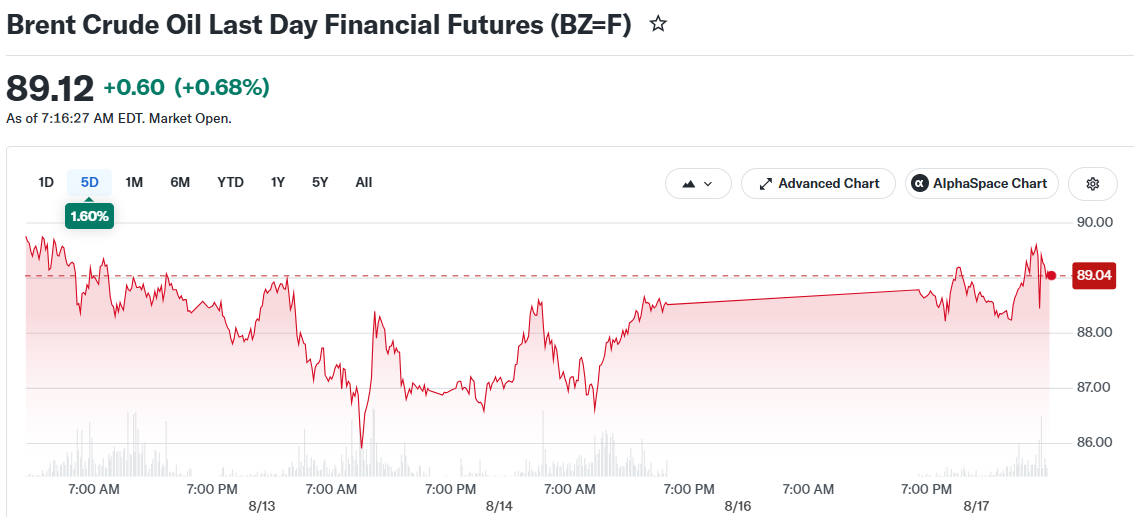
Brent surged more than 5% last week. The main driver was the ongoing conflict between the U.S. and Iran, which has caused major disruptions to oil and gas shipping.
Strait of Hormuz Nearly Closed to Tankers
The Strait of Hormuz, through which more than 130 ships passed daily before the conflict, has seen traffic fall sharply. Iranian attacks on tankers trying to cross the strait have scared off shipping.
JUST IN: Strait of Hormuz shipping falls to ZERO on Sunday ahead of today’s US-Iran ceasefire expiry. https://t.co/tr4Q8evyO3
— Coin Bureau (@coinbureau) August 17, 2026
Shipping data from Kpler, cited by Reuters, showed just five vessels passed through on Saturday. On Sunday, that number fell to zero.
Before the joint U.S. and Israeli military assault on Iran launched in late February, the strait was one of the busiest chokepoints for global oil and liquefied natural gas flows.

The U.S. is also maintaining a naval blockade of Iranian ports and has threatened to keep it in place indefinitely.
Iran’s Foreign Minister said over the weekend that Tehran is not engaged in direct talks with Washington. The U.S. warned it would impose more economic measures to pressure Iran into negotiations.
Analysts at ING said attacks on vessels were raising concerns over supply disruptions and making it harder to reach a U.S.-Iran deal.
Diesel Prices Hit Hardest
While crude oil prices stayed high, refined products felt more pressure from the conflict. ANZ analysts said diesel has become the tightest part of the oil market.
Refinery disruptions across the Gulf region have hurt diesel production and exports, even as global demand for the fuel stays strong.
The situation is being made worse by the war in Ukraine. Kyiv has continued to strike Russian oil infrastructure, adding more strain to already tight supplies.
ANZ analysts warned that diesel supplies could get even tighter in the coming months if conditions do not improve.
Despite these supply worries, OPEC and the International Energy Agency both cut their 2026 global oil demand forecasts last week. Those weaker demand outlooks did little to push prices down.
Iran and Oman are reported to be moving closer to an agreement over managing the Strait of Hormuz. However, the U.S. is not part of those talks and continues to demand unrestricted passage through the waterway.
MUFG analyst Soojin Kim said geopolitical uncertainty and risks to key shipping routes are keeping a risk premium firmly embedded in crude prices.
Stop guessing and start investing with confidence. KnockoutStocks gives you the AI insights, market intelligence, and stock research you need to spot opportunities, cut through the noise, and make smarter investment decisions — all in one powerful platform.
Sign up today and get 50% OFF full access to our premium stock picks.
Simply use coupon code SPECIAL50 at checkout to claim your exclusive discount.
Get 3 Free Stock Ebooks
Discover top-performing stocks in AI, Crypto, and Technology with expert analysis.
- Top 10 AI Stocks - Leading AI companies
- Top 10 Crypto Stocks - Blockchain leaders
- Top 10 Tech Stocks - Tech giants



