





Between 560 million and 741 million people own cryptocurrency worldwide, according to the most cited estimates. That is roughly 7% to 9% of the global population.
The exact number depends on who is counting. Surveys, exchange records and blockchain data each measure different things, so the honest answer is a range.
This article uses data from Triple-A, Crypto.com, Chainalysis, Security.org and other trackers. It shows how many people own crypto, where they live, who they are and what they hold.
Key takeaways:
- Global owners: between 560 million and 741 million people, or about 7% to 9% of the world.
- Growth: ownership rose from about 420 million in 2023 to 741 million in 2025.
- Countries: the UAE has the highest ownership rate at 25.3%, while India leads the Chainalysis activity index.
- People: 61% of owners are men, and the 25-34 age group is the largest.
- United States: 30% of adults own crypto, according to Security.org.
How Many People Own Crypto Worldwide?
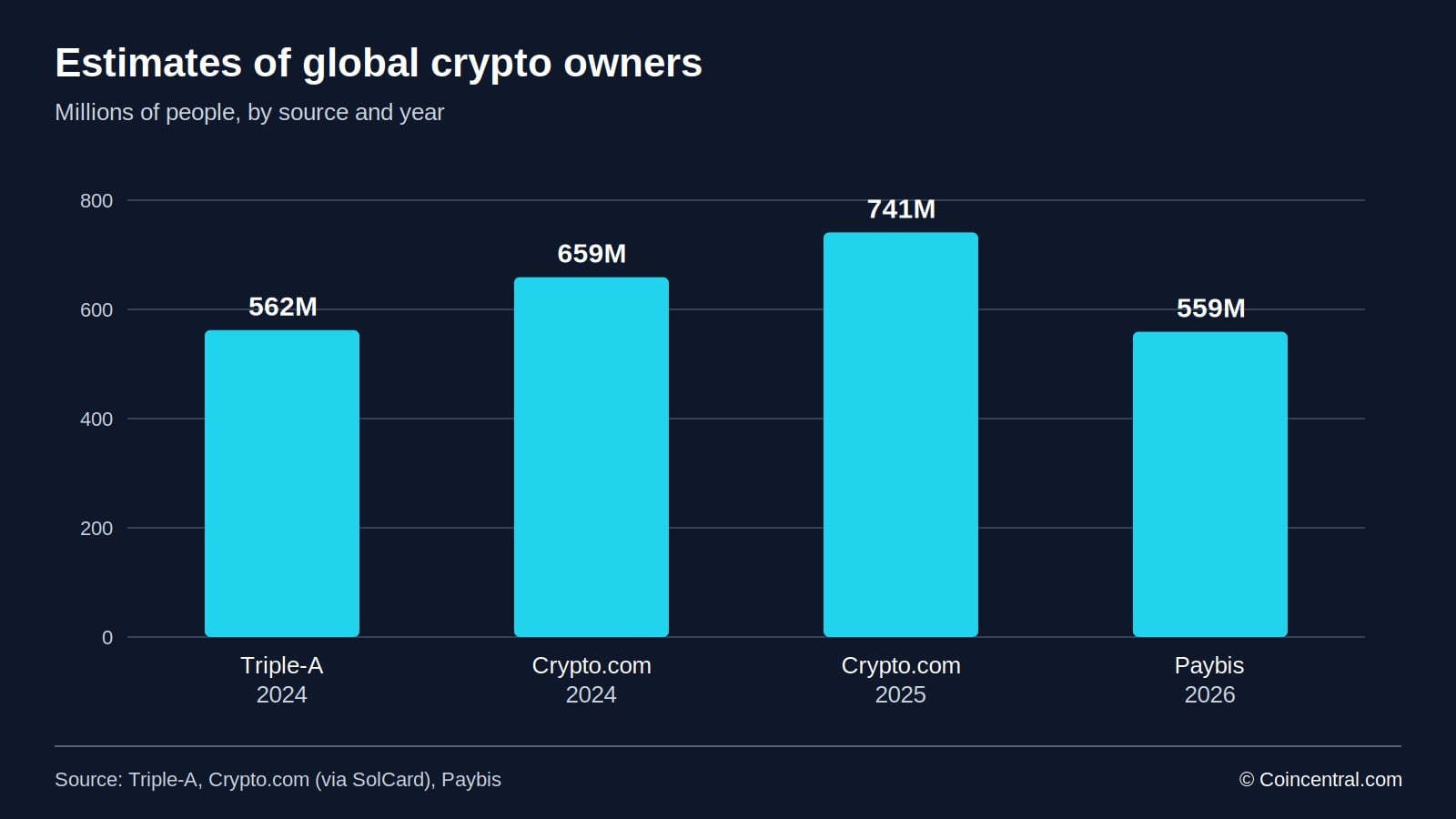
Four main estimates sit at the center of the debate. Triple-A counted 562 million owners in 2024, which was 6.9% of the world. Crypto.com counted 659 million for 2024 and 741 million for 2025, or about 9% of the world.
A 2026 report from Paybis puts the figure at 559 million, which is close to the Triple-A count. Oobit also cites 562 million owners for 2024, with a 6.8% global ownership rate.
Wallet counts add more confusion. One person often holds several wallets across chains and exchanges. A single exchange address can also stand for millions of customers whose coins never move on the blockchain.

The gap between sources comes down to method. Triple-A uses national surveys and banking data. Crypto.com blends blockchain data with exchange and survey inputs, which puts its count about 100 million higher.
| Source | Owners | Year | Share of world |
|---|---|---|---|
| Triple-A | 562 million | 2024 | 6.9% |
| Crypto.com | 659 million | 2024 | About 8% |
| Crypto.com | 741 million | 2025 | About 9% |
| Paybis | 559 million | 2026 | 9.9% of internet users |
Most reviews of the data settle on a range of 560 million to 741 million owners. The true figure is likely between 600 million and 700 million. Either way, more than 85% of the world still owns no crypto.
Paybis measures ownership against internet users instead of the whole population. By that measure, 9.9% of internet users hold crypto, or roughly one in ten. This is why the same trend can show up as 7%, 9% or 10% in different reports.
How Crypto Ownership Has Grown
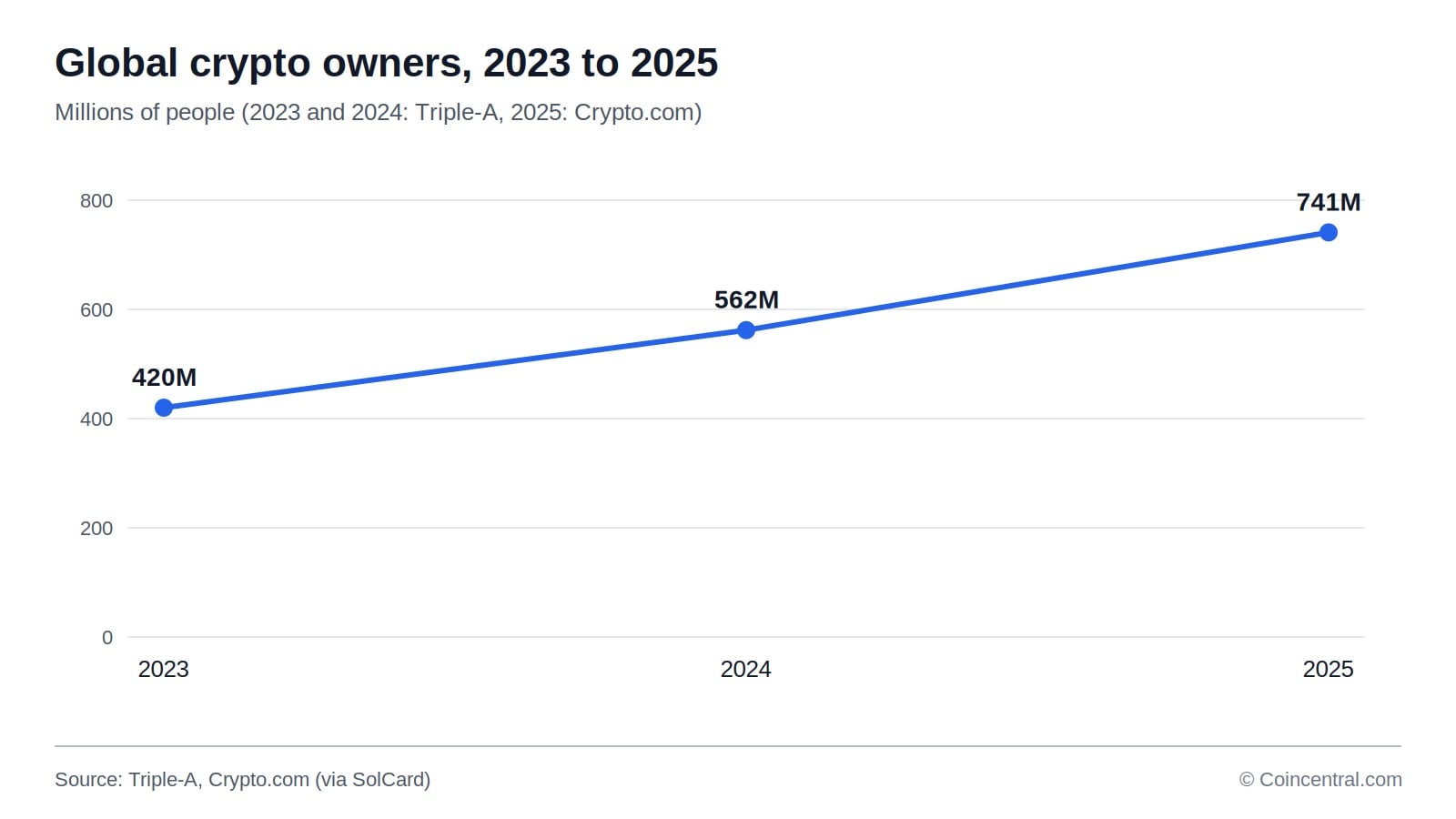
Ownership has roughly doubled in three years. Triple-A estimated 420 million owners in 2023, or about 5.3% of the world. Its 2024 count was 562 million, a jump of 33%.
Crypto.com’s data shows steadier growth. Its count rose 12.4%, from 659 million in 2024 to 741 million in 2025. The two trackers differ in level but agree on direction.
| Year | Owners | Share of world | Source |
|---|---|---|---|
| 2023 | About 420 million | About 5.3% | Triple-A |
| 2024 | 562 million | 6.9% | Triple-A |
| 2024 | 659 million | About 8% | Crypto.com |
| 2025 | 741 million | About 9% | Crypto.com |
Longer-term growth has been faster. Triple-A reports a 99% compound annual growth rate for digital currency ownership from 2018 to 2023. Traditional payment methods grew about 8% a year in the same period.
Growth has not been even across the world. Oobit reports that South America grew 116.5% in one year, from 25.5 million users to 55.2 million. North America grew 38.6% to 72.2 million users in 2024.
Paybis reports that Africa grew 19.4% in 2025. It links recent gains to clearer rules and new products. These include spot Bitcoin and Ethereum ETFs in the US and the MiCA framework in the European Union.
Crypto Ownership by Country
Two measures produce two different country rankings. One counts the share of people who own crypto. The other measures how much people use it.
By ownership rate, Triple-A places the UAE first at 25.3% of its population. Singapore follows at 24.4%, then Turkey at 19.3% and Argentina at 18.9%. Thailand, Brazil and Vietnam round out the top seven.
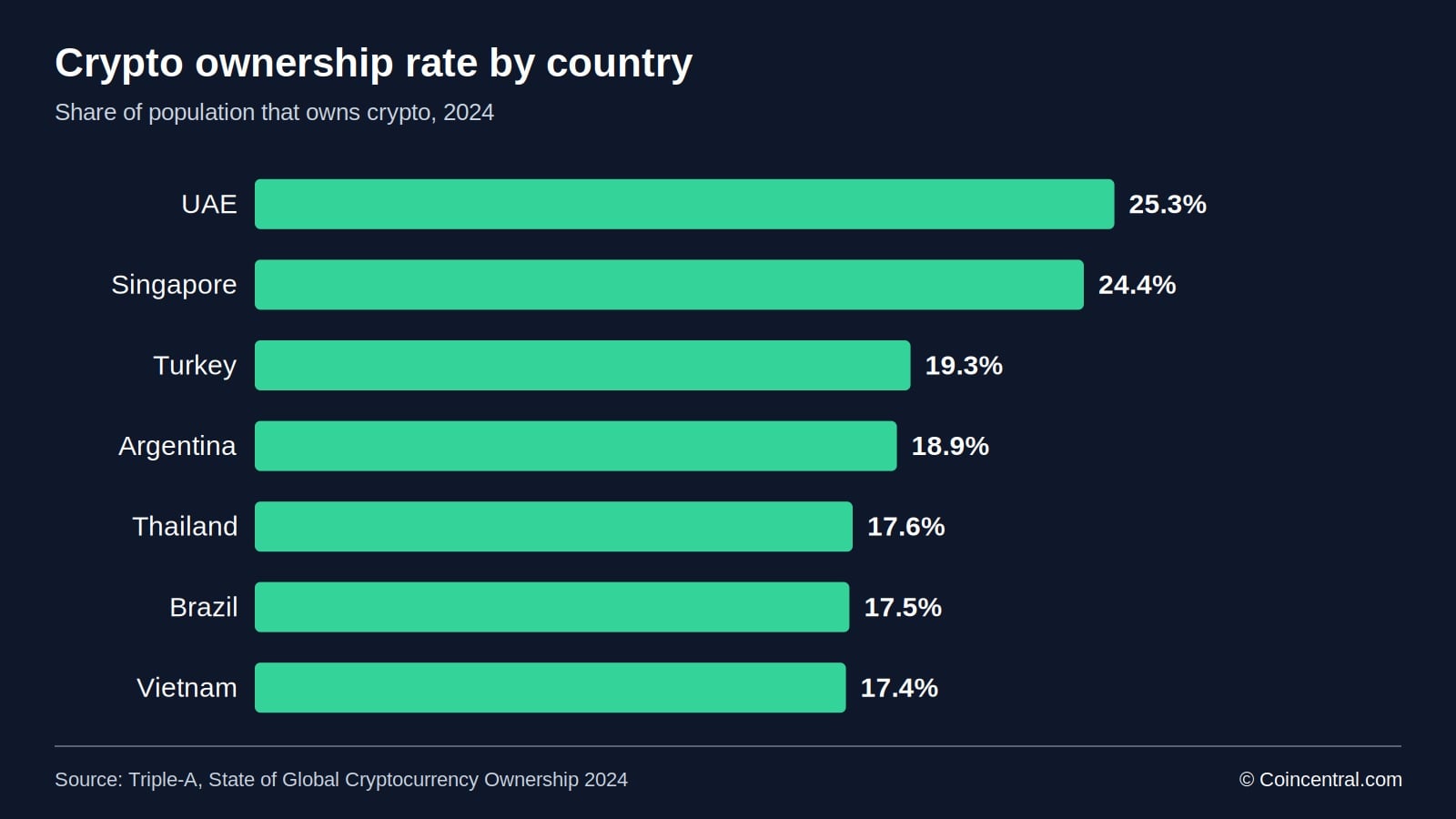
The list mixes two types of economy. The UAE and Singapore are wealthy trading hubs with friendly rules for crypto. Turkey and Argentina have faced high inflation, which pushes people to look for ways to protect their savings.
By activity, the Chainalysis 2025 Global Crypto Adoption Index ranks India first and the United States second. The index weighs the value people receive, retail use and DeFi activity.
| Rank | Country | Detail |
|---|---|---|
| 1 | India | First in all four sub-categories |
| 2 | United States | Institutional and retail scale |
| 3 | Pakistan | Grassroots retail growth |
| 4 | Vietnam | Long-standing high adoption |
| 5 | Brazil | Largest in Latin America |
| 6 | Nigeria | Third in the world for DeFi |
Paybis notes that seven of the top ten countries in the index were in Asia. SolCard, citing Chainalysis, says transaction volume in the Asia-Pacific region grew from $1.4 trillion to $2.36 trillion in 2025.
Raw owner counts tell a third story. Triple-A’s 2023 country data shows India with the most owners, followed by China and the United States. The table below shows the ten largest.
| Country | Owners (2023) | Ownership rate |
|---|---|---|
| India | 97,537,015 | 7.1% |
| China | 78,134,683 | 5.5% |
| United States | 46,888,108 | 13.7% |
| Brazil | 25,955,176 | 7.8% |
| Vietnam | 18,645,706 | 18.73% |
| Nigeria | 13,261,259 | 10.34% |
| Indonesia | 12,205,132 | 4.50% |
| Iran | 12,000,000 | 13.46% |
| Pakistan | 9,859,912 | 4.10% |
| Russia | 8,749,780 | 6.06% |
Turkey shows how inflation shapes ownership. SolCard says Turkish holders lean on dollar-pegged stablecoins to protect buying power from lira inflation. At 19.3%, Turkey has the third-highest ownership rate in the Triple-A survey.
Other trackers use different bases. Oobit reports that 25.6% of Turkey’s internet population owns crypto, while China sits at 3.7% of its internet users. Paybis puts the Philippines at 22% to 23%, helped by remittance use.
Crypto Adoption by Region
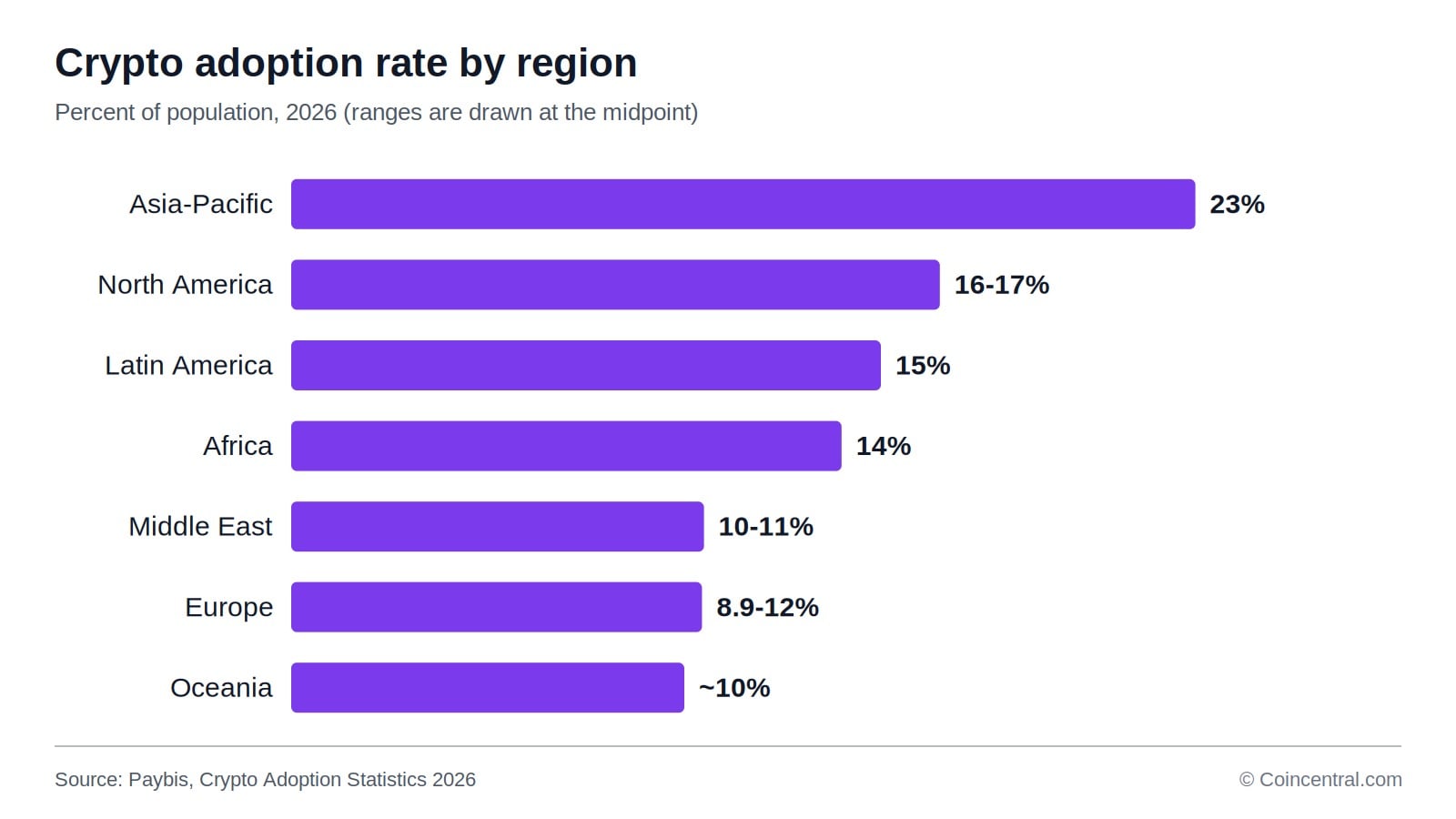
Asia-Pacific leads the world in adoption. Paybis puts the rate there at 23%, with about 350 million active wallet users. The region holds about 37.6% of the global market.
Oobit counts 326.8 million crypto users in Asia in 2024, more than all other continents combined. It credits high smartphone use and large populations in countries such as Vietnam, the Philippines and Indonesia.
| Region | Adoption rate | Active wallet users |
|---|---|---|
| Asia-Pacific | 23% | About 350 million |
| North America | 16-17% | About 134 million |
| Latin America | 15% | About 92 million |
| Africa | 14% | About 75 million |
| Europe | 8.9-12% | About 140 million |
| Middle East | 10-11% | More than 30 million |
| Oceania | About 10% | Not reported |
Africa has the fastest recent growth. Paybis says mobile wallet use there is the highest of any region. People use crypto for savings, remittances and protection against falling local currencies.
Latin America’s 15% rate reflects currency instability, which has made crypto a practical tool for tens of millions of people, according to Paybis. In El Salvador, Bitcoin is legal tender, and Paybis says 85% of small businesses there accept it.
Europe has more than 100 million crypto users and 140 million wallet users, up 12% in a year. Between 8.9% and 12% of European adults own crypto. Germany, Spain and Switzerland report the highest rates.
The MiCA rules, which began in December 2024, set one framework for all 27 EU states. The UK sits outside MiCA. A Deutsche Bank Research survey cited by Paybis found that ownership among UK adults aged 18 to 34 rose from 14% to 26% in 2025, while Oobit reports UK ownership overall rising from 18% to 24%.
Who Owns Crypto: Age and Gender
Crypto owners skew young and male. Triple-A says 61% of owners are men and 39% are women. Oobit estimates about 343 million male holders worldwide.
The 25-34 age group is the largest. It makes up about 34% of all owners, according to Triple-A. In this group, 16.2% of men and 8.7% of women own crypto.
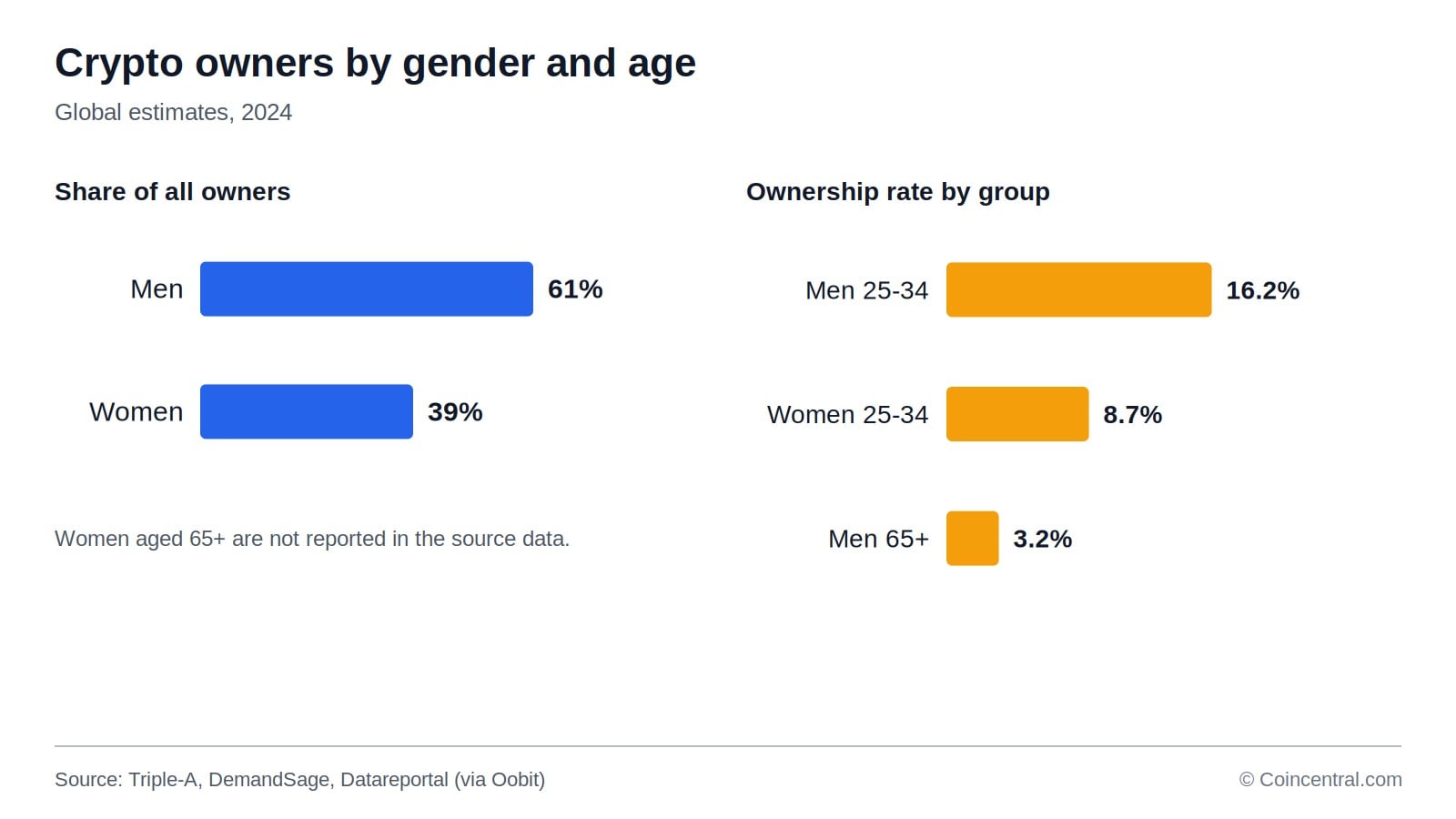
Men are nearly twice as likely as women to own crypto in every age group. Male ownership falls from 16.2% for ages 25 to 34 to 3.2% for ages 65 and older. Paybis adds that women’s ownership grew faster than men’s in 2024 and 2025 in most major markets.
| Measure | Figure | Source |
|---|---|---|
| Share of owners who are men | 61% | Triple-A |
| Share of owners who are women | 39% | Triple-A |
| Share of owners aged 25-34 | 34% | Triple-A |
| Owners who prefer to pay with crypto | 65% | Triple-A |
| Average age of users | 34.8 years | Paybis |
| Users under age 35 | 60% | Paybis |
| Ownership in urban areas | 25% | Paybis |
| Ownership in rural areas | 11% | Paybis |
| Users who access crypto on mobile | 78% | Paybis |
Location matters too. Paybis says rural adoption tends to follow urban adoption by two to three years. That gap is getting shorter as mobile-first platforms spread.
The gender gap shows up in US plans too. Security.org found that women are half as likely as men to plan a crypto purchase in the next 12 months. It also found that 19% of women see no benefit in crypto, compared with 10% of men.
In the US, Paybis reports that 28% of adults aged 18 to 29 have invested in crypto, compared with 8% of those aged 65 and older.
Which Coins Do People Own?
Bitcoin is still the most held coin. Crypto.com counted 365 million Bitcoin owners in 2025, or 49.3% of all owners. Ethereum had 175 million owners, or 23.6%.
Ethereum grew faster than Bitcoin. Its owner count rose 22.6% in a year, compared with 8.3% for Bitcoin. Stablecoins and other assets were the fastest-growing group.
| Asset | Owners (2025) | Share of owners | Yearly growth |
|---|---|---|---|
| Bitcoin | 365 million | 49.3% | 8.3% |
| Ethereum | 175 million | 23.6% | 22.6% |
| Other assets and stablecoins | Remainder | Not stated | Fastest-growing group |
US data from Security.org shows the same top two. In its 2026 survey, 74% of US owners held Bitcoin and 53% held Ethereum. Dogecoin was third at 25%, followed by Solana at 20% and USDC at 18%.
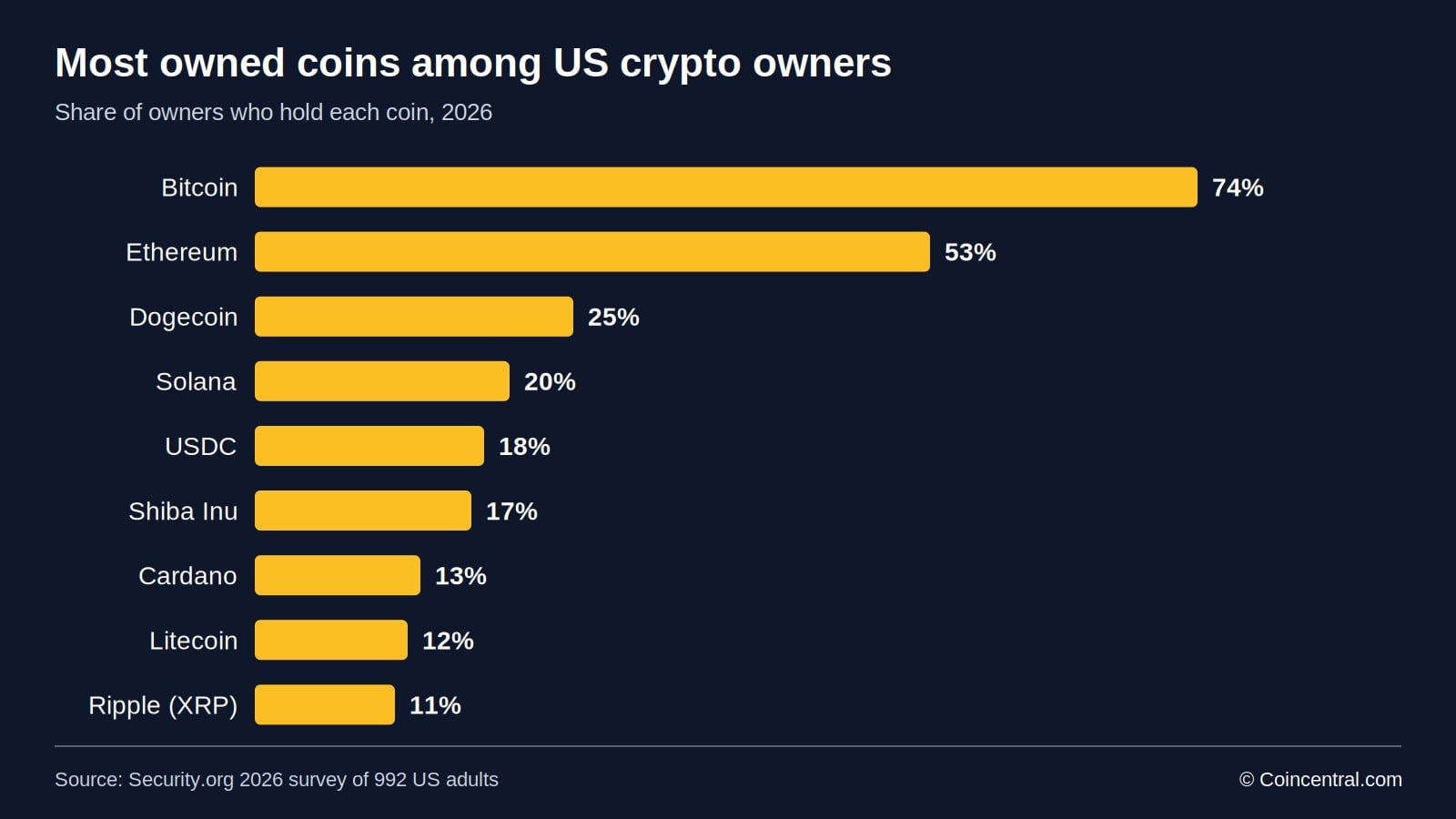
Solana had the biggest rise. Its ownership share went from 11% in 2024 to 20% in 2026. Security.org links this to faster transactions and lower fees than Ethereum.
Reasons for owning crypto differ by group. Security.org found that 38% of US adults see price gains as its greatest benefit, rising to 51% among owners. Only 10% cite avoiding bank fees, and 20% value anonymity.
| Coin | 2024 | 2025 | 2026 |
|---|---|---|---|
| Bitcoin | 76% | 74% | 74% |
| Ethereum | 54% | 49% | 53% |
| Dogecoin | 26% | 31% | 25% |
| Solana | 11% | 18% | 20% |
| USDC | 12% | 17% | 18% |
| Shiba Inu | 12% | 15% | 17% |
Dogecoin spiked to 31% in 2025 before falling back to 25%. Political tokens such as Melania Coin and the Official Trump coin are each held by about 1% of owners. Among people planning to buy, 59% say Bitcoin, 49% say Ethereum and 18% say Solana.
Crypto Ownership in the United States
Security.org found that 30% of US adults own crypto in 2026. That equals about 70.4 million people. The survey covered 992 adults and relies on self-reported answers.
Ownership has moved in a range since the 2022 peak of 33%. It fell to 27% in 2024, rose to 28% in 2025 and returned to 30% in 2026. Security.org links the recovery to spot Bitcoin ETFs and a friendlier federal stance on crypto.
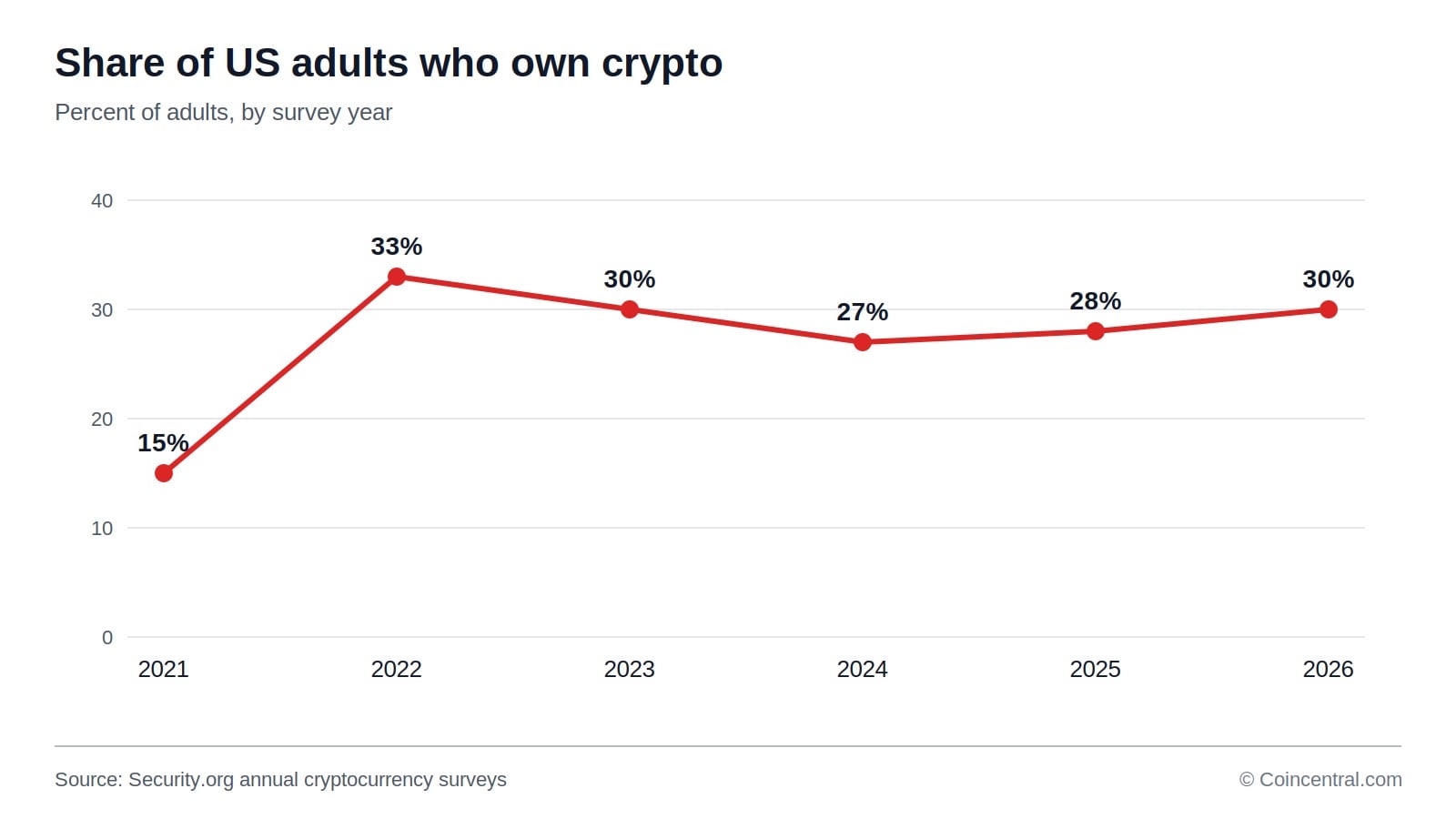
Other trackers show lower US rates because they measure the whole population. Triple-A’s 2023 data put US ownership at 13.7% of all residents, or 46.9 million people. Different methods likely explain the gap.
| Age group | Share of US crypto owners |
|---|---|
| 18-29 | 19% |
| 30-44 | 32% |
| 45-59 | 31% |
| 60 and older | 17% |
The federal government has also taken a larger role. The Strategic Bitcoin Reserve was set up in March 2025, and Congress passed the GENIUS Act on stablecoins in July 2025. Security.org found that 52% of Americans expect crypto values to rise under the Trump administration, while 24% say the reserve strengthened the economy.
Most owners report gains. Of people who have ever owned crypto, 53% say they have a net gain, 23% say they broke even and 21% report a net loss. The share reporting gains was 69% in 2025.
Price swings are the top worry. Unstable value was the main concern for 37% of respondents. About 59% of Americans lack confidence in crypto security, and 16% of owners have had trouble accessing their holdings.
Plans to buy differ sharply. Of current owners, 61% plan to buy more in 2026, but only 6% of non-owners plan to join. Another 47% of non-owners say they might consider it later.
| Year | Will never buy | Would consider | Plan to buy within 12 months |
|---|---|---|---|
| 2023 | 49% | 46% | 5% |
| 2024 | 44% | 41% | 15% |
| 2025 | 38% | 48% | 14% |
| 2026 | 47% | 47% | 6% |
How Many People Own Bitcoin?
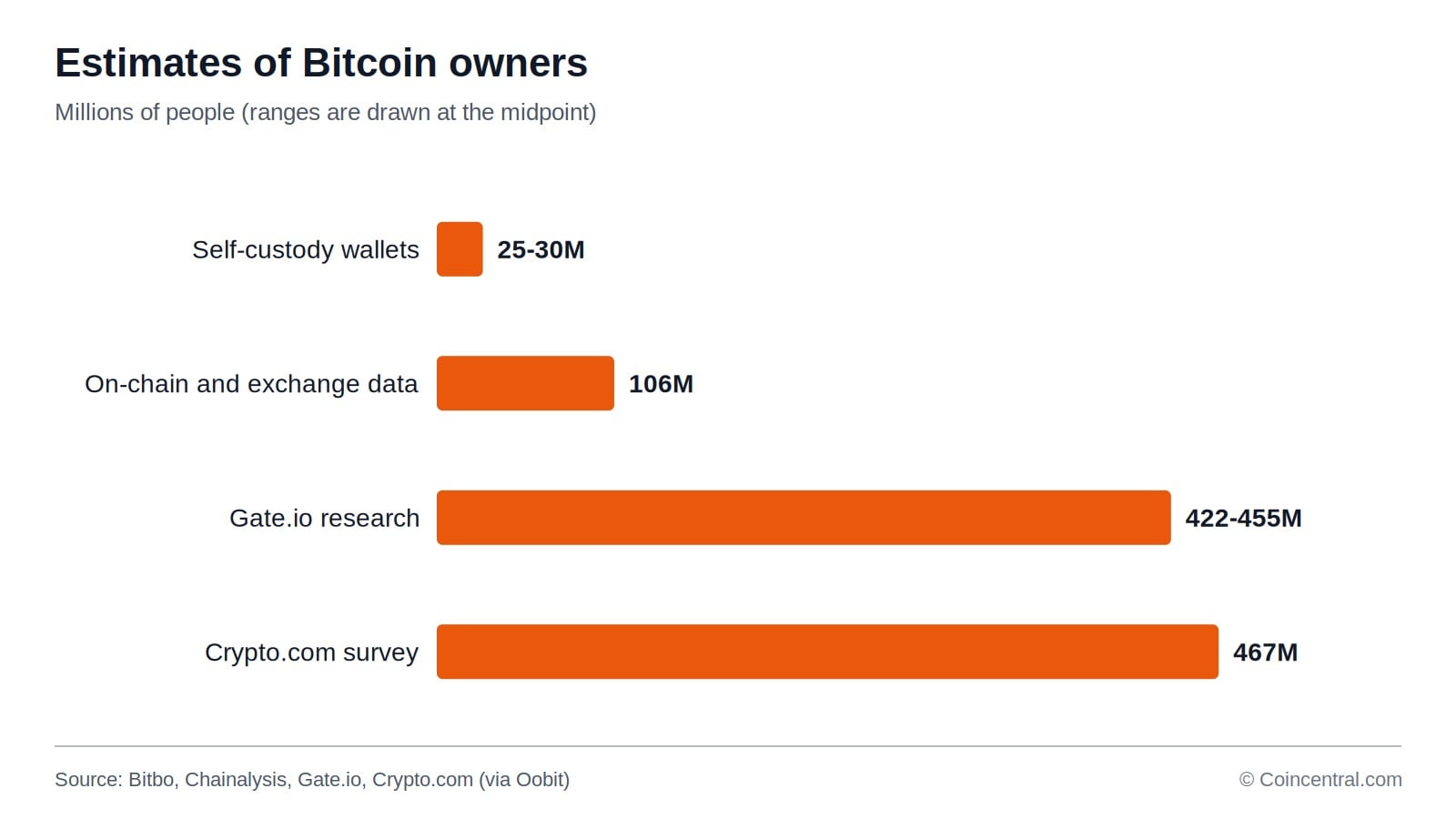
Bitcoin owner counts vary more than any other figure. Estimates run from 25 million to more than 460 million. The reason is that the blockchain records addresses, not people.
Self-custody wallet data points to 25 million to 30 million individual holders. Bitbo and Chainalysis data points to about 106 million, or 1.29% of the world. Gate.io estimates 422 million to 455 million, and a Crypto.com survey counts 467 million people with Bitcoin exposure.
Address data shows why. Of 460 million Bitcoin addresses that have held a balance, 288 million are now empty.
Of the remaining 172 million, 147 million belong to exchanges, services, merchants or other market players. Only about 25 million are believed to be active wallets owned by individuals.
The count also bends the other way. One exchange address can hold coins for millions of customers. That is why one person can own many wallets while one wallet can stand for many people.
Holdings are concentrated. The top 1% of holders own 87% of all Bitcoin, and 74% of supply has been held for more than a year. Binance’s cold storage holds the largest wallet at 248,598 BTC.
| Holding size | Wallets | Share of wallets |
|---|---|---|
| More than 100,000 BTC | 4 | 0.00001% |
| 10,000 to 100,000 BTC | 94 | 0.00016% |
| 1,000 to 10,000 BTC | 2,100 | 0.004% |
| 100 to 1,000 BTC | 18,463 | 0.03% |
| 10 to 100 BTC | 151,657 | 0.24% |
| At least 1 BTC | 988,627 | 1.52% |
| 0.1 to 1 BTC | 3.48 million | 6.3% |
| 0.01 to 0.1 BTC | 7.9 million | 14.3% |
| Under 0.01 BTC | 42.7 million or more | 77.6% |
The source labels some of these tiers in ways that can overlap, so treat the rows as a rough guide.
Few people own a whole coin. Around 988,627 wallets hold at least one BTC, and many belong to exchanges and funds. Oobit says the true number of individuals who hold one coin is likely well under one million.
Bitcoin millionaires are also growing in number. Oobit reports 85,400 in 2024, up 111% from 40,500 in 2023, and Paybis counts 192,205 in 2026. Public companies hold coins too: 64 or more held about 688,000 BTC as of May 2025.
Crypto Ownership Forecasts
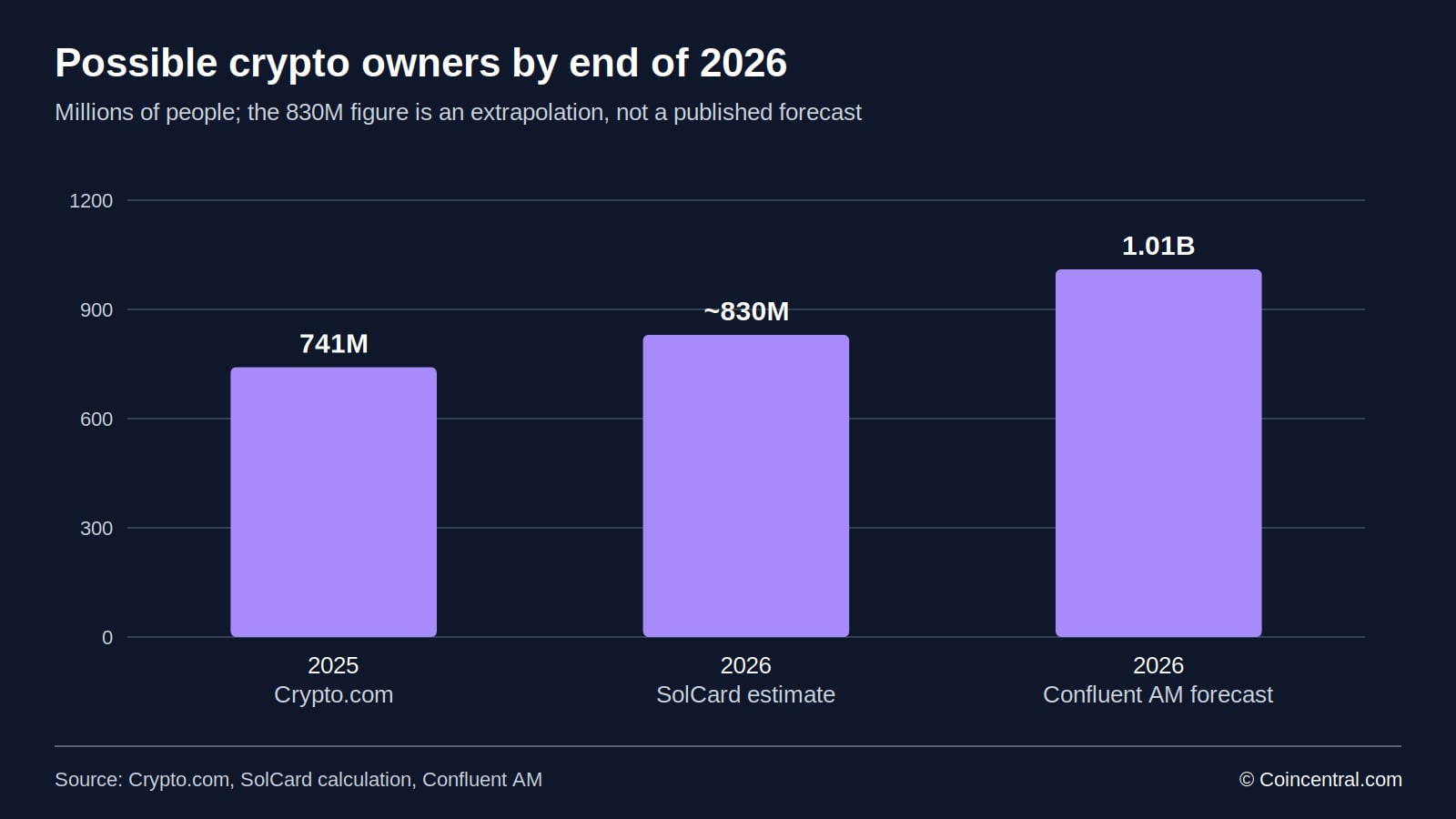
Forecasts depend on the growth rate used. SolCard applied Crypto.com’s 12.4% growth to its 741 million base, which gives about 830 million owners by the end of 2026. This is SolCard’s own extrapolation, not a published forecast.
Confluent AM models a faster path, with more than 1.01 billion owners in 2026. That would be about 12% of the world. Both views leave most people outside crypto.
| Projection | Figure | Source |
|---|---|---|
| Global owners, end of 2026 | About 830 million | SolCard extrapolation |
| Global owners, 2026 | 1.01 billion | Confluent AM |
| Bitcoin users by 2027 | 100 million | Oobit |
| Bitcoin users by 2030 | 250 million | Oobit |
| Crypto market value by 2030 | $7.98 trillion, up from $2.96 trillion in 2025 | Oobit |
Oobit also expects the retail share of Bitcoin to fall from 85% in 2024 to 60% by 2030 as institutions buy through regulated channels. Forecasts like these are estimates and can change with prices and rules.
Spending is a separate question. Triple-A says 65% of owners would prefer to pay with crypto. Sources disagree on how many merchants accept it: Paybis reports 46% of merchants globally, while SolCard says most merchants do not accept it directly.
The next wave may come from stablecoins, mobile wallets and payments, according to Paybis and SolCard. Paybis counts 56 million cross-border remittance users. Price swings and security worries remain the main barriers, as the US data shows.
In short, crypto ownership is growing, but the exact count is uncertain. Most credible estimates place it between 560 million and 741 million people. The trend is upward in every source reviewed.
Sources
- Triple-A, Digital Currency Ownership Data (2024 report) (https://triple-a.io/crypto-ownership-data/)
- SolCard Team, How Many People Own Crypto? 560-741 Million Worldwide (2026), July 6, 2026 (https://solcard.io/)
- Oobit, How Many People in the World Own Bitcoin?, May 18, 2026 (https://oobit.com/)
- Paybis, Crypto Adoption Statistics 2026: Europe and Global Data, May 31, 2026 (https://paybis.com/blog/)
- Security.org, 2026 Cryptocurrency Adoption and Sentiment Report (https://www.security.org/digital-security/cryptocurrency-annual-consumer-report/)
- Chainalysis, 2025 Global Crypto Adoption Index (https://www.chainalysis.com/blog/2025-global-crypto-adoption-index/)
- Crypto.com, 2026 crypto ownership report (as cited by SolCard and Oobit) (https://crypto.com/)


