





TLDR
- Brent crude fell to about $97 a barrel on Monday after Trump said new Iran strikes were unlikely.
- Brent dropped around 16% last week, its biggest weekly fall since the Covid-19 pandemic began.
- No ships crossed the Strait of Hormuz on Sunday, according to Iranian media.
- Houthi forces claimed an attack on Saudi Aramco’s Riyadh office, causing only window damage.
- Iraq says it has a deal with Washington to ship crude through a lane near Oman.
Oil prices slipped on Monday, with Brent crude staying below $100 a barrel. Traders reacted to comments from President Donald Trump, who said further U.S. strikes on Iran were highly unlikely. Attacks on ships and Saudi sites kept supply worries in place.
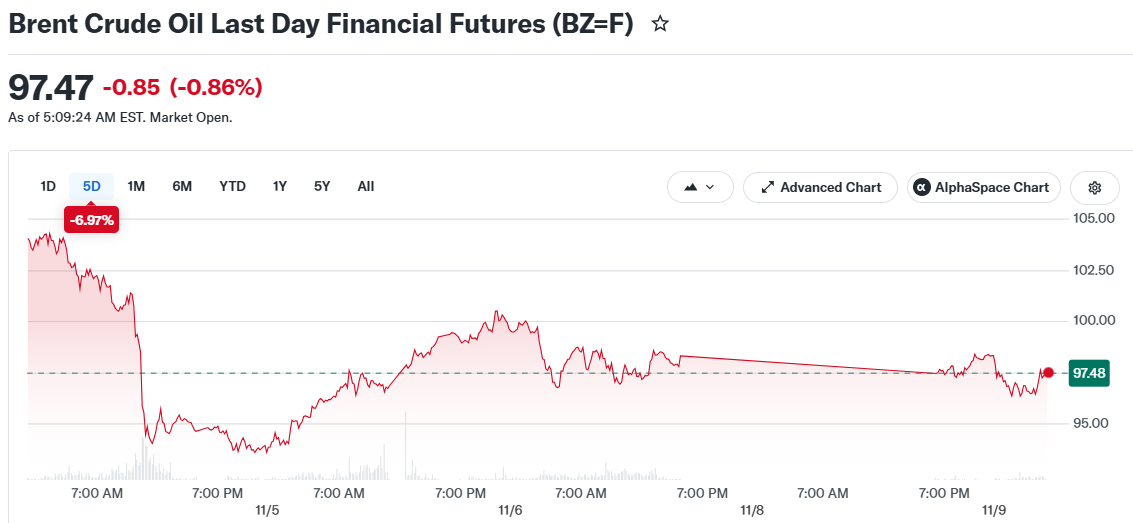
Brent futures for January delivery fell between 1.3% and 1.8% in early trade, depending on the time of the quote. They traded between $96.55 and $97.01 a barrel. West Texas Intermediate futures dropped between 0.7% and 1.2%, to between $89.78 and $90.17.
What Trump and Tehran Said
Trump made his remarks in a CNN interview over the weekend. He said new attacks were unlikely as long as talks on Iran’s nuclear program and the reopening of Hormuz kept moving forward. The comments helped calm fears of fresh escalation and led to some bargain buying.
BREAKING: Trump says Israel will have to pay the US back "any and all costs" of the Iran war.
"Pay us back any and all costs that we've had for the war," Trump tells CBS's 60 Minutes.
"We're gonna get all that money back," he adds.
Trump says "Without us, they wouldn't exist.…
— The Hormuz Letter (@HormuzLetter) November 9, 2026
Iran’s side has described the talks differently. Foreign Minister Abbas Araghchi said the discussions had made no progress. He said mediators had stopped traveling between the two sides after the U.S. midterm elections.
Secretary of State Marco Rubio also said the talks had made little headway. He added that a deal was not close. Trump was set to meet Qatar’s prime minister on Monday to discuss mediation.
The midterm results also shaped the mood. Democrats performed strongly, and traders expect more pressure on Trump in Congress to end the conflict. Trump said the war had played a role in Republican losses, and Vice President JD Vance linked the two as well.

Brent fell about 16% last week as traders weighed the chance of a diplomatic deal. That was its steepest weekly drop since the early days of the Covid-19 pandemic. ANZ analysts said investors are watching for signs of progress toward ending the conflict.
Washington is also adding pressure through Task Force Iron Gate. The effort aims to stop Iran from getting advanced weapons and other banned goods over land borders and Caspian Sea trade routes.
Shipping and Saudi Arabia Under Fire
Iranian media said no vessels passed through the Strait of Hormuz on Sunday. Tehran said navigation aids in the southern part of the waterway had been destroyed. That limits traffic on routes Iran considers unauthorized.
The U.K. Maritime Trade Operations agency reported two separate incidents on Sunday. An outbound tanker was struck by an unidentified projectile in the strait. The crew was safe, and no environmental impact was reported.
In the second case, a tanker caught fire about eight nautical miles northwest of Khasab, Oman. The crew evacuated, and the cause was not given. Iran also claimed that several tankers and a tugboat caught fire after hitting mines, but maritime authorities have not confirmed this.
Saudi Arabia faced missile and drone attacks over the weekend. Houthi militants backed by Iran claimed an attempted strike on Saudi Aramco’s office in Riyadh. Saudi officials said falling debris broke windows on several floors, and no one was hurt.
The Saudi-led coalition said air defenses stopped several missiles aimed at the kingdom. Civil defense officials said the danger had passed after an alert on Monday.
Iraq’s foreign minister said Baghdad reached an understanding with Washington to move crude through Hormuz. The oil would use a designated shipping lane near Oman. Iraq’s exports rose to about 3.5 million barrels per day in October, up from 2.65 million in September.
The minister estimated the war and export disruptions have cost Iraq around $60 billion. As of Monday morning, Brent was near $97 and WTI near $90.


