





TLDR
- Brent crude fell 1.1% to $114.00 a barrel and WTI slipped 1.3% to $101.49 on Thursday.
- Traders weighed new Iran diplomacy against fears of U.S. strikes after the Nov. 3 midterms.
- Goldman Sachs says fear of supply disruptions adds about $27 a barrel to Brent.
- Persian Gulf exports passed prewar levels, but attacks near the Strait of Hormuz keep costs high.
- U.S. crude stocks fell 1.9 million barrels, and global inventories are near their lowest since at least 2016.
Oil prices fell on Thursday as traders weighed new diplomatic efforts in the Middle East against the risk of renewed U.S. strikes on Iran. Fears of attacks on Saudi energy sites also kept prices high.
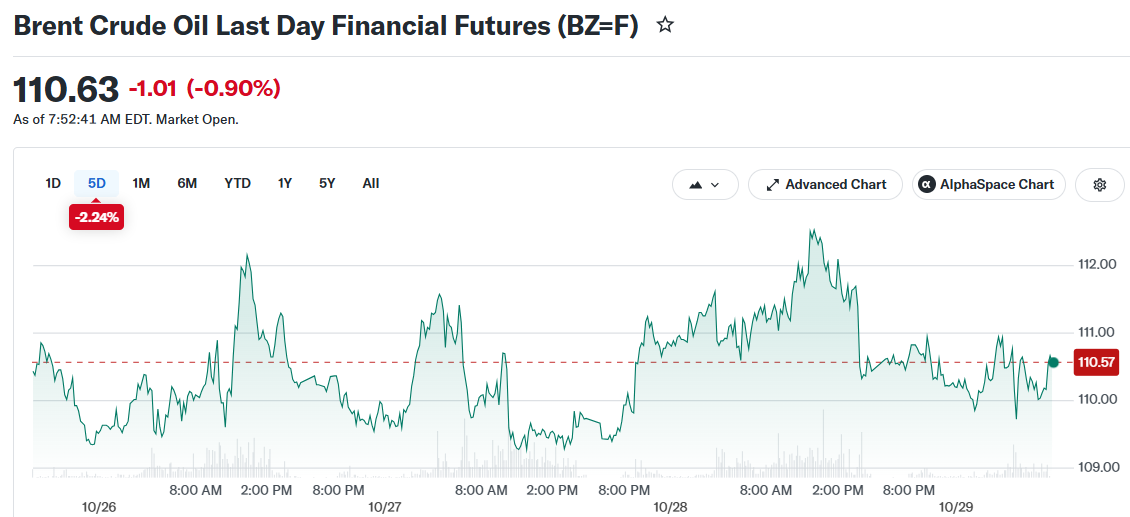
As of 07:37 ET, Brent crude futures dropped 1.1% to $114.00 a barrel. U.S. West Texas Intermediate slipped 1.3% to $101.49.
Both contracts had risen the day before. Yemen’s Houthi rebels said they attacked Saudi Arabia’s largest oil refinery.
Diplomacy and strike risk
The Wall Street Journal reported that Vice President JD Vance reached out to Mohsen Rezaei, secretary of Iran’s top security body. The move could open a channel for talks.
President Donald Trump told Axios that talks are taking place through mediators. He said he did not know whether they would produce results.
Qatari mediators gave Tehran a new draft proposal to end the conflict. An Iranian official called the ideas unacceptable, Reuters reported. Saudi Arabia, Turkey and Pakistan also held talks with Iranian officials this week.
Trump is reportedly considering short, intense military action against Iran after the Nov. 3 midterm elections. Washington has warned Gulf allies to prepare for strikes and possible Iranian attacks on energy sites.

Goldman Sachs estimates that fear of new supply disruptions has added about $27 a barrel to Brent. The bank says refiners are buying while supply is available, and investors are hedging with futures.
JPMorgan puts Brent’s fair value at $94 a barrel, well below current prices.
Shipping and supply
Persian Gulf oil exports topped 24 million barrels a day in the week through Oct. 18, above the prewar level of 23.3 million, according to Kpler. They fell to at least 15.7 million in the week through Oct. 26.
A record number of commercial ship attacks happened near the Strait of Hormuz this month. UBS said insurance and freight costs have risen sharply.
Shipping crude from the Gulf to Asia cost nearly $36 a barrel in early October, the International Energy Agency said. That is more than five times prewar levels.
Iran’s Persian Gulf Strait Authority warned of legal action against Sinokor vessels starting Nov. 1. Sinokor ships made up more than one-fifth of identified tanker traffic through Hormuz in the past three months, Kpler said.
Global on-land oil inventories are near their lowest since at least 2016, the IEA said. U.S. commercial crude stocks fell 1.9 million barrels to 410.6 million in the week ended Oct. 23.
China’s October crude imports appear to have risen from September, ship-tracking data suggest. U.S. gasoline averaged $4.25 a gallon on Wednesday, according to AAA.
Early Thursday, the most actively traded Brent contract was near $111 a barrel. WTI was at $101.49.
Stop guessing and start investing with confidence. KnockoutStocks gives you the AI insights, market intelligence, and stock research you need to spot opportunities, cut through the noise, and make smarter investment decisions — all in one powerful platform.
Sign up today and get 50% OFF full access to our premium stock picks.
Simply use coupon code SPECIAL50 at checkout to claim your exclusive discount.
Get 3 Free Stock Ebooks
Discover top-performing stocks in AI, Crypto, and Technology with expert analysis.
- Top 10 AI Stocks - Leading AI companies
- Top 10 Crypto Stocks - Blockchain leaders
- Top 10 Tech Stocks - Tech giants



