






Customer service representatives, data entry workers and telemarketers are among the occupations most exposed to artificial intelligence, according to a new analysis of more than 3,600 AI tools.
The AgentLocker AI Jobs Automation Index analysed 3,611 AI products and compared the tasks they can perform with US employment, salary and job outlook data.
The research found that AI products are already targeting job functions representing an estimated $3 trillion in annual US payroll, highlighting the scale of work now being addressed by AI software.
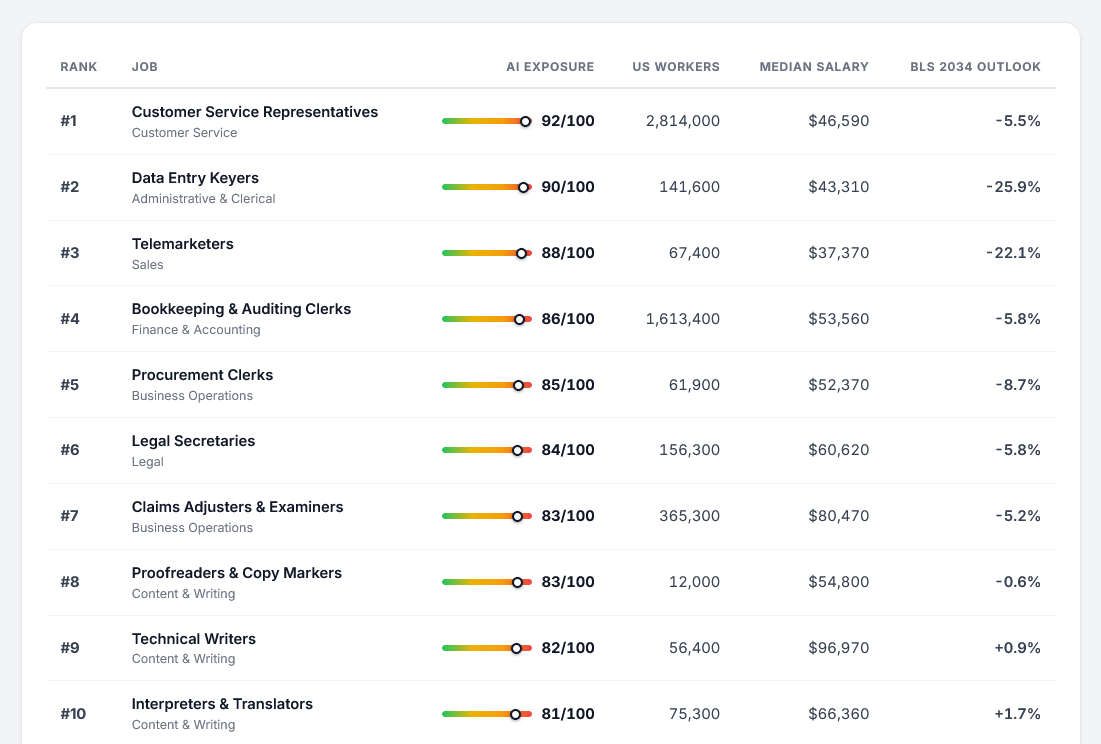
Customer service workers face the highest AI exposure
Customer service representatives ranked first among the 25 occupations analysed, receiving an AI exposure score of 92 out of 100.
There are around 2.8 million customer service representatives in the United States, while employment in the occupation is projected to decline by 5.5% between 2024 and 2034.
Data entry keyers ranked second with an exposure score of 90, followed by telemarketers at 88.
The ten occupations with the highest AI exposure were:

- Customer Service Representatives — 92/100
- Data Entry Keyers — 90/100
- Telemarketers — 88/100
- Bookkeeping & Auditing Clerks — 86/100
- Procurement Clerks — 85/100
- Legal Secretaries — 84/100
- Claims Adjusters & Examiners — 83/100
- Proofreaders & Copy Markers — 83/100
- Technical Writers — 82/100
- Interpreters & Translators — 81/100
Several of the occupations near the top of the ranking are also expected to shrink over the next decade.
The Bureau of Labor Statistics projects employment of data entry keyers to fall by 25.9% by 2034, while telemarketing employment is projected to decline by 22.1%.
Business operations attracts more AI tools than any other field
Looking beyond individual occupations, AgentLocker’s analysis found that Business Operations is the job function most heavily targeted by AI developers.
A total of 1,202 AI tools, equivalent to 33.3% of all products analysed, were capable of performing tasks associated with business operations.
Marketing came second with 930 tools, followed by Content & Writing with 828.
Other heavily targeted areas included productivity and office work, research and data analysis, customer service, administrative work and software development.
The results offer an indication of where AI companies currently see the greatest commercial opportunity.
Routine digital work involving research, writing, communication, administration and data manipulation is attracting significantly more AI development than sectors where work predominantly takes place in the physical world.
- Healthcare, for example, had just 1.3 AI tools per 100,000 US workers in the AgentLocker dataset.
- Research & Data Analysis had
High AI exposure doesn’t necessarily mean jobs will disappear
One of the more interesting findings from the index is that some occupations with significant AI exposure are still expected to grow.
Software developers received an AI exposure score of 68/100, yet employment is projected to increase by 15.8% between 2024 and 2034.
Data scientists have an exposure score of 66 while employment is forecast to grow by 33.6%.
Market research analysts are similarly highly exposed, with a score of 79, but employment is still expected to grow by 6.7%.
This suggests AI may transform many professions rather than simply eliminate them.
Workers could increasingly use AI to perform individual tasks while continuing to provide judgement, oversight, specialist knowledge and other work that remains difficult to automate.
By contrast, occupations where high AI exposure coincides with already-declining employment may face greater pressure.
Customer service, data entry, telemarketing, bookkeeping, procurement, legal secretarial work and computer programming all fall into this category in the index.
AI companies are targeting a huge pool of salaries
AgentLocker estimates that the US job functions currently being targeted by AI software account for approximately $3 trillion in annual payroll.
That figure does not represent wages expected to be lost to AI.
Instead, it illustrates the size of the economic opportunity software companies are pursuing as they build tools capable of completing tasks previously performed entirely by people.
Even capturing a small percentage of the work performed across areas such as business operations, marketing, software development, customer service and finance could represent an enormous market for AI companies.
Tracking where AI is actually being built
Much of the debate around AI and employment focuses on predictions about what artificial intelligence might eventually be capable of doing.
The AgentLocker index takes a different approach by looking at the AI products that already exist.
All 3,611 tools in the AgentLocker directory were grouped according to the types of work they perform and mapped to 16 broad job functions. Individual occupations were then assessed according to how much of their core work existing AI products could perform.
Employment, salary and projected job growth figures were matched against public US Bureau of Labor Statistics data.
AgentLocker says the index will continue to be updated as new AI products enter the market.


