






Bitcoin and Ethereum are the two largest cryptocurrencies by market capitalization. They both run on blockchain technology, but they were built for different purposes.
Bitcoin was designed to be a digital currency and a store of value. Ethereum was built to be a programmable platform for decentralized applications. This difference in purpose shapes nearly every aspect of how the two networks compare.
This article uses published data from multiple sources to break down how the two networks differ across market dominance, price history, blockchain speed, monetary policy, energy consumption, developer activity, and institutional adoption. All key statistics are drawn from cited sources.
Origins: Where Each Network Started
Bitcoin launched in January 2009. It was created by an anonymous individual or group using the name Satoshi Nakamoto. A white paper published in October 2008 described it as a peer-to-peer electronic cash system, designed to allow people to send money directly without needing a bank.
Ethereum came later. Developer Vitalik Buterin proposed it in 2013, and the network launched in July 2015. Buterin and his co-founders wanted to build a blockchain that could run programs, not just record payments. Their goal was a decentralized platform for applications of all kinds.
Both networks are open-source and maintained by global communities. Both use public blockchains where anyone can verify transactions. Their technical designs and stated goals, however, point in quite different directions.
Market Share and Dominance
Bitcoin has held the largest share of the total cryptocurrency market since its creation. That share has shifted over the years, driven by broader market cycles and the growth of competing assets.

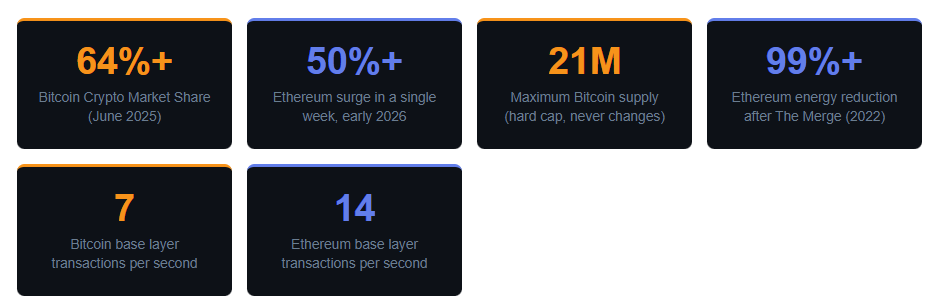
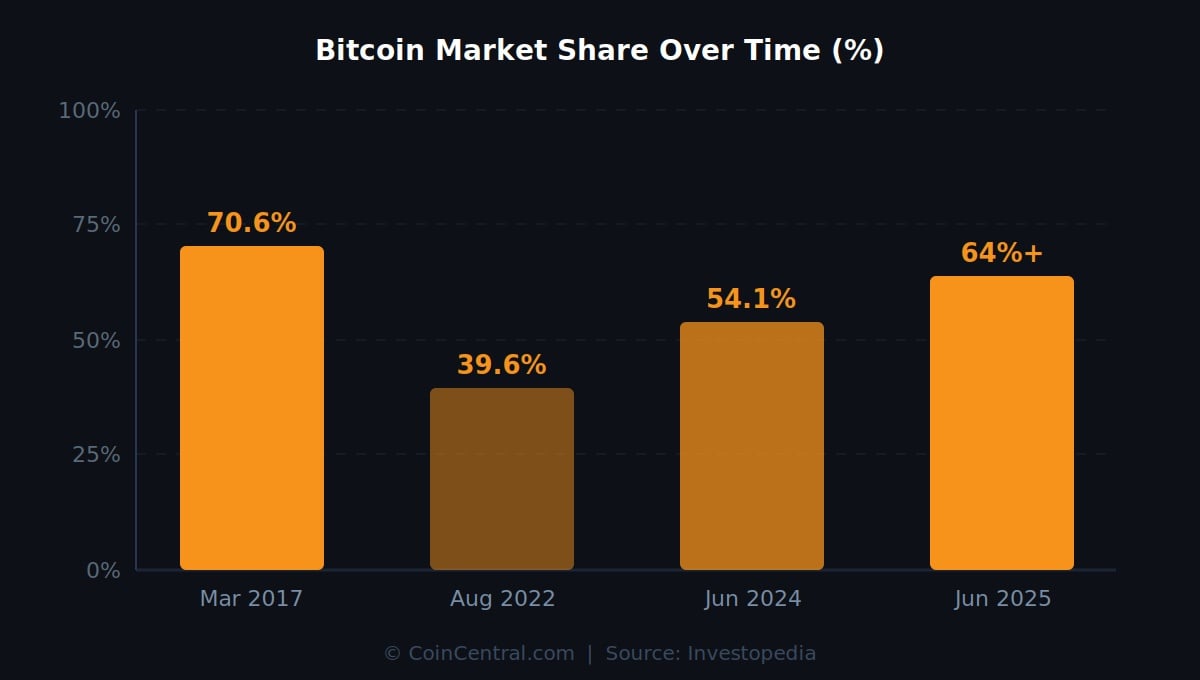
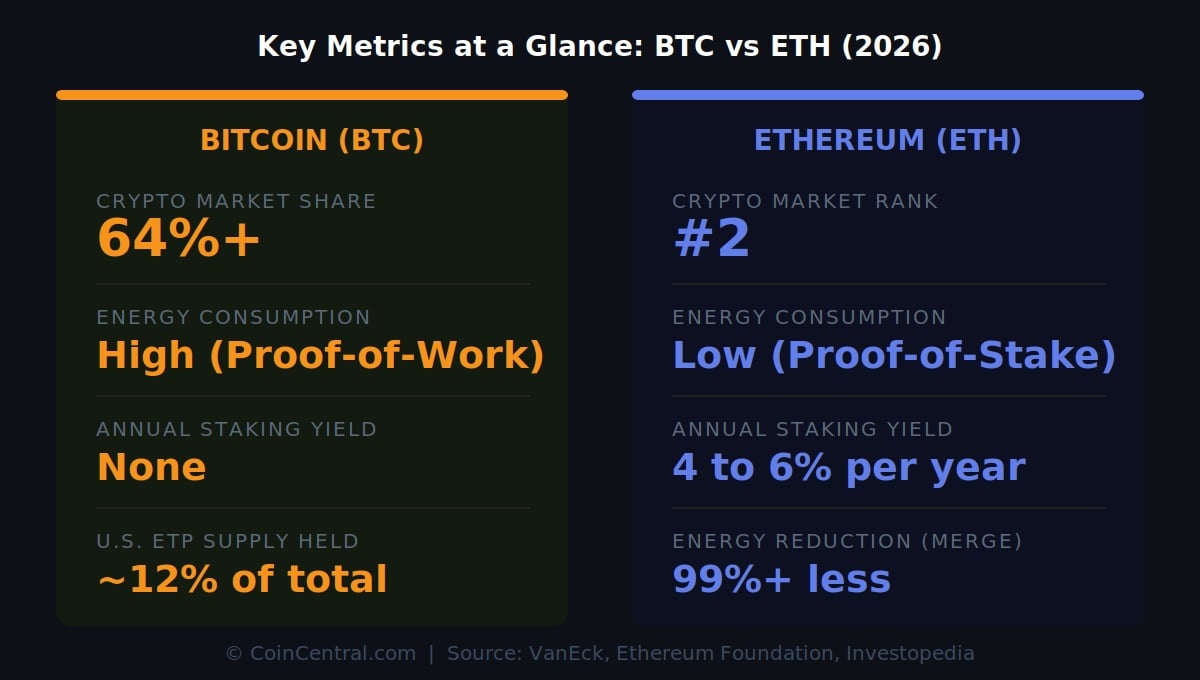
In March 2017, Bitcoin held 70.6% of the total crypto market. That share dropped to 39.6% by August 2022 as the ecosystem expanded with many new projects and tokens. It recovered to 54.1% by June 2024 and climbed above 64% by June 2025, according to data cited by Investopedia.
Ethereum consistently holds the second-largest market share. Its exact percentage changes with market conditions, but it has remained the clear number-two asset by total market capitalization for several years.
Bitcoin’s dominance tends to rise during periods of investor uncertainty. When markets become more cautious, capital tends to flow toward Bitcoin as the more widely held and established asset. This pattern has repeated across multiple market cycles.
| Period | Bitcoin Market Share |
|---|---|
| March 2017 | 70.6% |
| August 2022 | 39.6% |
| June 2024 | 54.1% |
| June 2025 | 64%+ |
Price Performance: BTC vs ETH
Bitcoin and Ethereum have both experienced wide price swings since they were created. They tend to follow the same broader market cycle, but the size of each move often differs by a large margin.
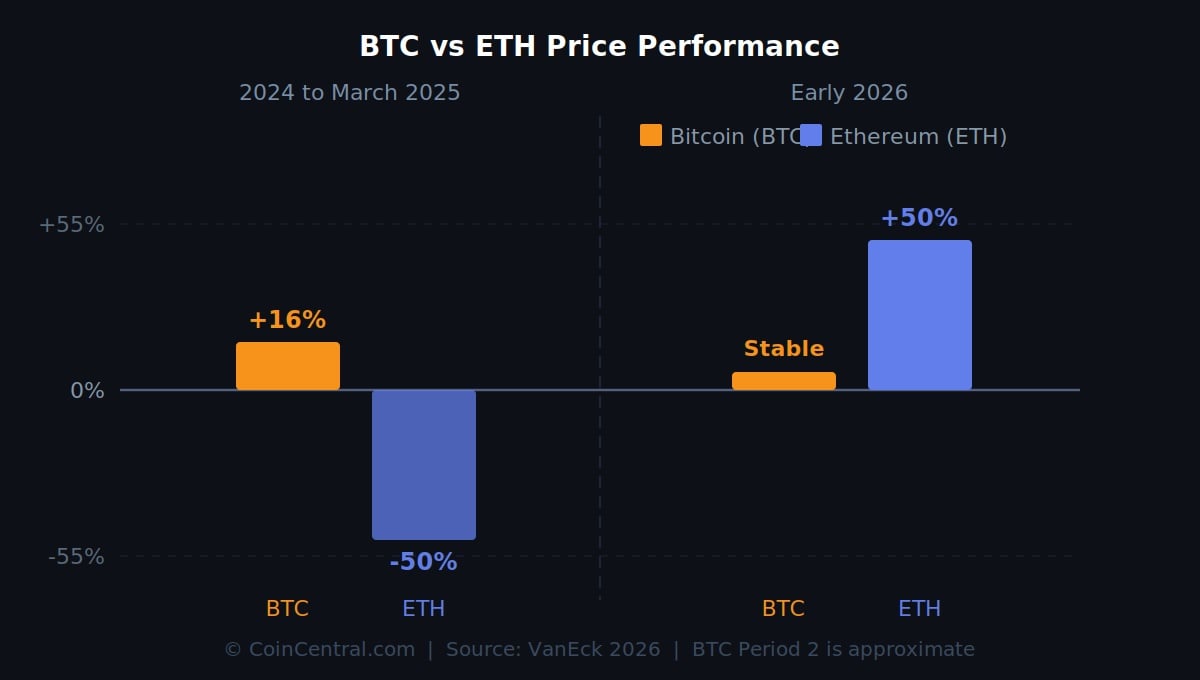
After Bitcoin’s fourth halving in April 2024 and the U.S. launch of spot Bitcoin exchange-traded products (ETPs), Bitcoin rose roughly 16% through March 2025. Ethereum fell nearly 50% during the same period, according to VanEck research. The gap reflects different levels of investor demand for the two assets during that stretch.
The picture shifted sharply in early 2026. Ethereum surged more than 50% in a single week, recovering a large portion of its earlier losses as macro conditions shifted and the ETH ecosystem attracted fresh attention.
Bitcoin has always traded at a higher price per coin than Ethereum. But looking at percentage returns across different timeframes tells a more complex story. During bull markets, Ethereum has historically posted higher percentage gains. During downturns, it has also seen steeper percentage drops.
Bitcoin tends to show lower volatility relative to other crypto assets across a market cycle, though it remains highly volatile compared to stocks or bonds.
Consensus Mechanisms
Bitcoin and Ethereum use different systems to agree on which transactions are valid. This choice affects energy use, security, and who can participate in securing the network.
Bitcoin uses proof-of-work (PoW). Miners run specialized computers called ASICs to solve cryptographic puzzles. The first machine to solve a puzzle adds the next block to the chain and earns newly issued bitcoin as a reward. This system has secured Bitcoin without interruption since 2009.
Ethereum switched to proof-of-stake (PoS) in September 2022, in an upgrade called the Merge. Validators lock up ETH to earn the right to propose and confirm new blocks. Acting dishonestly risks losing staked funds. This system uses far less energy than proof-of-work and achieves faster finality.
The Merge was one of the most technically demanding upgrades ever carried out on a live blockchain. It changed Ethereum’s core consensus layer without pausing the network or disrupting users.
| Feature | Bitcoin | Ethereum |
|---|---|---|
| Consensus method | Proof-of-Work (PoW) | Proof-of-Stake (PoS) |
| Participants | Miners | Validators |
| Hardware required | Specialized ASICs | Standard computer |
| Energy intensity | High | Low (post-Merge) |
| Time to finality | ~60 minutes (6 blocks) | ~15 minutes |
| Year adopted | January 2009 | September 2022 (The Merge) |
Transaction Speed and Throughput
The speed difference between Bitcoin and Ethereum at the base layer is one of the most-cited technical gaps between the two networks. It comes down to how often each chain produces a new block.
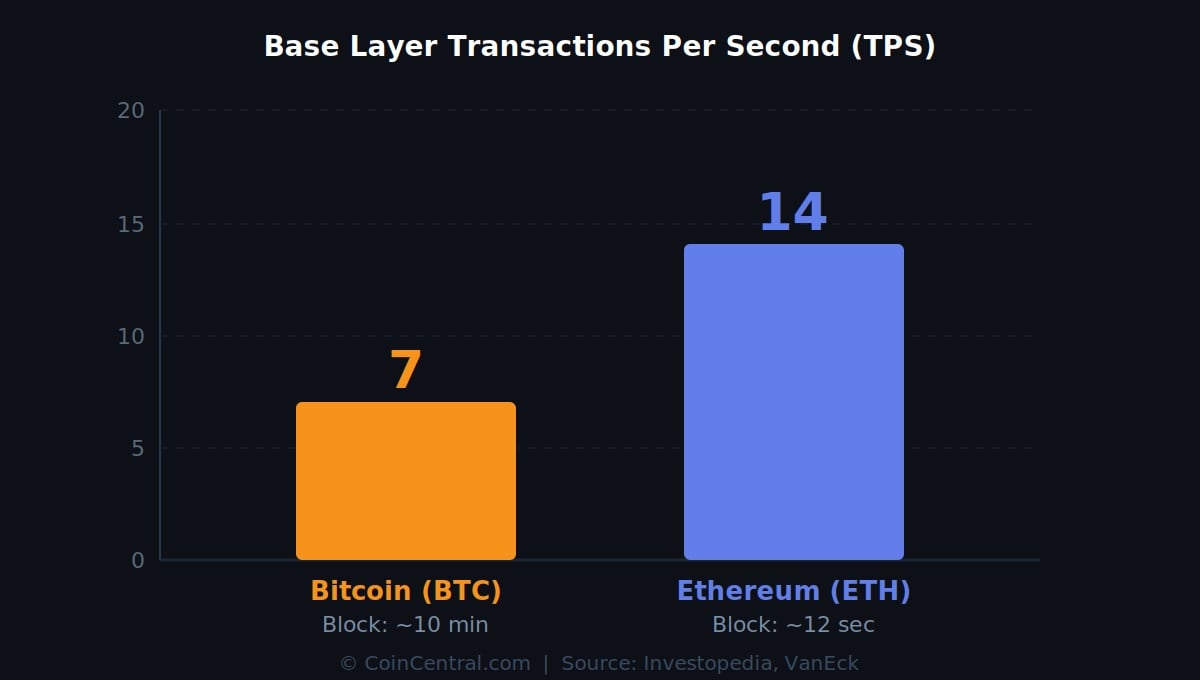
Bitcoin adds a new block roughly every 10 minutes. Ethereum adds one roughly every 12 seconds. That means Ethereum produces about 50 times more blocks per hour than Bitcoin at the base layer.
In terms of raw throughput, Bitcoin’s base layer handles around 7 transactions per second (TPS). Ethereum’s base layer handles roughly 14 TPS, about double Bitcoin’s rate.
Data from May 2025 puts the gap in perspective. Bitcoin created 157 blocks in a 24-hour period. Ethereum created 7,140 blocks in the same window, according to Investopedia. Ethereum processed nearly three times as many transactions during that day.
Both networks have built second-layer (Layer 2) solutions to handle more traffic without modifying their base chains. Bitcoin relies on the Lightning Network for fast, low-cost off-chain payments. Ethereum uses rollup networks including Arbitrum, Optimism, and Polygon to scale beyond its base layer limits.
| Metric | Bitcoin | Ethereum |
|---|---|---|
| Block time | ~10 minutes | ~12 seconds |
| Base layer TPS | ~7 | ~14 |
| Blocks per day (May 2025) | 157 | 7,140 |
| Time to finality | ~60 min (6 confirmations) | ~15 minutes |
| Main Layer 2 solution | Lightning Network | Arbitrum, Optimism, Polygon |
Supply and Monetary Policy
Bitcoin has a fixed maximum supply of 21 million coins. This limit is written into the protocol and cannot be changed without a hard fork, which would effectively create a new version of the blockchain. No more than 21 million bitcoin will ever exist.
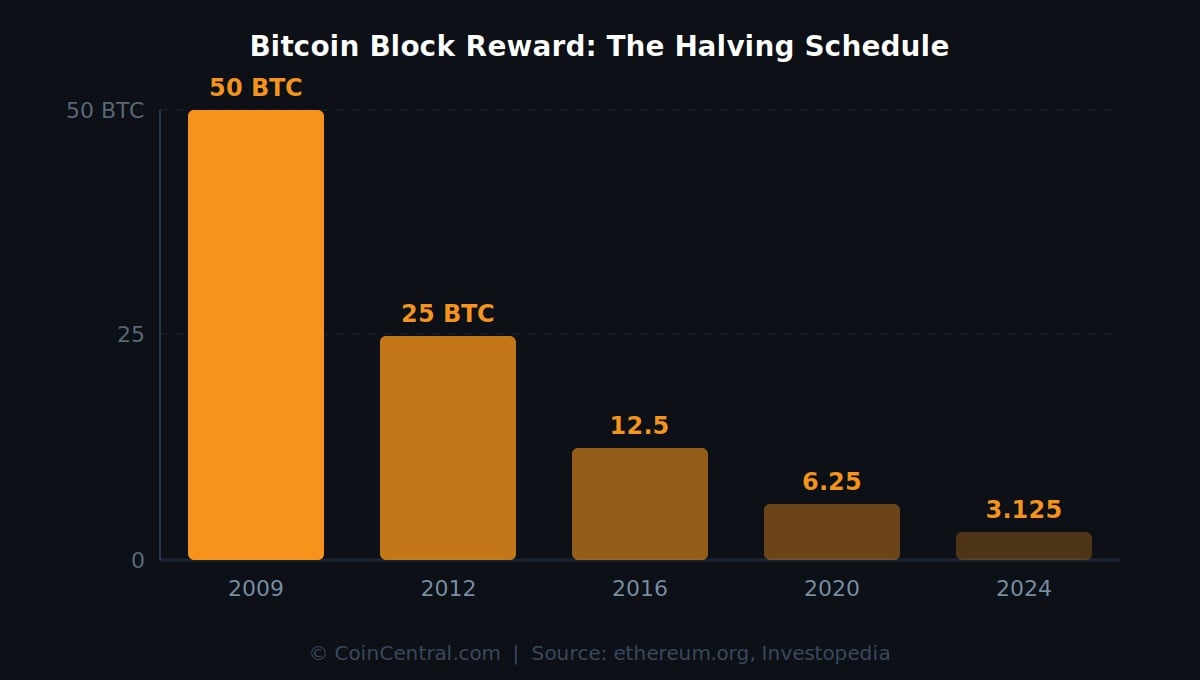
New bitcoin enters circulation through block rewards paid to miners. The protocol halves these rewards every 210,000 blocks, an event called the halving. This takes roughly four years. The reward started at 50 BTC per block in 2009, dropped to 25 BTC in 2012, 12.5 BTC in 2016, 6.25 BTC in 2020, and reached 3.125 BTC after the April 2024 halving. The last bitcoin is projected to be mined around the year 2140.
Ethereum has no fixed supply cap. Its monetary policy is governed by protocol rules that can be updated through community-approved Ethereum Improvement Proposals (EIPs). The EIP-1559 upgrade, introduced in August 2021, changed the fee structure by burning a portion of each transaction fee rather than paying it all to validators.
When Ethereum network activity is high, the amount of ETH burned can exceed the amount newly issued to validators. This reduces the total ETH supply over time. During quieter periods, supply may grow slightly. This flexible approach is a sharp contrast to Bitcoin’s fixed schedule.
Bitcoin’s long-term risk on this front is that as mining rewards fall toward zero, transaction fees must be high enough to compensate miners and keep the network secure. Currently, fees make up less than 5% of total miner income, according to Ethereum.org.
| Bitcoin Halving Event | Year | Block Reward |
|---|---|---|
| Genesis Block | 2009 | 50 BTC |
| First Halving | 2012 | 25 BTC |
| Second Halving | 2016 | 12.5 BTC |
| Third Halving | 2020 | 6.25 BTC |
| Fourth Halving | 2024 | 3.125 BTC |
| Feature | Bitcoin | Ethereum |
|---|---|---|
| Supply cap | 21 million BTC (hard limit) | No hard cap |
| Issuance model | Halving every ~4 years | Dynamic (staking rewards + EIP-1559 burns) |
| Block reward (post-2024 halving) | 3.125 BTC | Variable |
| Fee mechanism | Fees paid to miners | Base fee burned; tips go to validators |
| Deflationary potential | Yes (capped supply) | Yes (during high-activity periods) |
Energy Usage
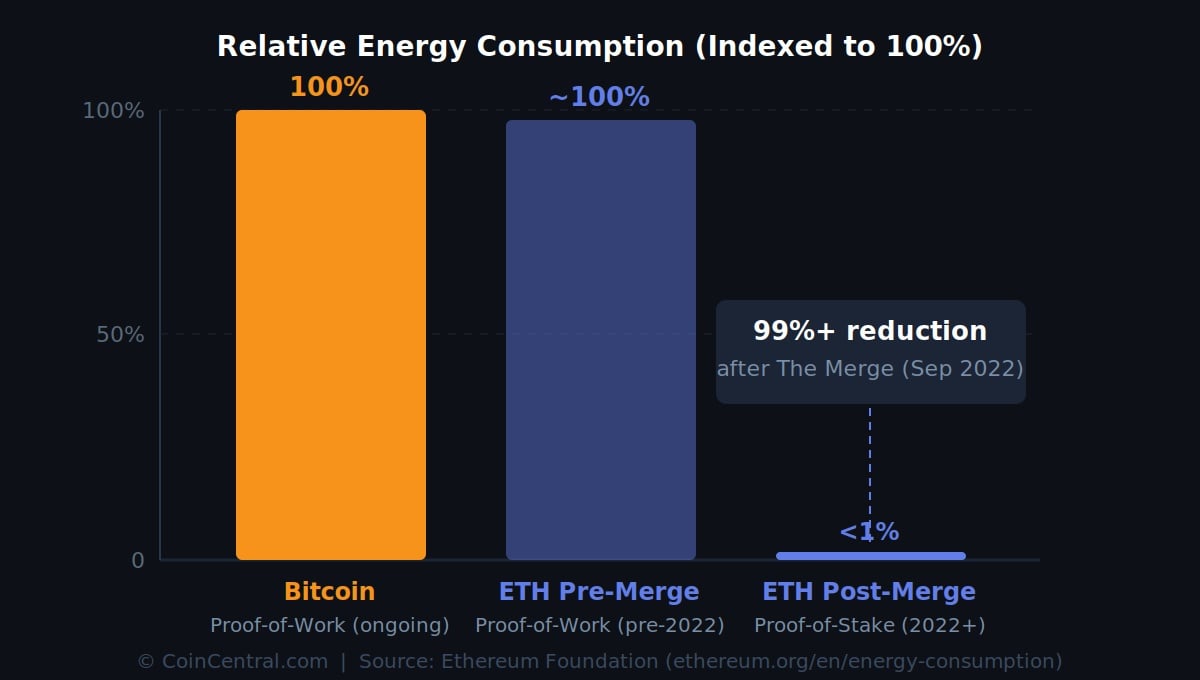
Bitcoin’s proof-of-work system is energy-intensive by design. Miners run specialized machines around the clock, competing to solve puzzles and earn block rewards. Total electricity demand rises as more mining hardware joins the network.
Some Bitcoin mining operations use renewable energy, including hydropower, solar, and flared natural gas from oil production. The Bitcoin community continues to discuss ways to reduce environmental impact. However, total electricity consumption remains high by most comparisons.
Ethereum’s energy profile changed dramatically in September 2022. The switch from proof-of-work to proof-of-stake, called the Merge, cut Ethereum’s energy consumption by more than 99%, according to the Ethereum Foundation. Validators no longer need to run energy-intensive hardware. A standard computer and a stable internet connection are sufficient.
This change made Ethereum one of the more energy-efficient large-scale blockchain networks in operation. For institutions and projects with environmental reporting requirements, this difference is a practical factor when choosing which network to build on or invest in.
Developer Ecosystem
Ethereum has one of the largest developer communities in the blockchain industry. A wide range of programming tools, libraries, and development frameworks are available to builders. The Ethereum Foundation runs grant programs, and independent hackathons attract new developers each year.
The Ethereum Virtual Machine (EVM) is a core piece of Ethereum’s architecture. It is the environment where smart contracts execute. The EVM has become an industry standard, and many other blockchains have built EVM compatibility so that developers can deploy the same code across multiple networks with minimal changes.
Token standards developed on Ethereum have shaped the wider crypto economy. ERC-20 is used for fungible tokens, including stablecoins and DeFi protocol tokens. ERC-721 is used for non-fungible tokens (NFTs). These standards allow tokens, wallets, and smart contracts to work reliably across different platforms and applications without custom integration work.
Bitcoin’s developer community is smaller but focused. Most of the work centers on maintaining the Bitcoin Core protocol and building Layer 2 tools like the Lightning Network. Changes to Bitcoin’s protocol move slowly and require broad community agreement. The Taproot upgrade in 2021 improved privacy and scripting capabilities after years of development and review before being activated.
Both ecosystems have attracted different types of contributors. Bitcoin draws developers focused on monetary properties and security. Ethereum draws developers building applications, protocols, and financial infrastructure.
Use Cases
Bitcoin’s primary use case in 2026 is as a store of value. Investors hold it as a long-term hedge against inflation and currency debasement. Some nation-states and corporate treasuries now hold bitcoin as a reserve asset. The Lightning Network enables faster, cheaper transactions for everyday use cases like payments and remittances.
Ethereum powers a wider range of applications. DeFi platforms like Uniswap and Aave allow users to lend, borrow, and trade without banks or brokers. NFT marketplaces run on Ethereum. Decentralized autonomous organizations (DAOs) use it for on-chain governance and treasury management.
Ethereum hosts most of the world’s major stablecoins, including USDC. This makes it a central network for moving digital dollars quickly and at low cost. Institutions are beginning to use Ethereum to tokenize real-world assets, including bonds and investment funds, according to VanEck.
In some cases, the two networks work together. Wrapped Bitcoin (wBTC) is an Ethereum-based token that represents bitcoin on the Ethereum network. This allows bitcoin holders to participate in Ethereum’s DeFi ecosystem without selling their BTC.
| Use Case | Bitcoin | Ethereum |
|---|---|---|
| Store of value | Primary use | Secondary use |
| Payments and transfers | Yes (Lightning Network) | Yes |
| Smart contracts | Limited scripting | Core functionality |
| Decentralized finance (DeFi) | No | Yes (Uniswap, Aave, etc.) |
| Non-fungible tokens (NFTs) | No | Yes |
| Stablecoins | No | Yes (USDC, DAI, etc.) |
| Real-world asset tokenization | No | Growing (bonds, funds) |
Institutional Adoption
Institutional interest in Bitcoin and Ethereum has grown steadily since 2020. The U.S. approval of spot Bitcoin ETPs in early 2024 was a turning point. These products allow traditional investors to gain Bitcoin exposure through standard brokerage accounts without directly holding cryptocurrency.
As of 2026, U.S. spot Bitcoin ETPs hold approximately 12% of the total Bitcoin supply, according to VanEck. Hedge funds, pension funds, and corporate treasuries have added Bitcoin to their holdings over the past two years.
Ethereum also has approved ETPs in the United States. Institutional interest in Ethereum is driven by its role as infrastructure for DeFi, tokenized assets, and stablecoin issuance. Ethereum’s proof-of-stake system allows validators and ETH holders to earn staking rewards of approximately 4% to 6% annually, an income component that Bitcoin does not offer.
Both assets are now discussed at central banks and included in institutional investment frameworks. A decade ago, both were held almost entirely by individual enthusiasts and early adopters. The shift to mainstream institutional participation has been one of the most consequential changes in crypto’s history.
Full Technical Comparison
| Feature | Bitcoin | Ethereum |
|---|---|---|
| Launch date | January 2009 | July 2015 |
| Creator | Satoshi Nakamoto | Vitalik Buterin et al. |
| Primary purpose | Digital currency, store of value | Platform for dApps and smart contracts |
| Consensus method | Proof-of-Work | Proof-of-Stake |
| Block time | ~10 minutes | ~12 seconds |
| Base layer TPS | ~7 | ~14 |
| Maximum supply | 21 million BTC (hard cap) | No hard cap |
| Energy use | High | Low (post-Merge 2022) |
| Smart contracts | Limited scripting | Full Turing-complete support |
| Staking rewards | None | ~4 to 6% annually |
| Main Layer 2 solution | Lightning Network | Arbitrum, Optimism, Polygon |
| Protocol change frequency | Rare, conservative | Frequent, iterative |
Future Outlook
Bitcoin’s near-term path is tied closely to its growing role as a reserve asset. The April 2024 halving reduced the rate of new supply entering the market. Historically, halvings have preceded price appreciation over the following year or two. Sovereign and corporate adoption of Bitcoin as a treasury asset continues to expand in 2026.
Bitcoin is unlikely to change in fundamental ways. Its protocol is conservative by design, and changes require broad community agreement. For supporters, this stability is the point. The long-term challenge is that as mining rewards approach zero, transaction fees must be high enough to keep the network secure.
Ethereum faces a more complex set of challenges. Its roadmap includes sharding, further rollup-centric scaling, and continued base layer improvements. The shift toward a rollup-first architecture raises questions about how much economic activity and fee revenue stays on the Ethereum base layer versus moving to Layer 2 networks.
Competition from high-throughput blockchains adds pressure to Ethereum. Solana and others have attracted developers and users looking for lower costs and faster speeds. How Ethereum handles fee capture, Layer 2 fragmentation, and this broader competition will help determine its role over the next several years.
For most investors and users, Bitcoin and Ethereum are not substitutes for each other. They were built for different purposes. The data shows they behave differently across market cycles, attract different types of participants, and serve different functions within a digital asset portfolio.
Sources
- Ethereum.org: Bitcoin vs Ethereum
- Investopedia: Bitcoin vs. Ethereum: Key Differences Explained, Nathan Reiff (March 2026)
- VanEck: Bitcoin vs Ethereum in 2026: Comparison and Outlook (March 2026)
- Ethereum.org: Ethereum Energy Consumption Report
- Ethereum.org: The Merge History
- EIP-1559: Fee Market Change for ETH 1.0 Chain
- Ethereum.org: Proof-of-Stake Consensus Mechanism


