






The number of people who own cryptocurrency has grown from around 420 million in 2024 to somewhere between 560 million and 770 million today. The gap between those two figures reflects how difficult this data is to collect, not a disagreement about whether growth is happening.
No central authority tracks crypto wallets by country. Transactions are pseudonymous by design. Every ownership estimate is built from a mix of exchange data, on-chain analytics, and consumer surveys. Different methods produce different totals.
This article brings together data from TripleA, GWI, Crypto.com, the Chainalysis Global Adoption Index, and a 2026 European Central Bank working paper covering 17 euro area countries. The aim is to present what the data shows, where sources agree, and where they diverge. All country-level figures are estimates and should be treated as directional rather than exact.
How Many People Own Crypto Worldwide?
The two most widely cited global estimates for 2026 come from TripleA and Crypto.com. TripleA puts the total at roughly 560 million people, or about 6.8% of the world’s population. Their 2024 global ownership study combines on-chain data with exchange user numbers and survey inputs, normalized by country. For comparison, the same measure stood at around 4.2%, or 420 million people, just two years earlier.
Crypto.com’s H1 2026 market sizing report gives a higher figure of around 770 million owners. Of those, 373 million hold Bitcoin, accounting for 48.3% of all crypto owners. Another 191 million hold Ethereum, about 24.7% of owners. Bitcoin ownership grew 2.5% in the first half of 2026 while Ethereum ownership grew 9.1%.
The difference between the two estimates comes from counting method, not market divergence. TripleA tries to avoid double-counting people who hold multiple assets. Crypto.com counts holders of each asset separately, producing a higher total. Both series are consistent within themselves over time, which means their growth rates are more reliable than any headline total.
| Source | Estimated Owners | % of World Pop. | Bitcoin Holders | Data Period |
|---|---|---|---|---|
| TripleA | ~560 million | ~6.8% | Not specified | 2024 study |
| Crypto.com | ~770 million | ~9.4% | ~373 million (48.3%) | H1 2026 |
Sources: TripleA Global Crypto Ownership Data; Crypto.com H1 2026 Market Sizing Report.

One group missing from both figures: ETF investors. Crypto.com estimates that between 300,000 and 1.3 million investors hold Bitcoin or Ethereum through US spot ETFs without holding the underlying assets in a personal wallet. These holders do not show up in most ownership surveys.
Top Countries by Total Crypto Owners
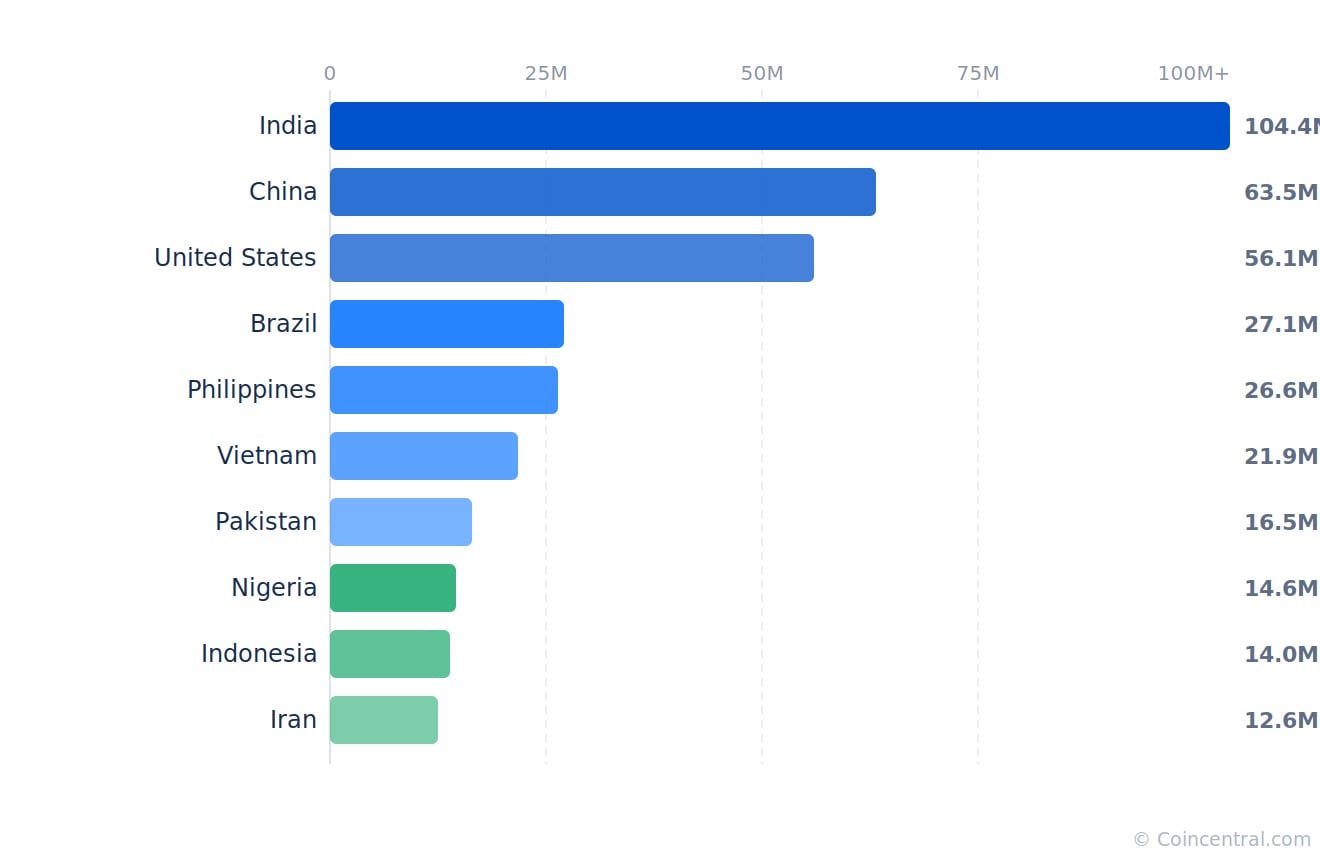
When ranked by total number of owners, India, China, and the United States take the top three spots. This reflects large populations and active retail investor bases in each country. The figures below come from TripleA’s ownership study, based on 2024 data.
India leads with an estimated 104.4 million owners, about 7.2% of its population. The country has a fast-growing base of retail investors and strong interest in digital finance among younger age groups. India also generates some of the highest search volume for crypto keywords globally, as covered in a later section.
China ranks second at roughly 63.45 million. This is despite the fact that most forms of crypto trading and mining have been legally prohibited there since 2021. Most activity is thought to continue through VPNs and peer-to-peer channels. The United States comes in third at around 56.1 million owners, representing about 16.5% of the population.
Two Southeast Asian nations rank higher than their economic size might suggest. Vietnam (21.89 million) and the Philippines (26.55 million) both appear in the top six. Both countries have seen wide adoption driven by blockchain-based gaming platforms, particularly Axie Infinity, which was created by Vietnamese studio Sky Mavis. Vietnam topped the Chainalysis Global Crypto Adoption Index in both 2021 and 2022.
Brazil is the largest crypto market in Latin America at 27.1 million owners (12.5% of the population). Many Brazilians cite currency devaluation against the US dollar as a driver. Iran rounds out the top 10 at 12.6 million owners (14% of the population). High inflation, a weak currency, and international sanctions have pushed many Iranians toward Bitcoin and stablecoins as financial alternatives.
Nigeria (14.63 million) and Indonesia (14 million) also make the list. Nigeria has one of Africa’s most active crypto communities, partly because of limited access to traditional banking and persistent currency pressure. Indonesia is a large emerging market with a young, mobile-first population and growing interest in digital finance.
| Rank | Country | Estimated Owners | % of Population |
|---|---|---|---|
| 1 | India | 104.4M | 7.2% |
| 2 | China | 63.45M | 4.5% |
| 3 | United States | 56.1M | 16.5% |
| 4 | Brazil | 27.1M | 12.5% |
| 5 | Philippines | 26.55M | 22.5% |
| 6 | Vietnam | 21.89M | 22.0% |
| 7 | Pakistan | 16.52M | 6.8% |
| 8 | Nigeria | 14.63M | 6.5% |
| 9 | Indonesia | 14.0M | 5.0% |
| 10 | Iran | 12.6M | 14.0% |
Source: TripleA Global Crypto Ownership Data (2024 study). Figures are estimates and should be treated as directional.
Crypto Adoption Rates: Which Countries Lead by Percentage?
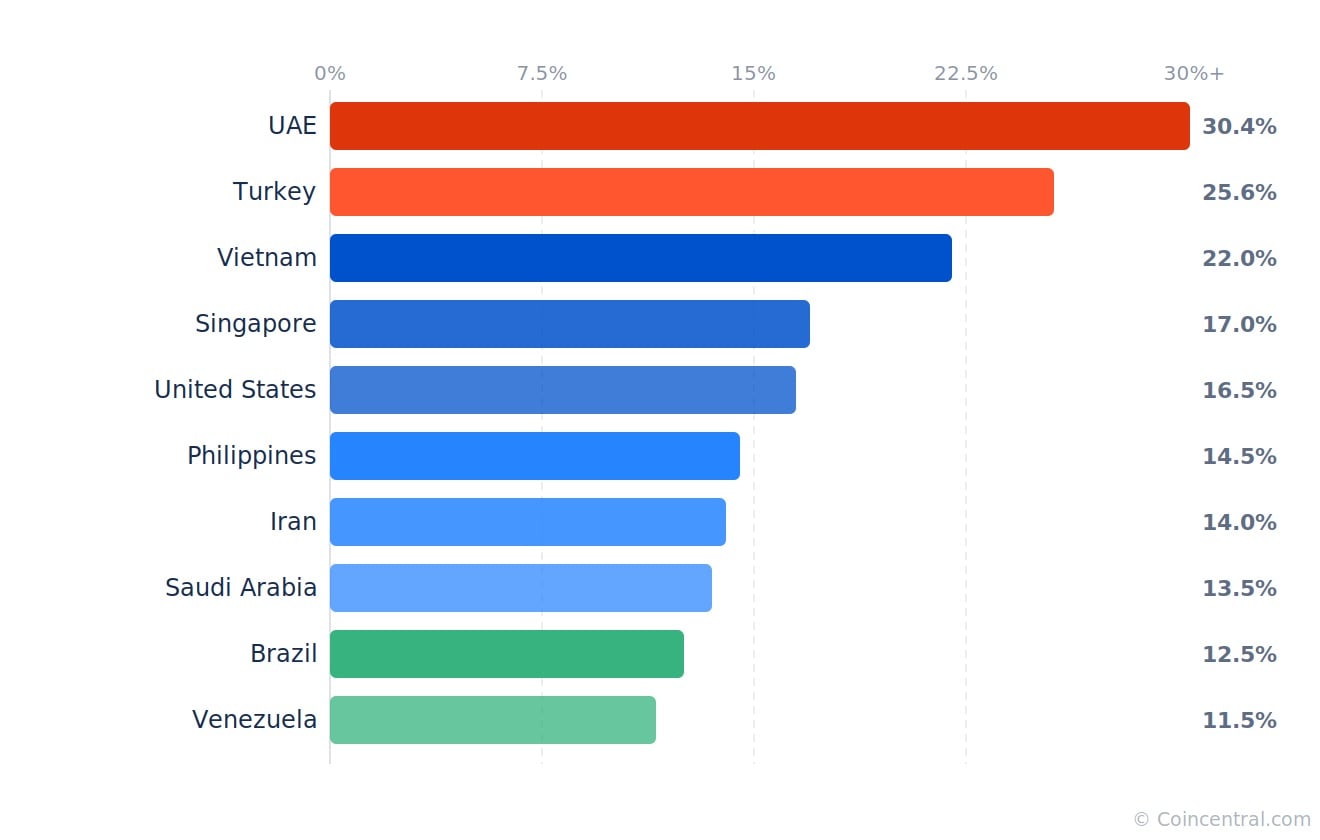
Ranking countries by the share of the population that owns crypto tells a different story. GWI, which surveys more than 700,000 internet users per year, tracks ownership as a percentage of each country’s internet-using population. The top of this list is dominated by countries where currency instability or regulatory clarity have driven faster adoption.
The United Arab Emirates leads at around 30.4% of internet users. About 49% of UAE residents describe themselves as “crypto curious,” meaning they see it as a future investment even if they have not yet bought any. The country has a clear regulatory framework, a high proportion of high-income residents, and strong tech adoption. Crypto is legal to hold and trade, though it cannot be used directly as a payment method without conversion.
Turkey ranks second at 25.6%. Persistent lira inflation over the past decade has eroded purchasing power steadily, pushing many Turkish citizens toward Bitcoin and USD-pegged stablecoins to protect their savings. Vietnam (22%) is third, driven by its gaming culture and platforms like Binance and Remitano that make trading accessible.
Singapore (17%) and the United States (16.5%) are the two high-income entries in the top five. Both have clear legal frameworks for crypto and near-universal internet access. Venezuela (11.5%) rounds out the bottom of the top 10 as a result of severe currency collapse, not technological enthusiasm. For many Venezuelans, crypto is a necessity rather than an investment choice.
There is a key methodological point here. GWI measures percentages against the internet-using population, not total population. Countries with near-universal internet access will rank higher in this measure than in population-based rankings. The Philippines, for example, appears at 22.5% in TripleA’s population-based data but 14.5% in GWI’s internet-user data. That gap in a single country shows why any country-level ranking should be read as a range.
| Rank | Country | % of Internet Users Owning Crypto | Est. Owners |
|---|---|---|---|
| 1 | United Arab Emirates | 30.4% | ~3.25M |
| 2 | Turkey | 25.6% | ~21.5M |
| 3 | Vietnam | 22.0% | ~21.9M |
| 4 | Singapore | 17.0% | ~980K |
| 5 | United States | 16.5% | ~56.1M |
| 6 | Philippines | 14.5% | ~16.5M |
| 7 | Iran | 14.0% | ~12.6M |
| 8 | Saudi Arabia | 13.5% | ~4.5M |
| 9 | Brazil | 12.5% | ~27.1M |
| 10 | Venezuela | 11.5% | ~3.3M |
Source: GWI Research (online surveys of 700,000+ internet users annually). Percentages reflect the internet-using population, not total population.
Search Interest by Country
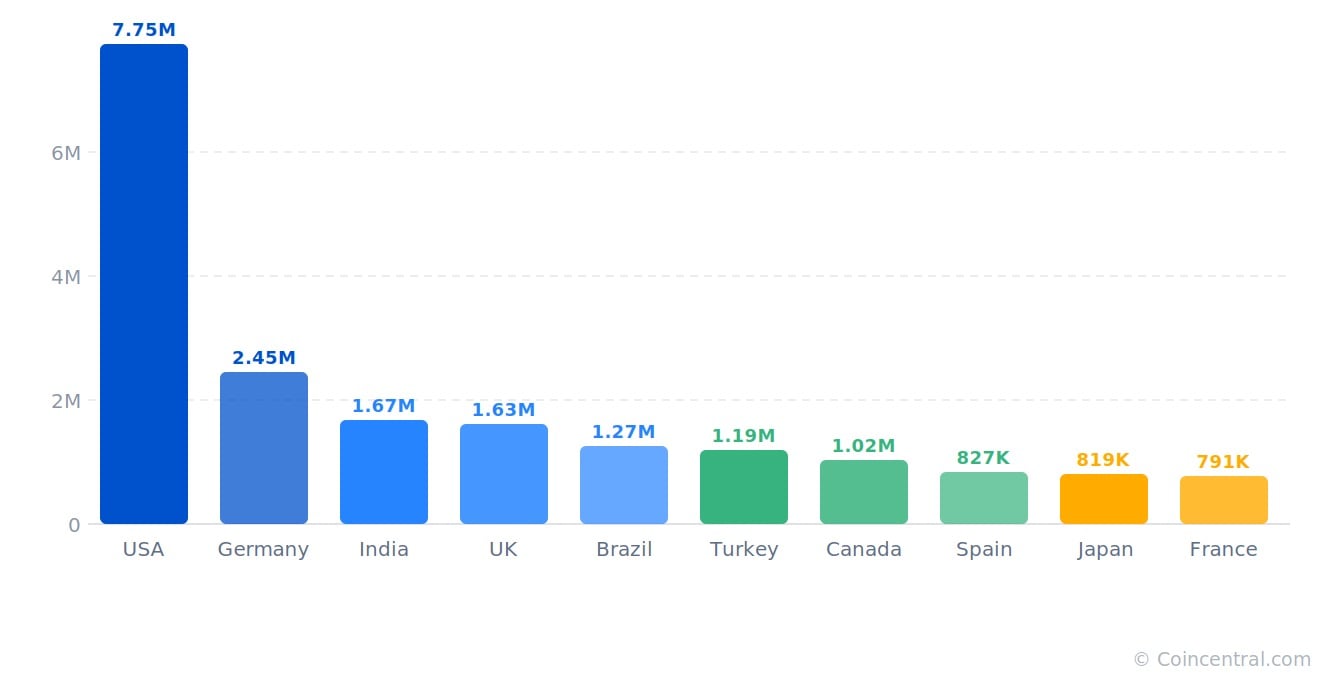
Google search volume for crypto-related keywords is another way to gauge where interest is highest. Research firm Ahrefs tracked monthly searches for “Bitcoin,” “Bitcoin price,” “cryptocurrency,” and “crypto wallet” across dozens of countries in September 2026.
The United States leads by a large margin with 7.75 million monthly searches across those four terms. That is more than three times the volume of second-place Germany (2.45 million). Germany’s high search interest sits alongside a relatively modest ownership rate, suggesting an audience that is curious but has not fully converted to holding assets.
India and the United Kingdom rank third and fourth at 1.67 million and 1.63 million searches per month. Brazil (1.27M), Turkey (1.19M), and Canada (1.02M) each cross the one million mark, bringing the number of countries with seven-figure monthly search volumes to seven.
China was excluded from this analysis. Its 2021 ban on crypto trading makes Google search data unreliable there, as activity runs through VPNs and the local Baidu search engine. Russia and South Korea were treated with similar caution because local search engines hold a large share in both markets, understating true interest levels in Google data alone.
| Rank | Country | Monthly Searches (4 Keywords) |
|---|---|---|
| 1 | United States | 7,750,000 |
| 2 | Germany | 2,450,000 |
| 3 | India | 1,670,000 |
| 4 | United Kingdom | 1,630,000 |
| 5 | Brazil | 1,270,000 |
| 6 | Turkey | 1,190,000 |
| 7 | Canada | 1,020,000 |
| 8 | Spain | 827,000 |
| 9 | Japan | 819,000 |
| 10 | France | 791,000 |
Source: Ahrefs, September 2026. Keywords: “Bitcoin,” “Bitcoin price,” “cryptocurrency,” “crypto wallet.”
Institutional Bitcoin Holdings
Retail holders are only part of the picture. Since the US approved spot Bitcoin ETFs in January 2024 and spot Ethereum ETFs later that year, a growing share of crypto has moved into regulated investment products and corporate balance sheets rather than personal wallets.
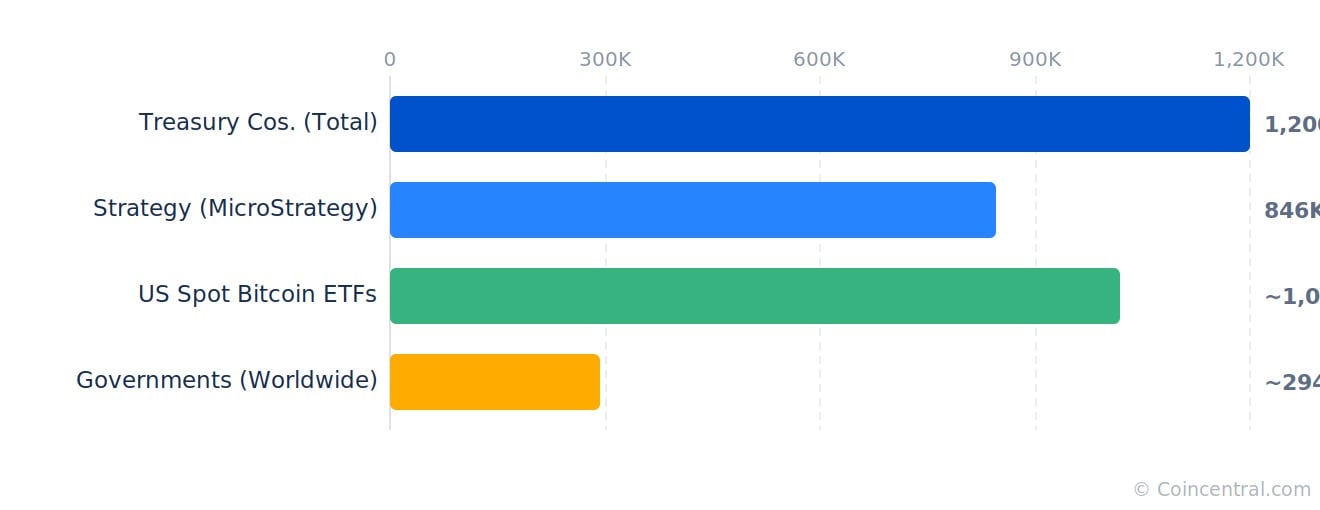
By June 2026, digital asset treasury companies held more than 1.2 million BTC combined. That represents over 6% of all Bitcoin in circulation. Strategy, formerly known as MicroStrategy, is the single largest corporate holder. The firm reported around 846,000 BTC as of June 30, 2026, making up roughly 70% of all corporate treasury Bitcoin on its own.
US spot Bitcoin ETFs held roughly 5.2% of circulating Bitcoin supply as of February 2026. This figure reflects how quickly institutional products have absorbed available supply since their approval. Governments worldwide hold about 1.5% of supply, mostly through assets seized in criminal investigations. The United States is the single largest government holder.
Stablecoins are also a growing part of this institutional picture. Latin America has become one of the largest stablecoin remittance corridors in the world. Countries like Mexico, Brazil, Colombia, and El Salvador show high stablecoin transaction volumes for cross-border transfers, which settle faster and cost less than traditional wire services.
These institutional figures matter for how you read the country ownership tables. Survey-based estimates count people, not coins. The United States can appear relatively modest in per-capita ownership rates while controlling an outsized share of the total value through ETFs and corporate treasuries.
| Holder Type | Est. BTC Held | % of Circulating Supply | Notes |
|---|---|---|---|
| All digital asset treasury companies | 1,200,000+ | 6%+ | June 2026 figure |
| Strategy (formerly MicroStrategy) | 846,000 | ~4.3% | Largest single corporate holder |
| US spot Bitcoin ETFs | ~1,020,000 | ~5.2% | February 2026 figure |
| Governments worldwide | ~294,000 | ~1.5% | Mostly held through seizures |
Source: Crypto.com H1 2026 Market Sizing Report. Circulating supply estimated at approximately 19.6 million BTC.
Who Owns Crypto? A Demographic Breakdown
A 2026 European Central Bank working paper provides some of the most detailed demographic data available on crypto ownership. The study used survey responses from 39,507 adults across 17 euro area countries, collected in 2022 through the ECB’s Study on the Payment Attitudes of Consumers in the Euro Area (SPACE). The paper was authored by Alejandro Zamora-Pérez of the ECB.
The average crypto owner in the study was about 10 years younger than the average respondent. Crypto owners averaged 38.97 years versus 48.78 for the overall sample. Younger generations, particularly Millennials and Gen Z, made up the largest share of owners across all 17 countries surveyed. The researchers found high variability between countries, but the generational pattern held broadly.
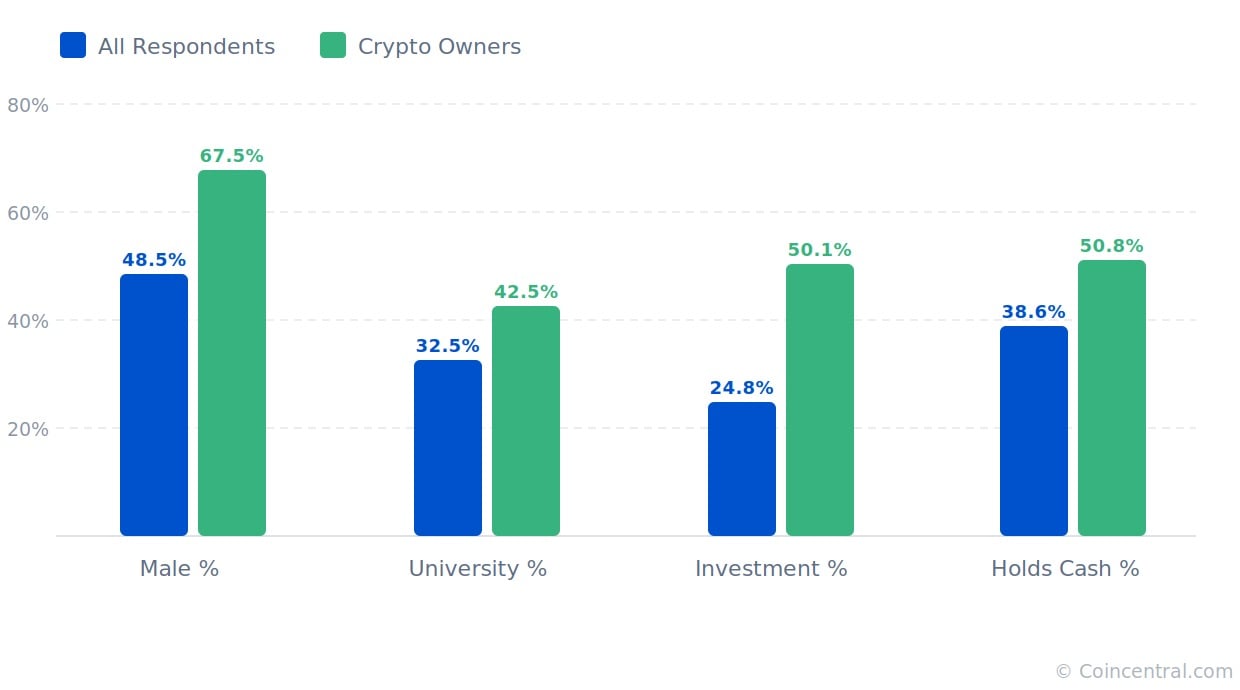
There is also a clear gender gap. While 48.5% of the overall sample was male, 67.5% of crypto owners were male. This gap held even after the researchers controlled for income and education levels. The ECB paper noted that similar gaps have been found in studies from Canada, Japan, and Austria.
Crypto owners were twice as likely as the general population to hold other financial investments. About 50.1% of crypto owners held stocks, bonds, or other instruments, compared to 24.8% of all respondents. This places crypto firmly in the category of supplementary investment choice rather than a replacement for traditional finance.
One finding that challenges common assumptions: crypto owners were more likely to hold physical cash reserves than the average respondent, not less. Around 50.8% of crypto owners kept cash at home, compared to 38.6% of all adults in the survey. The ECB researchers suggest this points to a portfolio-based approach, where both digital assets and physical cash coexist as different types of protection.
| Characteristic | All Respondents | Crypto Owners | Crypto Payers |
|---|---|---|---|
| Average age | 48.78 | 38.97 | 38.51 |
| Male | 48.5% | 67.5% | 63.3% |
| University graduate | 32.5% | 42.5% | 39.1% |
| Has financial investment | 24.8% | 50.1% | 43.9% |
| Holds cash reserves at home | 38.6% | 50.8% | 51.4% |
| Uses internet daily | 85.0% | 91.8% | 85.8% |
| Has online banking | 59.9% | 76.4% | 72.9% |
| Has payment card | 91.4% | 92.0% | 87.5% |
Source: ECB Working Paper No. 3215, Zamora-Pérez (2026). Data from ECB SPACE survey 2022. Sample: 39,507 adults across 17 euro area countries. “Crypto payers” are those who reported using crypto for payments.
Crypto Owners vs. Crypto Payers
The ECB study makes a clear distinction between people who own crypto and those who actually use it to pay for things. Across 17 euro area countries, about 4.4% of adults reported owning crypto. Only around 1.4% said they used it to pay for goods or services. That gap between ownership and payment use is a consistent finding across multiple countries and studies.
The ECB researchers found that these two groups have fundamentally different motivations. Crypto owners tend to value both the speed of card payments and the privacy of cash. They hold diversified portfolios and treat crypto as an investment alongside other financial instruments. Crypto payers, the smaller group, are driven by cash-like features: privacy, ease of use, and the ability to transact without third-party oversight.
The study also tested what happens during periods of economic stress. Using the COVID-19 pandemic as a natural experiment, the researchers found that people who built precautionary cash savings during the crisis were about 10 percentage points less likely to own crypto. In calmer times, cash and crypto tend to coexist in portfolios. When uncertainty rises, households move toward central bank-issued money and away from volatile digital assets. This substitution effect was also visible in aggregate market data: during the March 2020 shock, euro currency demand rose while Bitcoin’s market cap fell.
Why People Use Crypto
The reasons people buy crypto depend heavily on where they live and what their local financial system looks like. In countries with stable currencies and developed banking infrastructure, the most common driver is price speculation. In economies with weaker conditions, the motivations often go deeper.
Inflation protection is a primary driver in Turkey, Argentina, Nigeria, and Venezuela. Bitcoin’s fixed supply schedule makes it a long-term inflation hedge for many buyers. USD-pegged stablecoins have become especially popular in countries with declining local currencies because they offer dollar-denominated savings without needing a US bank account.
Remittances are another major use case. Research from the Stellar Development Foundation suggests about 25% of US remittance payments to other countries now use some form of crypto. Cross-border transfers via blockchain settle faster and cost less than traditional wire services. Latin America is now one of the largest stablecoin remittance corridors in the world.
Blockchain-based gaming brought millions of new users into the crypto ecosystem, particularly in the Philippines and Vietnam. Axie Infinity, built by Vietnamese studio Sky Mavis, became so widely played in the Philippines that the Bureau of Internal Revenue introduced specific crypto tax rules for Axie players in 2021. Play-to-earn games lowered the barrier to entry by letting users earn crypto through gameplay rather than purchasing it outright.
Financial access is a factor in parts of Africa and Southeast Asia, where large portions of the population do not hold bank accounts. Crypto wallets can be set up with only a smartphone and internet connection, offering a way to store and move money that traditional banking has not reached. Nigeria, Uganda, Kenya, and Tanzania all appear in global adoption data partly for this reason.
In countries like the US, UK, and Germany, portfolio diversification and price speculation account for most purchases. Investors treat crypto as a high-risk asset similar to early-stage technology stocks. DeFi (decentralized finance) platforms also attract users who want to earn yield on crypto holdings through lending and liquidity provision, though DeFi activity has remained primarily in the hands of more experienced crypto users.
Crypto in Emerging Markets vs. Developed Nations
Unlike most technology adoption patterns, where wealthy countries tend to lead, crypto adoption is more evenly distributed across income levels. The Chainalysis Global Adoption Index weights data by purchasing power parity. In its rankings, the only two high-GDP-per-capita nations in the global top 20 were the United States and the United Kingdom.
This spread happens because crypto requires only an internet connection and provides a stronger value proposition in countries where the local financial system is weaker or more restricted. A person in Turkey or Argentina gains more from holding Bitcoin than a person in Switzerland does, because the alternative in those countries is a currency losing value each year.
The United Nations has pointed to two main reasons crypto adoption runs higher in lower-income countries: remittance payments and inflation hedging. Both uses depend on the domestic alternative being worse, which it often is in nations with capital controls, high inflation, or limited access to banking services. As mobile internet access expands into previously underserved regions, adoption in those areas is expected to grow further.
Conclusion
Global crypto ownership has grown from around 420 million people two years ago to somewhere between 560 million and 770 million today, depending on which source and methodology you use. The data points to a consistent picture for 2026 across the three main measures: total owners, adoption rates, and search interest.
India, China, and the United States lead by absolute number of owners. The UAE, Turkey, and Vietnam lead by share of the internet-using population. The United States dominates Google search volume. And institutional holders now control a growing share of the Bitcoin supply through ETFs and corporate treasuries, with over 6% of supply held by treasury companies and another 5.2% held by US spot ETFs.
Adoption drivers split clearly by economic context. Currency instability pushes adoption in Turkey, Argentina, Nigeria, and Venezuela. Regulatory clarity and tech infrastructure drive it in the UAE and Singapore. Gaming culture and remittance needs drive it in Vietnam, the Philippines, and El Salvador. Demographics point consistently toward younger, more financially active males, though that gap may narrow as crypto products become more mainstream.
What stays consistent across all the data is that most crypto owners treat it as an investment, not a currency. The ECB’s euro area study found fewer than 1.5% of adults use crypto for payments. Whether that changes will depend on regulatory clarity, the wider acceptance of stablecoins as payment tools, and how institutional products shape the next wave of adoption.
Sources
- TripleA: Global Crypto Ownership Data (2024 global ownership study)
- Crypto.com: H1 2026 Global Crypto Market Sizing Report
- GWI Research: Global Consumer Survey Data on Crypto Ownership
- Chainalysis: 2025 Global Crypto Adoption Index
- Ahrefs: Keyword Search Volume Data, September 2026
- ECB Working Paper No. 3215: “Who owns crypto in the euro area? Drivers of crypto adoption, payment use, and its interaction with fiat cash” — Zamora-Pérez, Alejandro (2026)
- Investing in the Web: Crypto Ownership and Interest by Country Report 2026
- CoinCentral: Bitcoin Ownership by Country 2026 — Global Crypto Adoption Index Data
- Stellar Development Foundation: Remittance and Crypto Payment Data


