






TLDR
- Crypto liquidations reached $1.47 billion in 24 hours, affecting 175,687 traders.
- Bitcoin made up $783.12 million of the total, and Ethereum added $259.65 million.
- Long positions were 89.2% of all liquidations.
- Hotter US inflation data and ETF outflows weighed on prices.
- Bitcoin fell below $70,000 and Ethereum slid under $2,000 on Friday, November 13.
Bitcoin dropped below $70,000 on Friday, November 13. Ethereum fell under $2,000 on the same day. The moves set off a wave of forced closures on crypto exchanges.
CoinGlass data shows about $1.47 billion in leveraged positions were liquidated in 24 hours. The figure covers 175,687 traders.
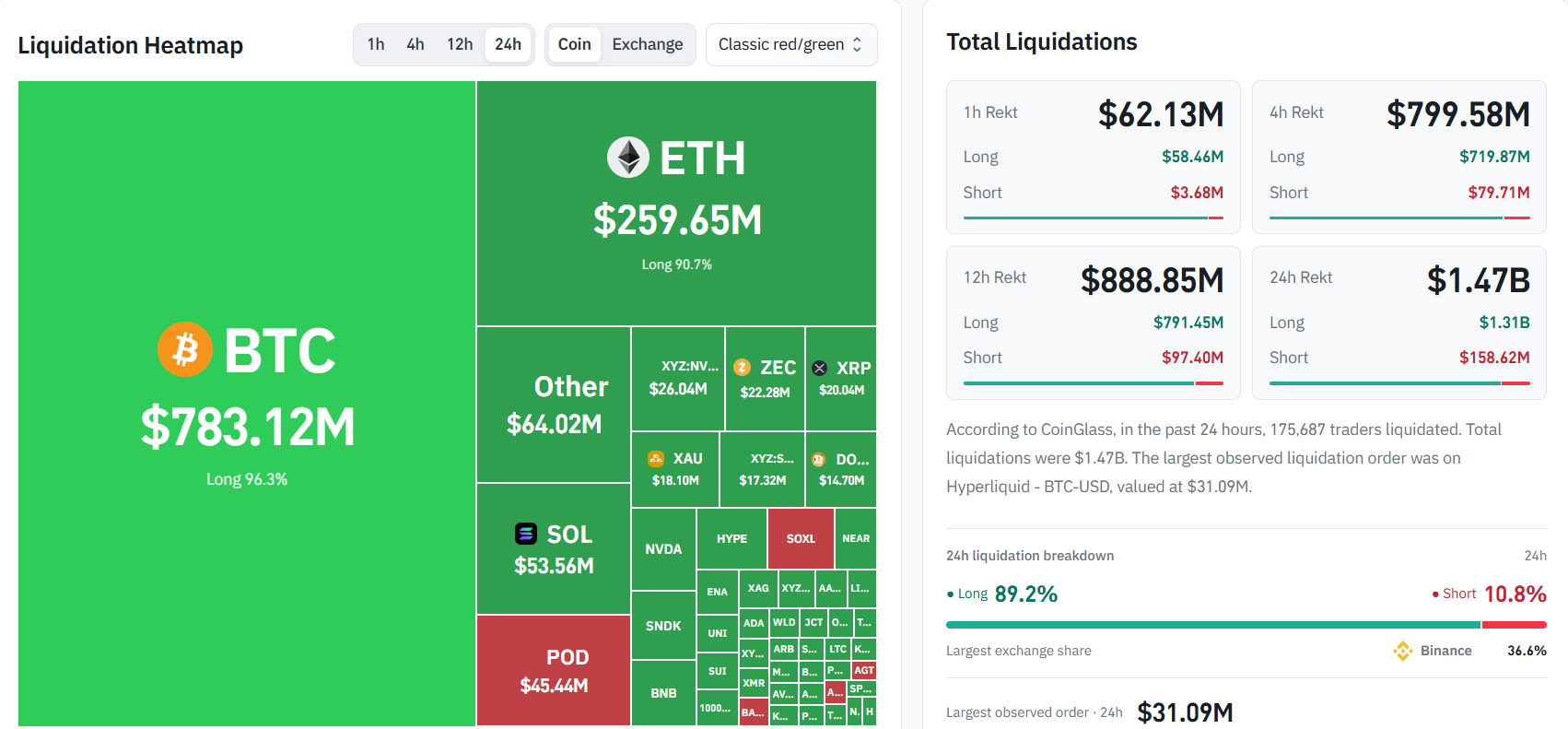
Most of the damage fell on traders betting that prices would rise. Long positions made up about $1.31 billion of the total, while short positions made up $158.62 million.
Where the Liquidations Hit Hardest
Bitcoin accounted for $783.12 million of the forced closures. Long positions made up 96.3% of that amount.
Ethereum followed with $259.65 million, and about 90.7% of it came from longs. Solana saw $53.56 million in liquidations. Zcash recorded $22.28 million, and XRP recorded $20.04 million.
The pace was fast. CoinGlass logged $799.58 million in liquidations in the last four hours alone, with $719.87 million coming from long positions. Over 12 hours, the total was $888.85 million.
The largest single liquidation took place on Hyperliquid. A Bitcoin position worth $31.09 million was closed by force. Binance had the biggest exchange share of liquidations at 36.6%.

What Pushed Prices Lower
US inflation data released earlier this week showed consumer prices rose 0.4% in October. That was higher than economists expected.
🇺🇸 Bitcoin BROKE below $70K for the first time in 3 months
Rising bond yields and hot inflation data kept pressure on the Fed, while spot Bitcoin ETFs saw over $2.5B in outflows in two weeks.
After BTC broke $70K, more than $1B in leveraged long positions were liquidated.… pic.twitter.com/JglgxZnd8f
— Mario Nawfal (@MarioNawfal) November 13, 2026
The reading raised concerns that the Federal Reserve could raise interest rates again in December. Higher rates tend to reduce demand for assets that carry more risk, such as crypto.
Fund flows also turned weaker. Trading firm Talos reported that US spot Bitcoin ETFs saw about $1.66 billion in net outflows over 30 days. Of that, $684 million left in the past week.
Stablecoin supply also shrank by about $2.15 billion over seven days. That points to less cash available in crypto markets.
Technology stocks have also been weak, which added to worries about risk assets.
How Forced Closures Feed on Themselves
A liquidation happens when a trader’s collateral falls too low to support a leveraged position. The exchange then closes the trade automatically.
A trader using 10x leverage can lose a large part of their margin on a small price move. When many traders hit that point together, the forced selling can push prices down further.
Lower prices can then trigger more liquidations. Talos said Bitcoin’s order-book depth was well below its recent average. Thin books make prices more sensitive to large sell orders.
Bitcoin is now at its lowest level since August. Ethereum and other major coins have also posted sharp losses.
Traders are watching the next US producer inflation report. It may offer more clues about the Fed’s December rate decision.


