






TLDR
- Bitcoin traded near $59,023 on Sunday, up 1.8% after failing to hold $60,000.
- Friday’s low of $55,130 was the weakest level since September 2024.
- About $1.8 billion in leveraged positions were wiped out, mostly bullish bets.
- Hashprice fell to $26.16 as miners face weaker profits.
- U.S. markets reopen Monday after the Nasdaq dropped more than 4% on Friday.
Bitcoin (BTC) traded near $59,023 on Sunday, up 1.8% on the day, after slipping back under $60,000. The price touched $60,292 on Saturday but could not hold that level.
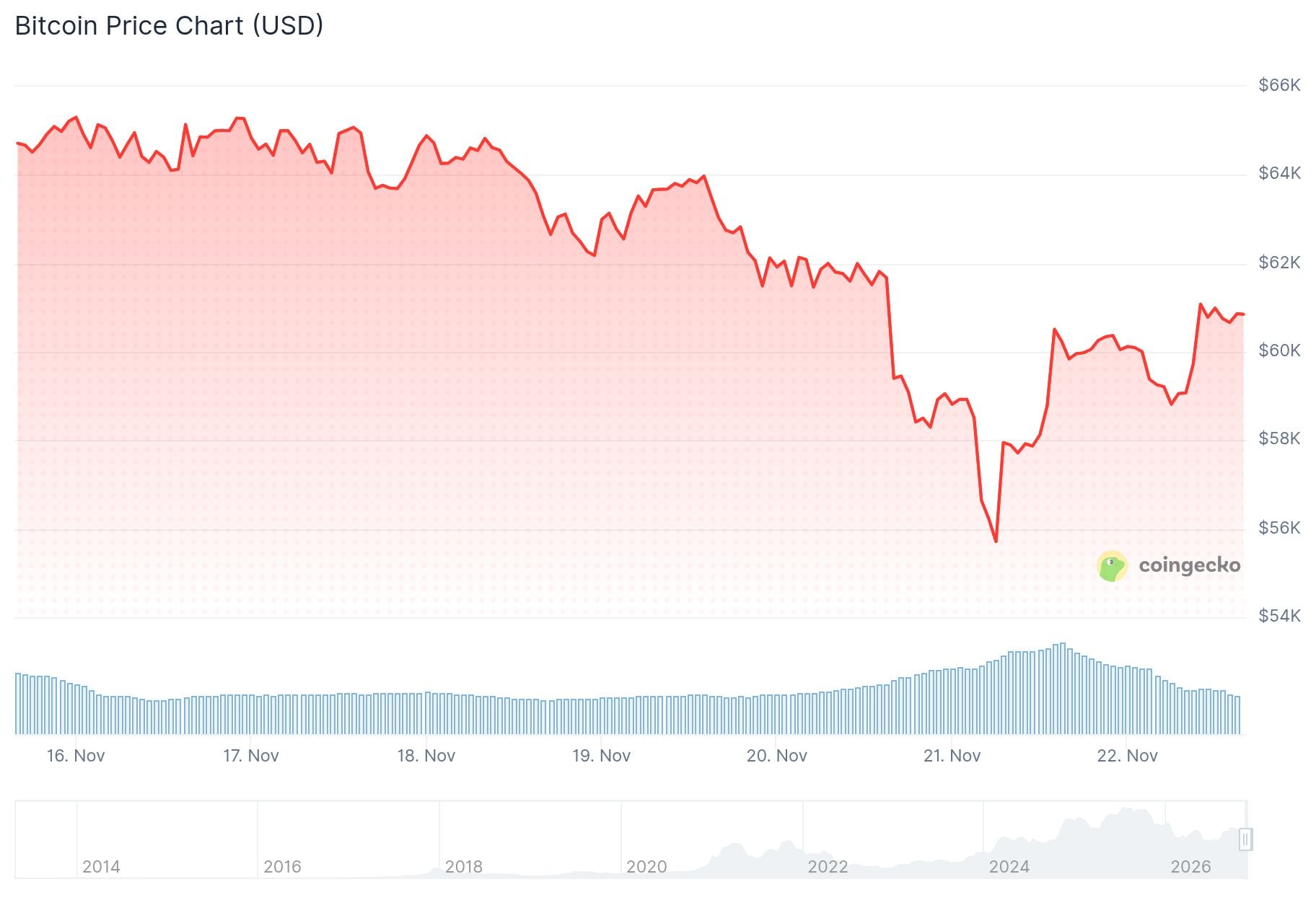
The pullback follows a sharp selloff on Friday that pushed Bitcoin down to $55,130. That was its lowest price since September 2024, and the price then bounced more than 9% before stalling.
Over the past month, Bitcoin has lost more than a quarter of its value. Ether (ETH) was near $1,680, up about 3%, while Solana (SOL) rose 2.3% to around $71.
The drop wiped out about $1.8 billion in leveraged positions, according to CoinGlass data. About $1.3 billion of that came from traders betting on higher prices.
Liquidations Clear a Key Cluster
Glassnode had tracked a large group of leveraged long bets between $59,000 and $62,000 for months. Friday’s move closed that cluster, which the firm said removes a large source of forced selling below the market.
The largest bitcoin:native liquidation cluster has been cleared.
We have been tracking a dense cluster of long liquidations between $59K and $62K for months.
Yesterday, they were fully cleared out, removing a large source of forced selling under price. pic.twitter.com/jJtjB4mbtz
— glassnode (@glassnode) November 21, 2026
CryptoQuant analyst Darkfost described the move as extreme capitulation. He said holders realized more than $11.3 billion in losses over seven days, about eight times the gains booked in the same period.

Analyst Lao-Qi (@laoqi_hl) posted on X that he warned followers to sell Bitcoin near $120,000. He now believes the market has not found a bottom at $55,000 and expects a real low in the $50,000 to $40,000 range.
I was one of the first to warn you to sell all your $BTC around the $120K zone.
Now people think we've found a bottom for $BTC at $55K.
Sorry to be the bearer of bad news, but I believe we're still heading lower. I don't think we'll find a real bottom until we reach the… pic.twitter.com/MtYaueQhNR
— Lao-Qi 劳奇 🈲 (@laoqi_hl) November 21, 2026
He added that he plans to buy Bitcoin and several altcoins at those levels. He also said the Federal Reserve could raise interest rates again, which gives the market more reasons to fall than rise.
Traditional markets also weighed on the mood. The Nasdaq fell more than 4% on Friday, putting it close to bear-market territory, and U.S. markets reopen on Monday.
U.S. spot Bitcoin ETFs recorded about $1.1 billion in net withdrawals over the past week. Updated Friday figures for BlackRock’s IBIT, the largest fund by net assets, are still pending.
QCP Capital, a Singapore-based trading firm, said the next real recovery will likely need steadier tech stocks, calmer rate volatility and signs that institutional flows are returning. Until then, it said short-covering rallies may struggle to turn into lasting gains.
Miners and Strategy Feel the Pressure
Mining revenue has dropped even as computing power recovers. Hashprice fell to $26.16 per petahash per second per day on Saturday.
Transaction fees made up just 0.64% of block rewards over the prior 24 hours. That leaves miners heavily dependent on Bitcoin’s price, while the network hashrate rebounded above one zettahash per second after falling to about 912 exahashes on November 14.
Strategy holds 850,849 Bitcoin bought at an average price of $75,452, well above current prices. Its stock closed down 9.67% at $77.80 on Friday, and Executive Chairman Michael Saylor urged investors to keep their conviction.
Bitcoin Core also disclosed a medium-severity vulnerability on Friday that could briefly stall network nodes. AI-assisted research found the flaw, which has been fixed in updated releases and could not be used to steal Bitcoin.
Former U.S. Space Force technology official Jason Lowery proposed using proof-of-work to defend digital infrastructure against AI attacks. The idea remains conceptual, with no implementation announced.
Mining difficulty is projected to rise nearly 9% around November 27. That adjustment could add pressure on operators already facing weak profitability.


