





TLDR
- Brent crude rose above $97 a barrel Monday after U.S. and Iranian forces struck each other’s vessels in and around the Strait of Hormuz
- The U.S. military hit three Iranian oil tankers on Saturday; Iran responded by targeting U.S. Navy vessels and a naval drone
- About one fifth of global oil supply normally passes through the Strait of Hormuz, and tanker traffic has dropped to its lowest level since May
- Iran’s top security official said a new restricted maritime zone will be announced outside the Strait of Hormuz in the coming days
- OPEC+ held production steady for October, pausing six months of output increases as the group works on new 2027 quotas
Oil prices climbed sharply on Monday after the United States and Iran exchanged strikes on vessels in and around the Strait of Hormuz, raising fears of a longer-term disruption to global crude supplies.
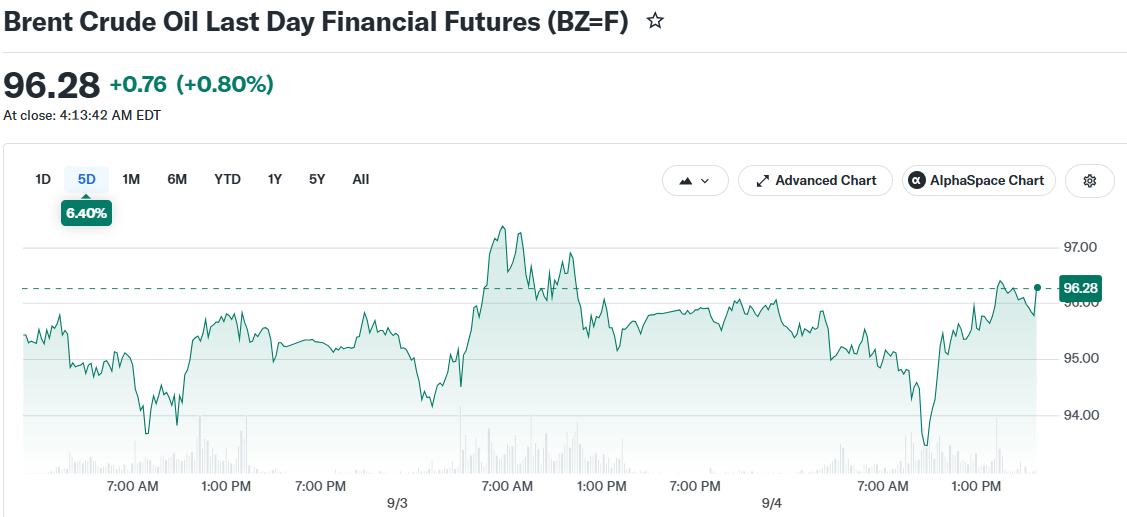
Brent crude futures rose as high as $97.58 a barrel, up about 1.4% on the day. West Texas Intermediate gained 1.3% to around $92.69 a barrel. Both benchmarks had already risen sharply the previous week, with Brent up nearly 8% and WTI up close to 10%.
The latest flashpoint came on Saturday when the U.S. military struck three Iranian oil tankers. One of those tankers was hit off the coast of Kharg Island, close to Iran’s main oil export hub.
Iran hit back quickly. The Islamic Revolutionary Guard Corps Navy said it targeted three tankers travelling through what it called unauthorized routes in the Strait of Hormuz. Iran also struck three additional U.S. vessels in other areas and later hit a U.S. naval drone.
BREAKING: Iran launches anti-ship ballistic missiles from Chabahar, southeastern Iran, toward vessels under US Navy escort in the US-backed southern Omani corridor of the Strait of Hormuz, per initial reports.
For the first time, the US Navy is escorting vessels during daylight,…
— The Hormuz Letter (@HormuzLetter) September 7, 2026
Iran’s top security official warned that any further U.S. action would trigger a stronger response. He also said Tehran plans to announce a new restricted maritime zone outside the Strait of Hormuz within days. Vessels entering that zone could face sanctions.
Maritime intelligence firm Marisks described Saturday’s events as a “major escalation in the maritime conflict.” It said commercial tankers are now being used as tools of economic pressure, blurring the line between military action and commercial shipping.

Tanker Traffic Falls to Lowest Level Since May
The number of commodity ships passing through the Strait of Hormuz has dropped to an average of 10 per day over the past 10 days, the lowest level since May, according to data from analytics firm Kpler.
The U.S. energy secretary said oil moving through the strait is currently averaging just over 9 million barrels per day, maintained partly through U.S. Navy escorts.
Analysts at Phillip Nova warned that if tanker traffic slows further, the market could price in a much larger supply shock. There are already early signs of this happening.
ING analysts said the oil market “remains well-supported with little sign of a peace between the U.S. and Iran,” though they noted that oil continues to flow for now.
ANZ analysts said a prolonged standoff with intermittent military action is the most likely outcome. They expect exports to stay constrained through the rest of 2026, with a gradual reopening only toward the end of the fourth quarter.
A full return to pre-conflict throughput levels is not expected until late in the first quarter or early in the second quarter of 2027.
OPEC+ Holds Output Steady for October
OPEC+ met on Sunday and decided to keep production unchanged for October. The group had been raising output for six straight months but paused those increases to focus on agreeing new production quotas for 2027.
The group’s decision comes as the Hormuz situation adds fresh uncertainty to global supply. With Iran being a key OPEC member, any further escalation could tighten the market further.
For now, oil continues to move through the strait with U.S. naval support, but the risk of deeper disruption remains on the table heading into the final months of 2026.
Stop guessing and start investing with confidence. KnockoutStocks gives you the AI insights, market intelligence, and stock research you need to spot opportunities, cut through the noise, and make smarter investment decisions — all in one powerful platform.
Sign up today and get 50% OFF full access to our premium stock picks.
Simply use coupon code SPECIAL50 at checkout to claim your exclusive discount.
Get 3 Free Stock Ebooks
Discover top-performing stocks in AI, Crypto, and Technology with expert analysis.
- Top 10 AI Stocks - Leading AI companies
- Top 10 Crypto Stocks - Blockchain leaders
- Top 10 Tech Stocks - Tech giants



