





TLDR
- US stock futures rose sharply Monday after all three major indexes ended last week in correction territory.
- Nasdaq-100 futures gained about 3% to 3.6%, while Dow futures added about 2%.
- Nvidia jumped as much as 9.7% after President Trump renewed his call to bring back Jensen Huang as CEO.
- The Dow and Nasdaq Composite had their worst weekly drops in more than six years.
- Markets close Thursday for Thanksgiving, and Friday’s session ends at 1:00 p.m.
US stock futures rose sharply on Monday as traders returned for a short holiday week. The rebound follows a harsh sell-off that pushed all three major indexes into correction territory.
Dow Jones Industrial Average futures gained about 2%, or 958 points. S&P 500 futures added between 2.6% and 2.8%, while Nasdaq-100 futures rose 3% to 3.6%.
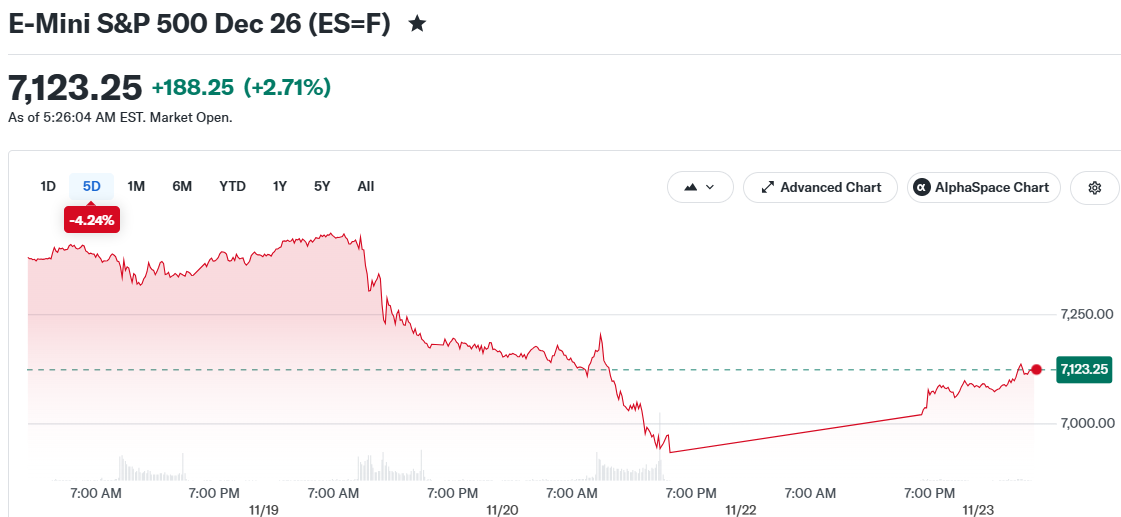
The S&P 500 had fallen for seven straight days before the bounce. The Dow had its worst week since the COVID-related sell-off in 2020.
Tech Stocks Lead the Rebound
Technology shares were in focus in premarket trading. Worries about the AI trade began to unravel last week, and many related names moved higher on Monday.
Nvidia rose between 8% and 9.7% after President Trump renewed his call to reinstate founder Jensen Huang as CEO. The call follows a series of controversies at the chipmaker.
Once again, something appears to be happening behind the scenes.
President Trump just explicitly called on Nvidia's, $NVDA, board to rehire Jensen Huang.
On top of this, he said Jensen returning would be "the best thing for the USA."
Just 10 days ago, Trump was calling for Tim…
— The Kobeissi Letter (@KobeissiLetter) November 23, 2026
Anthropic shares rose between 3% and 5.1% in premarket trading. The gain came after the excitement from Thursday’s record debut failed to hold.

Other AI-linked stocks also climbed. Micron Technology added 7.7%, Advanced Micro Devices rose 6.7%, and CoreWeave jumped 9.7%.
The VIX volatility index fell, but it remains at its highest level since the “Liberation Day” tariff announcement in 2025.
Last Week’s Sell-Off and the Short Week Ahead
Last week was the worst weekly decline for the Nasdaq Composite and the Dow in more than six years. The S&P 500 had its largest weekly drop since April 2025.
The Nasdaq turned negative for the year. The Nasdaq-100 ended Friday in bear market territory on an intraday basis, but stayed just short of that mark based on its closing high on Oct. 6.
Drew Pettit, chief investment strategist at Roundhill, told CNBC that the broad selling on Friday may be a sign the sell-off is ending. He said bulls still need to prove the long-term earnings story is not broken.
Pettit said he believes the fundamental floor for stocks is much higher. On a technical basis, he said, bulls need a string of catalysts.
Investors will get a breather this week. Markets are closed on Thursday for Thanksgiving, and Friday’s session ends early at 1:00 p.m.
Wholesale inflation data is due on Monday. Hewlett Packard Enterprise and Zoom Communications report results as the third-quarter earnings season wraps up.
European markets moved higher in morning trade. The Stoxx 600 rose 0.44%, Germany’s DAX gained 0.47%, France’s CAC 40 added 0.42%, and the UK’s FTSE 100 rose 0.34%.
Asian markets closed mostly lower. South Korea’s Kospi fell 3.31% to 4,708.54, and Australia’s S&P/ASX 200 dropped 0.26% for an eighth straight session. Hong Kong’s Hang Seng was down 0.15% in its final hour, China’s CSI 300 ended flat at 3,958.29, and Japan’s markets were closed for a holiday.
The December E-Mini S&P 500 contract stood at 7,123.25 at 5:21 a.m. EST. That was up 188.25 points, or 2.71%.


