






TLDR
- Bitcoin fell to $75,463, its lowest level since Sept. 16, after the post-election rally reversed.
- The Nasdaq lost 5.5% in a session driven by a sell-off in AI stocks.
- More than $1 billion in crypto derivatives positions were liquidated in 24 hours, per CoinGlass.
- BTC briefly dipped below its 50-week SMA at $75,733.
- Gold rose 0.6% to $4,094 per ounce while risk assets fell.
Bitcoin gave back its post-election gains on Thursday. The price dropped below $76,000 as US stocks sold off sharply. Data from TradingView showed BTC/USD falling more than 6% to $75,463 on Bitstamp.
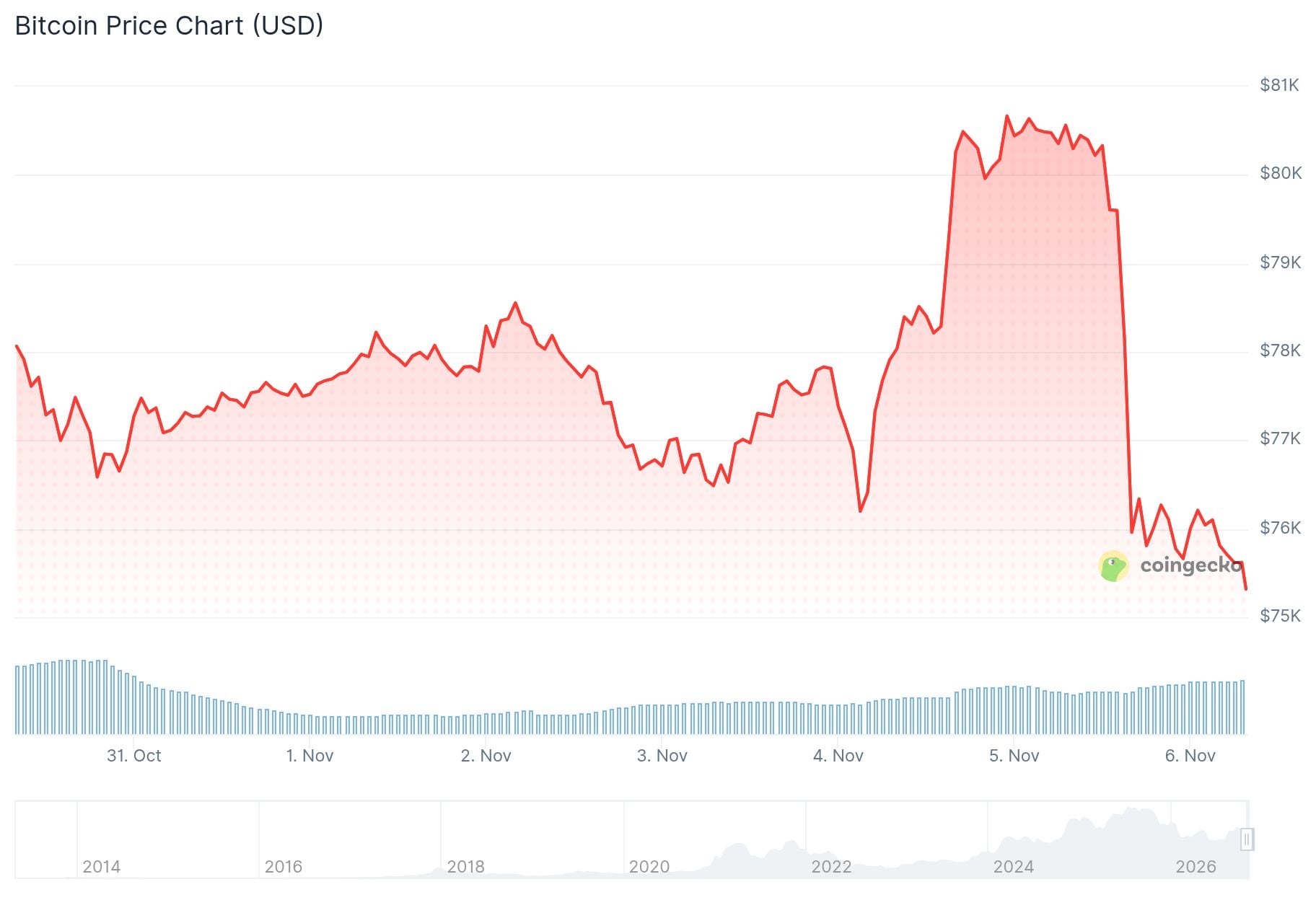
That is the lowest level for the coin since Sept. 16. CoinDesk data showed bitcoin down about 5.2% over 24 hours, trading just under $76,000. Ether fell 7.5%, while XRP and Solana each lost 5.5%.
The drop followed a rally on Wednesday after Tuesday’s midterm elections. Democrats won control of both chambers of Congress. Stocks rose on the news, but the gains did not last into Thursday.
Wall Street had its worst session since the April 2025 tariff announcements. The Nasdaq shed 5.5%, the S&P 500 fell 4.3%, and the Dow lost 3.4%. Cointelegraph’s figures, taken earlier in the session, were smaller, with the Nasdaq Composite down 4.2%.
What just happened?
The Nasdaq 100 just posted its largest daily drop since the 2020 Pandemic, with the S&P 500 erasing -$3 trillion today.
Just 24 hours ago, the Dow surged +1,600 points after the Democrats "swept" the Midterms.
So, what changed? Let us explain.
(a thread) pic.twitter.com/pf5ZW1Q9Qd
— The Kobeissi Letter (@KobeissiLetter) November 5, 2026
The Nasdaq 100 fell 6.4%, its worst day since March 2020. The Philadelphia Semiconductor Index dropped 12%, also its worst day since that month. Traders were rotating out of tech names.
Why AI Stocks Pulled the Market Lower
Investors worry that Democratic control of Congress could slow the building of data centers. Those centers power the AI boom. They also matter to bitcoin miners, who have shifted part of their business toward AI.

Joshua Lim, global co-head of markets at FalconX, said fresh selling returned as the effects of a slower data center buildout came into focus. He said Wednesday’s relief rally came mostly from short-covering ahead of a widely expected result.
Carlos Guzman, vice president of research at GSR, said the midterms appeared to trigger the sell-off. He noted that doubts about returns on AI spending were already growing. Weak earnings from chipmakers added to the pressure.
Economist Mohamed El-Erian wrote that he is less sure a shift in Congress would slow tech. He asked whether the rest of the economy could do well without tech earnings and spending. He called the day’s weakness in tech stocks “not surprising.”
Jordan Watson, a portfolio manager at Tandem Investment Advisors, told CNBC that more volatility may be ahead. He said the post-election stock gains were not an “all-clear signal.”
Oil also moved higher on Thursday. WTI crude returned above $90 per barrel, and Brent gained 2.5% to near $97. Reports of new strikes on tankers in the Middle East drove the move. Uncertainty over the US-Iran war also played a part.
Gold rose 0.6% to $4,094 per ounce, off its earlier highs. It gained while stocks and crypto fell.
Liquidations and Key Chart Levels
Crypto derivatives saw heavy forced selling. CoinGlass data showed more than $1 billion in positions were liquidated over 24 hours. Most were bets on higher prices.
It was the largest wipeout since at least Oct. 28-29. In that period, bitcoin fell from nearly $82,000 to $76,000. Cointelegraph reported nearly $500 million in liquidations in the first hour of US trading.
Guzman said the mood flipped on Thursday as risk appetite fell and leverage added to the move. Bitcoin returned to levels seen before Wednesday’s rally.
BTC briefly traded below its 50-week simple moving average, which sits at $75,733. The price also neared the bottom of its one-month trading range. The level’s role as support is now under pressure.
Trader Rekt Capital pointed to a pattern from May. Bitcoin moved sideways near $80,000 then, before breaking down. It later reached a macro low of $57,000 in late June.
"If the 3-Day bearish retest is successful once again on this occasion, that could see price go below the recent local lows of ~$76000"
Indeed, the 3-Day bearish retest continues to be successful
Back in May, Bitcoin also developed a cluster of price action at these… https://t.co/h091XjPFXa pic.twitter.com/6Iycxg0jQM
— Rekt Capital (@rektcapital) November 5, 2026
Analyst Bob Loukas said in a post on X that he believes the cycle low is already in. He said the weekly cycle is still in decline. In his view, any drop over the next few months is part of that process.
Lot of questions on Bitcoin's 4yr Cycle. I'm of the view the cycle low is well in.
But the weekly Cycle is in decline. Any drop over the next few months is part of that process and back-filling. pic.twitter.com/t6YOmAObJr— Bob Loukas 🗽 (@BobLoukas) November 5, 2026
Jasper De Maere of Wintermute urged caution about reading too much into one day of selling. He said crypto held up relatively well compared with AI stocks. He called the medium-term outlook “glass half full.”
De Maere added that correlations across assets are running high. He said investors should watch for bargains over time. At the time of writing, bitcoin was trading just below $76,000.


