






TLDR
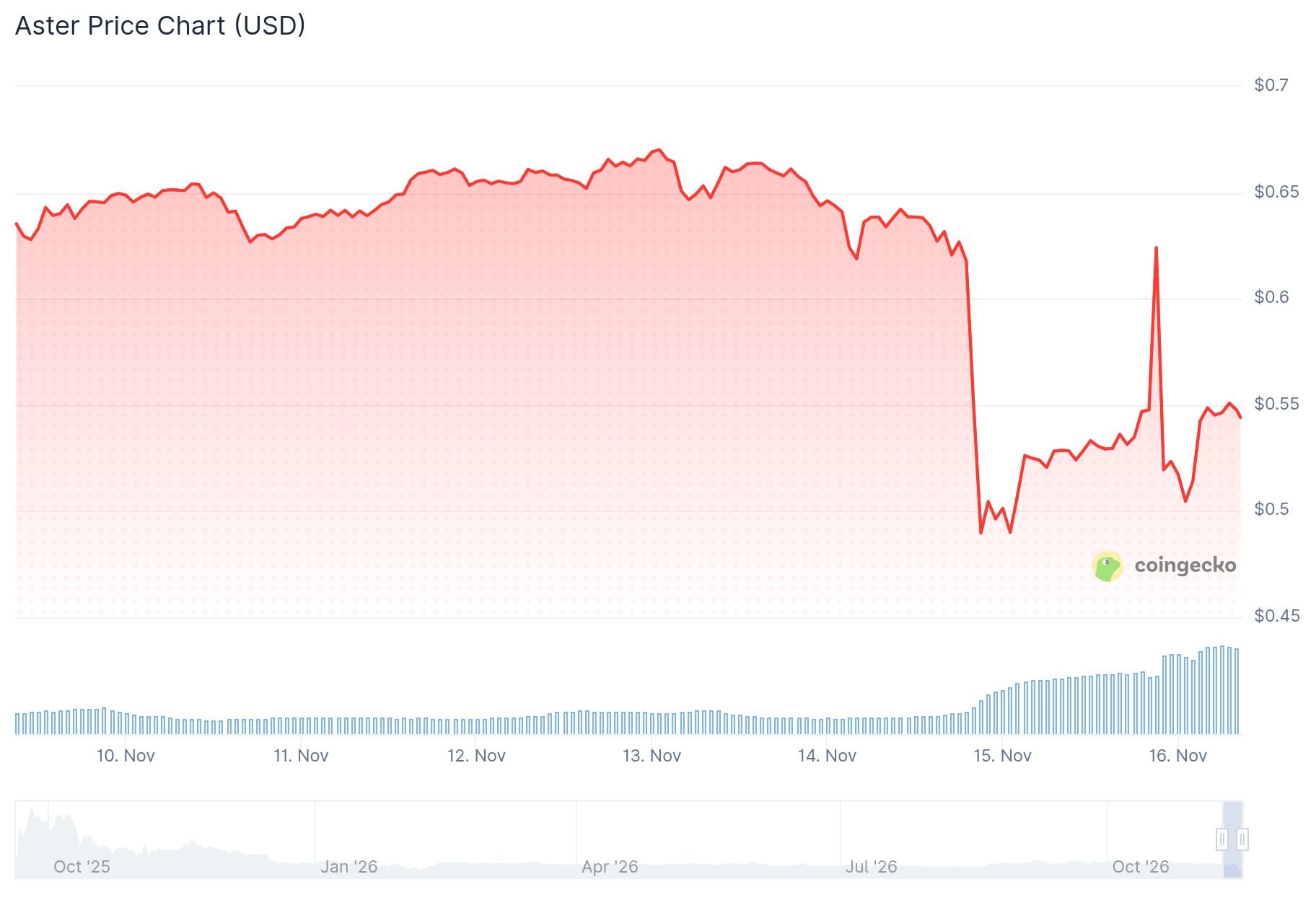
- ASTER fell 32.5% in about 15 minutes, from $0.7124 to $0.4812, on November 16.
- CEO Leonard Leung blamed liquidations of highly leveraged positions that he called “likely malicious.”
- The token bounced to around $0.55, up 4.3% over 24 hours but down 22.67% over 30 days.
- Futures volume hit about $1.29 billion, and liquidations totaled roughly $9.1 million.
- Resistance sits near $0.56 and $0.60, with support near $0.53 and $0.49.
ASTER had a sharp round trip on Monday. The token ran up about 30% in an hour and touched $0.7124. It then dropped to $0.4812 in just over 15 minutes.
Aster CEO Leonard Leung said the team is looking into what happened. He wrote that the swing came from liquidations of highly leveraged positions that were “likely malicious.” No one has been named, and the probe is still open.
We are aware of the abnormal price fluctuation and the team is investigating .
The price volatility is a result of liquidations of highly leveraged positions, likely malicious. We will share full details in the upcoming reports.
— Leonard 💛 Aster 🥷 (@Leonard_Aster) November 16, 2026
Leung also said Aster is running business as usual. He said the exchange has no market-making arrangements for ASTER and that the move was unrelated to any.
Analyst Ardi (@ArdiNSC) saw it differently on X. He called it a “pretty blatant hunt” by market makers to clear leverage below $0.60. He noted that other assets also fell the day before, but said those drops played out over a day, not a few hours.
Pretty blatant hunt on $ASTER by its MMs to clear the leverage below $0.60.
After holding it like a stablecoin for six months, it's a shame to see bearish market sentiment used as an excuse to flush longs in one move.
And before we start hearing that other assets dumped hard… pic.twitter.com/wvIjAJXrE9
— Ardi (@ArdiNSC) November 15, 2026
Ardi said he still holds ASTER from the early $0.60s. He expects it to reach $1.40 or higher in 2027 and said the flush does not change that view.

How the Crash Looked in the Data
The token later rebounded to about $0.55. That is up roughly 4.5% over 24 hours. It still sits about 22.5% below the intraday peak.
Trading was heavy during the swing. CoinGlass logged about $1.29 billion in ASTER futures volume over 24 hours, up 121% from the day before. Spot volume was $118.3 million, up 67%.
Tracked liquidations came to about $9.1 million. Long positions made up $5.97 million of that, and shorts made up $3.14 million.
Aster has not said which positions were hit or how much traders lost. Leung said more details will come in later reports, but he gave no date.
Why Leverage Can Move the Price So Fast
Aster is a decentralized exchange that offers perpetual futures. These contracts have no expiry date and let traders borrow to open larger positions. If a trader’s collateral falls too low, the exchange closes the position automatically.
Aster’s documentation says it uses a mark price built from funding data and several spot exchanges. When an account’s margin drops below the maintenance level, the closing process begins. Some positions can pass to an insurance fund at their bankruptcy price.
Leung’s statements did not say whether the insurance fund took losses. They also did not name the contracts involved.
In August, Aster set new rules for perpetual listings. Applicants must stake 1 million ASTER for four years. The platform’s risk team still controls leverage limits and contract settings.
Price Levels and Buyback Program
ASTER was priced at $0.5456 at the time of reporting. It is down 14.9% over seven days and 22.67% over 30 days. Daily trading volume was near $362.8 million.
Market cap stands near $1.40 billion, with 2.57 billion tokens in circulation. The token trades more than 77% below its September 2025 record of $2.41.
The token is below its 20-day simple moving average of $0.6548. The Stochastic RSI reads 18.02, under its signal line of 26.66.
Resistance sits near $0.56, followed by $0.60. Support is near $0.53, and $0.49 would put the crash low back in view.
Aster’s buyback program remains in place. Since June, 99% of daily platform fees go to buying ASTER, and the bought tokens go to veASTER stakers. An equal number of tokens is burned from reserves.
The plan aims to cut total supply from 8 billion to 3 billion over time. The October 19 to November 2 update showed about 2.60 million ASTER bought back and burned from the team allocation. Burns run every two weeks.


