





TLDR
- Bernstein says the AI bear case is not compelling but a full recovery in AI stocks could take time.
- The SOX chip index is down 38% from its June 22 high.
- Nasdaq fell 3.4% last week and the S&P 500 had its worst week since June.
- Bernstein cut price targets on Lumentum, Celestica and Corning.
- Next week brings October consumer price index data.
Bernstein analyst Daniel Zhu says the bear case on AI does not sound particularly compelling. He still admits it is hard to disprove in the short term. He also said a full recovery in AI-linked stocks could take time.
“We were wrong to be bullish on AI on the short term,” Zhu wrote. He was referring to the firm’s Sept. 29 start of coverage on networking stocks.
How Deep the Chip Selloff Went
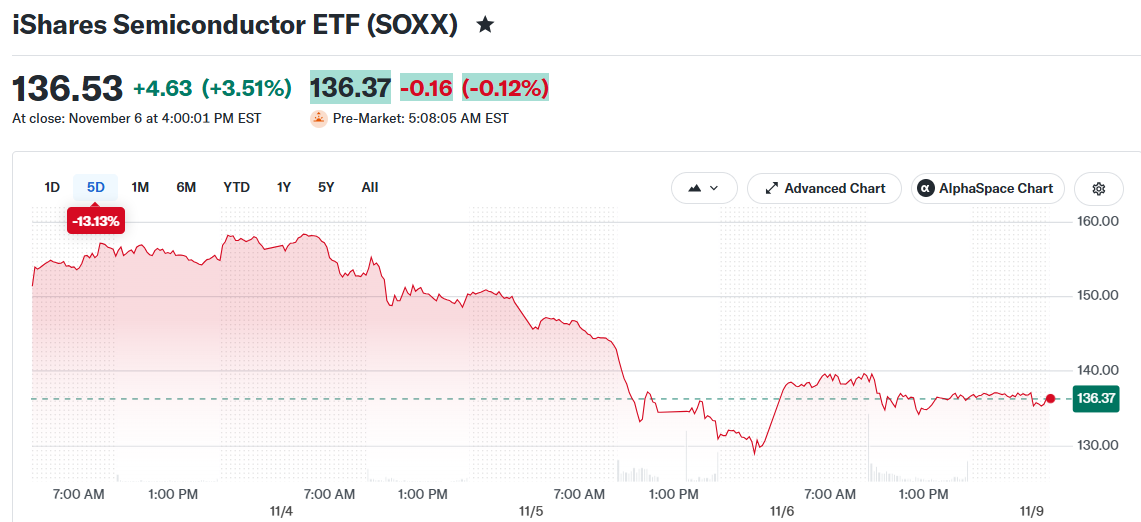
The SOX semiconductor index is down 38% from its June 22 high. That is the second sharpest drop since ChatGPT launched. Only the decline after Liberation Day was worse.
Bernstein’s networking coverage has fallen between 12% and 42%. All five companies that have reported since the launch gave guidance above consensus. Zhu says the drop came from lower valuation multiples, not from weaker estimates.
Thursday was the sharpest day of the week for the broader market. The selloff erased about $3 trillion in market value and pushed the Nasdaq into a correction. The VIX volatility index surged during that session.
Two Bear Arguments Bernstein Weighed
Zhu named two core bear arguments. The first is concern over the economics of AI labs and how the buildout is financed. This followed weaker AI annual recurring revenue in September.
He called September “a pricing blip rather than a structural deceleration.” Lab revenue was stronger in October, he said, and token volume growth has stayed strong.
Zhu estimates hyperscalers will have about $1.2 trillion of AI infrastructure online by 2027. At a 15% return hurdle and 24% net margins, that implies about $729 billion in end spending. He called that plausible, though “not necessarily a slam dunk.”

The second concern is land and power limits, raised by Democratic midterm wins. Texas Governor-elect Gina Hinojosa campaigned on a pause in approvals. Zhu sees limited impact on 2027 because most of that year’s capacity is already in the ground.
Only 0.3 gigawatts of credible Texas capacity has yet to break ground. He sees more risk for 2028. He believes data centers are generally willing to pay to solve such issues.
Zhu also pointed to macro and technical factors. These include investors selling tech holdings to raise cash ahead of major IPOs, rising rates and fears of renewed war with Iran. Pressure on short positions to force liquidations also played a part.
He sees room for a technical bounce, but few catalysts before January. “We would wait to see more evidence that AI lab buildouts are actually under strain before we’d begin to panic,” he said.
Bernstein left its forecasts unchanged. It cut its price target on Lumentum to $635 from $900. Celestica fell to $340 from $495, and Corning to $120 from $140.
The firm kept Outperform ratings on Arista, Ciena, Celestica, Coherent and Lumentum. It kept Market-Perform on Cisco and Corning.
Chip stocks bounced on Friday. The Nasdaq Composite gained 1.1% to close at 24,579.42, but still lost 3.4% for the week. The S&P 500 rose 0.3% to 7,376.86, down 2.7% for the week.
Nvidia rose 3.9% on Friday and AMD jumped 10.8%. The US added 165,000 jobs in October, well above the 65,000 expected. October consumer price index data is due next week.


