





TLDR
- Whales bought over 2.50 million LINK in 10 days, per analyst Ali Charts.
- Chainlink Reserve added 373,791 LINK in September, reaching 6.04 million total.
- LINK trades near $14.33-$14.50, below key resistance at $16 and $17.70.
- New Infosys partnership will connect banking systems to blockchain via Chainlink.
- Analysts point to a long-term W pattern that could target $52.
Chainlink is showing renewed activity this week. Large holders, known as whales, have been buying up the token even though it faces resistance overhead.
Crypto analyst Ali Charts reported that whales bought more than 2.50 million LINK over the past 10 days. This buying comes alongside steady growth in new addresses on the network.
Nearly 1,500 new LINK addresses are being created each day, according to Ali Charts. This points to more people joining the network, though some addresses may belong to exchanges or automated systems rather than new individual users.
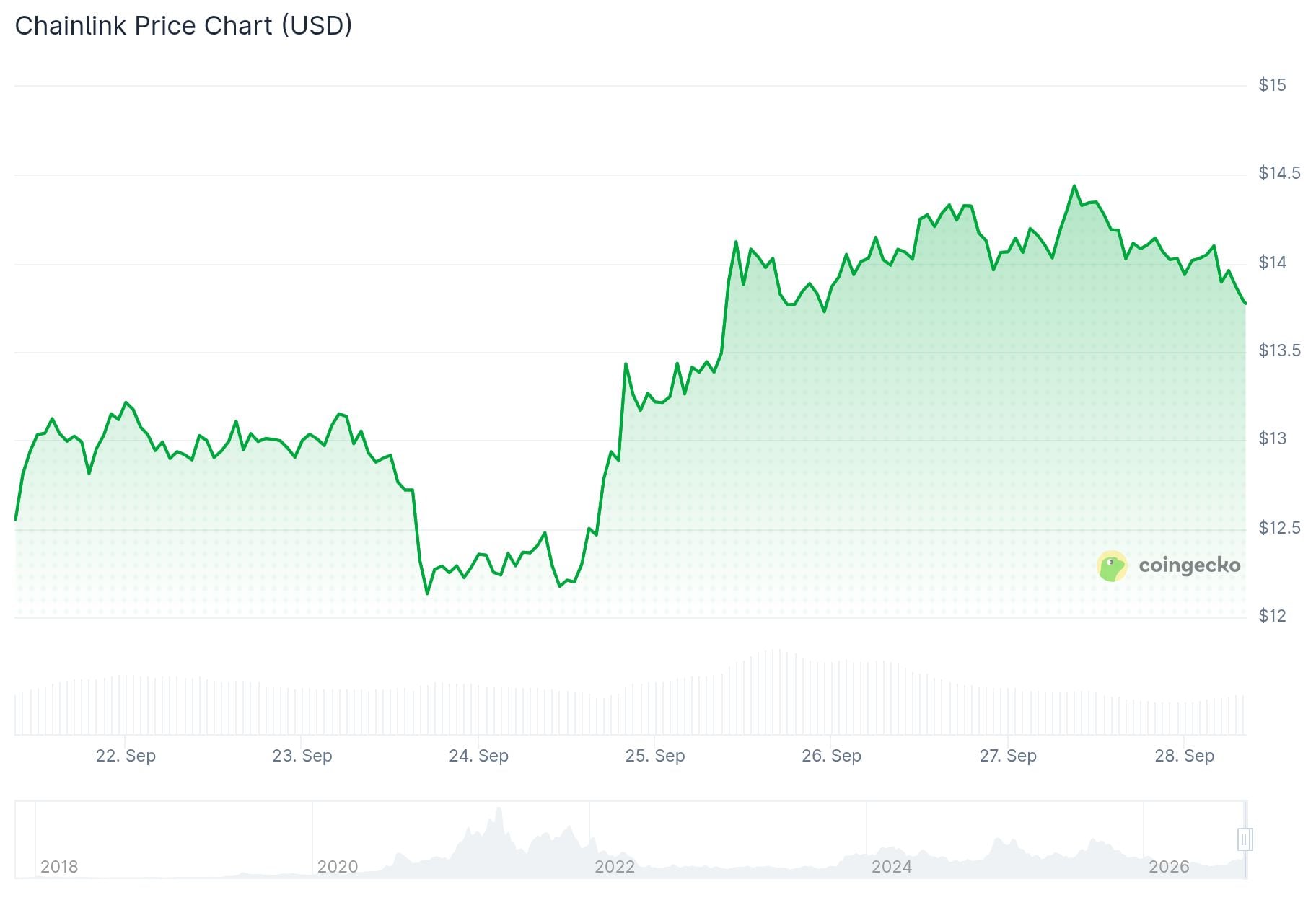
Quinten, an analyst on X, shared his own view on the recent price action. He said LINK closed its weekly candle at $14.04, calling it a meaningful close because it held above $13.70 resistance and marked the highest weekly close since November 2025. He added that the move also took out the August 30 weekly close, creating a higher high. Quinten said momentum is strong, but noted resistance sits near $15, calling it the biggest monthly resistance level. He said breaking that level could send LINK a lot higher.
$LINK closed its weekly at $14.04
Very meaningful weekly close because:
– above the $13.70 resistance
– highest weekly close since November 2025
– took out the 30 August weekly close, making a higher highMomentum is strong, but there's quite a lot of resistance in the area… pic.twitter.com/PUFLXGIcEW
— Quinten (@QuintenFrancois) September 28, 2026
Key Resistance Levels Ahead
LINK is currently trading between $14.33 and $14.50. Ali Charts pointed to $16 as a major resistance zone, where about 16.9 million LINK were previously bought. A second zone near $17.70 saw roughly 22.7 million LINK accumulated.
Another analyst, Whale Factor, posted about a long-term downtrend line that has controlled LINK’s price for months. He said LINK has now pushed through that structure and is trading around $14. He laid out a Fibonacci roadmap with targets at $15, $17.3, $20, $23, and $28. He called $20 the big level, saying a reclaim there would put the higher targets into focus.

🐋 WHALE WATCH :Something interesting is happening with $LINK.
The daily chart shows a long term downtrend line that has controlled price for months.Now LINK has pushed through that structure and is trading around $14.
Potential Fibonacci roadmap:
=> $15
=> $17.3
=> $20
=> $23… pic.twitter.com/0IoTq7Hcot— Whale Factor (@WhaleFactor) September 27, 2026
Separately, analyst Giannis Andreou highlighted a larger W pattern forming on a higher timeframe. He said this structure could support a move toward $52 if it continues developing as outlined. He noted the pattern is not confirmed and depends on LINK holding its structure through resistance breaks.
Reserve Growth and New Partnership
Chainlink’s fundamentals have also grown alongside the price. The Chainlink Reserve added 373,791 LINK in September, worth more than $4.3 million, bringing total holdings to 6.04 million LINK. That figure has nearly doubled since the end of Q1, when the Reserve held 3.06 million LINK.
Chainlink’s Cross-Chain Interoperability Protocol now secures $82.39 billion in cross-chain tokens.
Chainlink also announced a partnership with Infosys, an Indian IT company whose banking platform supports 1.7 billion accounts. The deal aims to connect banks’ existing systems to blockchain markets using Chainlink infrastructure. Infosys joins other institutions already linked to Chainlink, including Swift, UBS, Mastercard, and DTCC.
Researchers at Santiment noted the announcement did not name a specific bank or provide a timeline. Still, on-chain data showed 1,344 new LINK addresses were created the day of the announcement, about 19% above the monthly average.

Since August 1, only 11 days recorded higher address growth than that, with the peak of 1,929 new addresses on August 21.


