





TLDR
- The KOSPI fell more than 5% on Monday after a 5.21% drop on Friday.
- Seoul is preparing a 10 trillion won stabilization fund but has not used it yet.
- Samsung Electronics and SK Hynix led the losses as AI spending worries grew.
- The finance minister still expects upper-3% economic growth.
- Share buyback limits will be eased for three months starting Tuesday.
South Korean stocks fell sharply on Monday, even after the government said it was ready to step in. The KOSPI dropped more than 5% during the session, and chip makers led the decline.
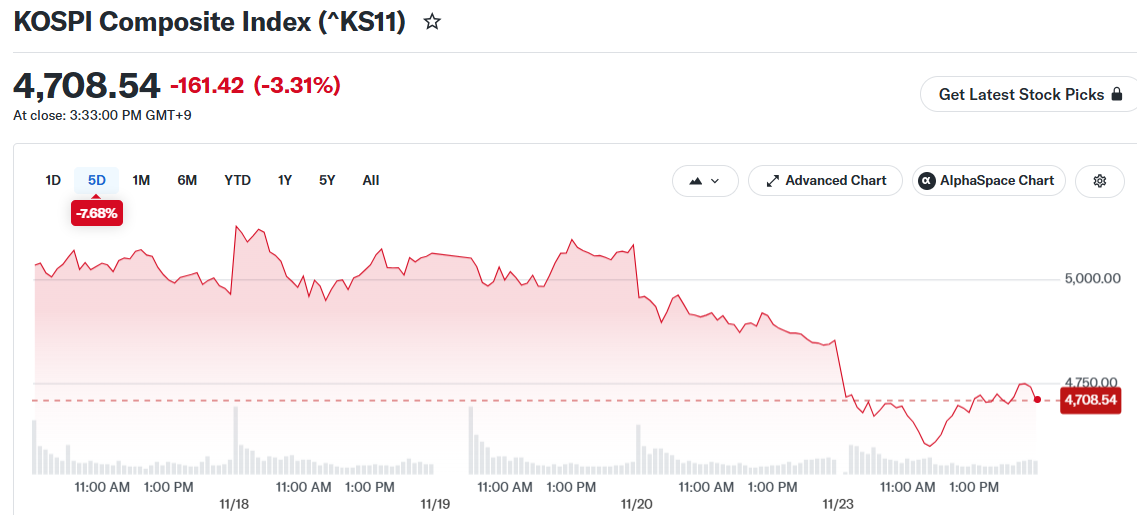
The index traded near 4,600 at its lowest point, following a 5.21% loss on Friday. That left it about 21.4% below its November 2 close.
🚨BREAKING: ₩316,000,000,000,000 wiped out from South Korean stocks as the KOSPI crashes to a 10-month low.
Program selling halted for 5 minutes after the index plunged 5%, despite emergency stabilization measures.
The KOSPI is now just 274 points (6.1%) away from turning… pic.twitter.com/UWKo7Iad5w
— Coin Bureau (@coinbureau) November 23, 2026
Finance Minister Lee Hyoung-il said officials would decide on action based on market conditions. He did not announce any share purchases.
Seoul Prepares a Fund but Holds Back
Authorities are preparing a 10 trillion won stabilization fund, worth about $6.8 billion. On Sunday, they said it could be used right away if conditions worsened.
Lee said Monday that steps would come at an appropriate time. So far, the fund has not been used to buy shares.
The government will also ease daily limits on share buyback orders for listed companies. The change lasts three months and begins Tuesday.

Regulators will step up checks on illegal short selling and market manipulation. They will also watch margin loans and possible forced selling.
Lee ruled out new short-selling limits and chose stronger enforcement of current rules. South Korea ended a 17-month ban in March 2025 after setting up a central detection system.
Chip Stocks Lead the Drop
Samsung Electronics fell between 5.5% and 6% during the session. SK Hynix lost between 4.9% and 6%.
Over the past month, Samsung is down about 20.1% and SK Hynix is down about 18.1%. Both companies carry heavy weight in the index, so their moves pull the whole market.
Other large firms also fell on Monday. Hyundai Motor dropped 4.90%, Kia lost 4.42%, and Samsung Biologics declined 5.61%.
The selling followed a sharp drop in US technology and chip stocks on Friday. Investors are questioning whether huge AI spending will pay off, and tighter US limits on advanced chip access have added to the worries.
Foreign investors are on track for a seventh straight month of net selling. Total outflows have reached $115.2 billion, based on LSEG data.
Funds that track Korea took heavy losses in November. The Direxion Daily MSCI South Korea Bull 3X ETF fell 54.10% through November 20, while the iShares MSCI South Korea ETF lost 18.70%.
Chip-focused funds also dropped, with the KICK Korea Semiconductor Index ETF down 26.90%. A defense-focused fund fell a smaller 13.51%.
Lee said growth could reach the upper-3% range if current trends hold. The International Monetary Fund forecasts 3.9% growth this year and 3.3% in 2027.
He warned that AI regulation, geopolitical tension and higher global interest rates remain risks. He said chip volatility could spill into the wider economy.
Kiwoom Securities analyst Han Jiyoung said the market needs a catalyst to bring foreign buyers back. The new buyback limits take effect Tuesday, and the stabilization fund has not yet bought any shares.


