






TLDR
- Zcash activated its NU7 upgrade at block 3,543,405, cutting target block time from 75 seconds to 25.
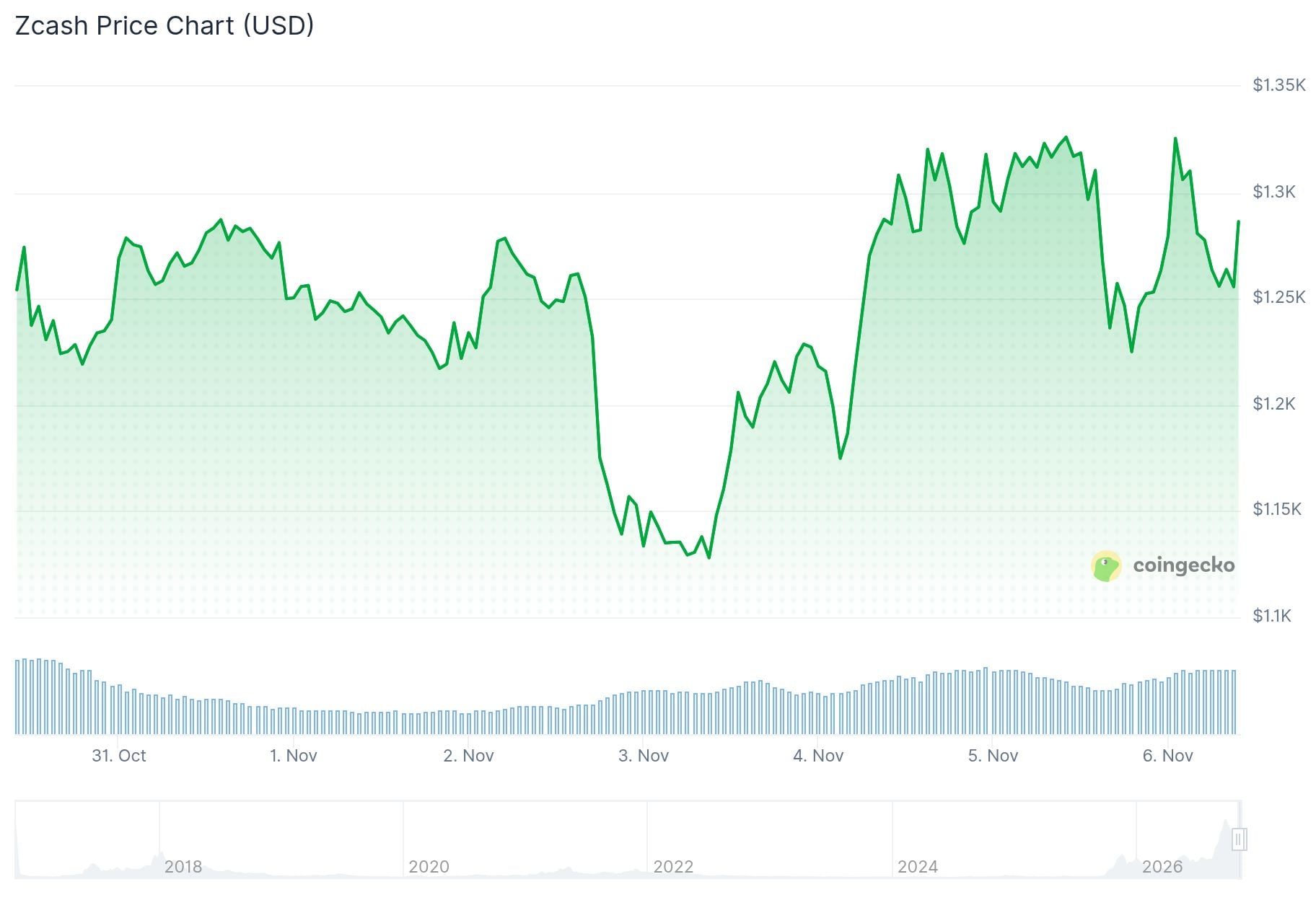
- ZEC traded near $1,308, with $1,340 as the key resistance level.
- Grayscale’s ZEC ETF saw $10.99 million in outflows on Thursday.
- Open interest rose to 2.15 million ZEC, up from 2.05 million a day earlier.
- Miners now get 40% of fees, while 60% goes into a reserve for future rewards.
Zcash switched on its NU7 upgrade early Friday. The change cuts the target time between blocks from 75 seconds to 25. Private payments should now confirm about three times faster.
The upgrade went live at block 3,543,405, mined at 02:34 UTC. By 04:59 UTC, the network had added another 225 blocks. They averaged about 39 seconds apart, according to ZecStats.
🚨ZCASH NU7 ACTIVATES ON MAINNET!@Zcash announced the network upgrade is live, cutting target block times from 75 seconds to 25 seconds.
The upgrade also takes 60% of transaction fees out of circulation under the Network Sustainability Mechanism, reducing immediate… pic.twitter.com/TYrpl2kgd8
— Crypto Banter (@crypto_banter) November 6, 2026
Mining difficulty was still adjusting toward the faster pace. That means real block times may keep moving closer to the 25-second target. Each service also sets its own rules, so payment speed will vary by platform.
For shoppers, a merchant could see a first confirmation in about 25 seconds on average. An exchange that needs three confirmations could cut its wait from nearly four minutes to about 75 seconds. Zcash lets users hide the sender, the recipient and the amount.
How NU7 keeps miners in sync
Faster blocks leave less time for miners to share new blocks with each other. When two miners find blocks at nearly the same moment, the network drops one of them. Shorter gaps make this more likely.
Zakura, a Zcash node program built by Valar Group and Project Tachyon, tested 25-second blocks. The test used 80 computers across 11 regions, with every block full of transactions. In that test, 3.43% of mined blocks were discarded, compared with 1.57% at the old pace.

Engineers also cut repeated work in the software. A transaction is checked once when it arrives, and parts of that check are saved for later. Checks that rely on the latest balances and chain history still run again.
NU7 also caps how much private transaction activity fits in each block. Wallets must scan the chain to find payments meant for them, so heavy spam can add work. The cap lowers the worst-case daily download from 271 megabytes to 169.
The upgrade specification estimates that capacity for simple private payments could more than double. It would rise from about three a second to more than six.
Fees work differently now as well. Miners receive 40% of transaction fees. The other 60% is removed from circulation and held in a reserve. That reserve starts feeding future block rewards around February 2031, and the 21 million coin cap stays in place.
NU7 also retired Sprout, Zcash’s original privacy pool from 2016. About 12,224 ZEC remain unspendable there. Co-founder Sean Bowe has outlined a possible recovery method, but none has been approved as of Friday.
ZEC price action and market data
ZEC traded at $1,308 on Friday, up about 2%. That came a day after more than $1 billion in crypto liquidations hit the wider market. The token is testing resistance near $1,340, the October 8 high.
Analyst Altcoin Sherpa said on X that $1,300 to $1,360 remains the zone ZEC needs to break. He said Zcash has held up well on relative strength, and that he holds some spot. He added that Bitcoin is still in a shaky area and that more chop may be ahead.
$ZEC 1300-1360 remains the levels to break. ZCash has held up pretty well on a relative strength basis and I hold some spot but btc is still in a shaky area. Still probably should expect more chop? pic.twitter.com/GQmvPgvsvY
— Altcoin Sherpa (@AltcoinSherpa) November 6, 2026
Grayscale’s ZEC ETF, ZCSH, recorded $10.99 million in outflows on Thursday, per SoSoValue. That brings weekly net outflows to $14.77 million. A weak Friday could end the fund’s two-week streak of inflows.
Derivatives traders took a different path. CoinGlass shows ZEC open interest rose to 2.15 million ZEC from 2.05 million the day before. That marks a rebound after a dip tied to the liquidation day.
ZEC sits above its 50-day EMA at $1,216, which is well above the 200-day EMA at $856. The RSI is near 55, and the MACD is above its signal line. Support sits at $1,216, then at the October 8 low near $1,112. A close above $1,340 would open the way to the September 26 peak at $1,698, about 25% higher.


