





TLDR
- The U.S. dollar steadied near a two-week low after weak June jobs data reduced expectations of a Fed rate hike
- The Japanese yen sits close to a 40-year low at around 161-162 per dollar, keeping intervention fears alive
- Fed meeting minutes due this week, though new Chair Kevin Warsh may have limited how much guidance they offer
- The euro held near $1.1435 and sterling near $1.3351 as both dipped slightly Monday
- South Korea launched historic 24-hour onshore dollar-won spot trading on Monday
The dollar recovered slightly on Monday but remains near its weakest level in two weeks after last week’s soft U.S. jobs report cooled expectations for further Federal Reserve rate hikes. At the same time, the Japanese yen is sitting dangerously close to a 40-year low, keeping traders on high alert for possible government intervention.
Dollar Under Pressure After Weak Jobs Data
The dollar index, which tracks the greenback against six major currencies, was at around 100.9 in early Monday trading. That follows a 0.5% drop last week — its biggest weekly loss since April.
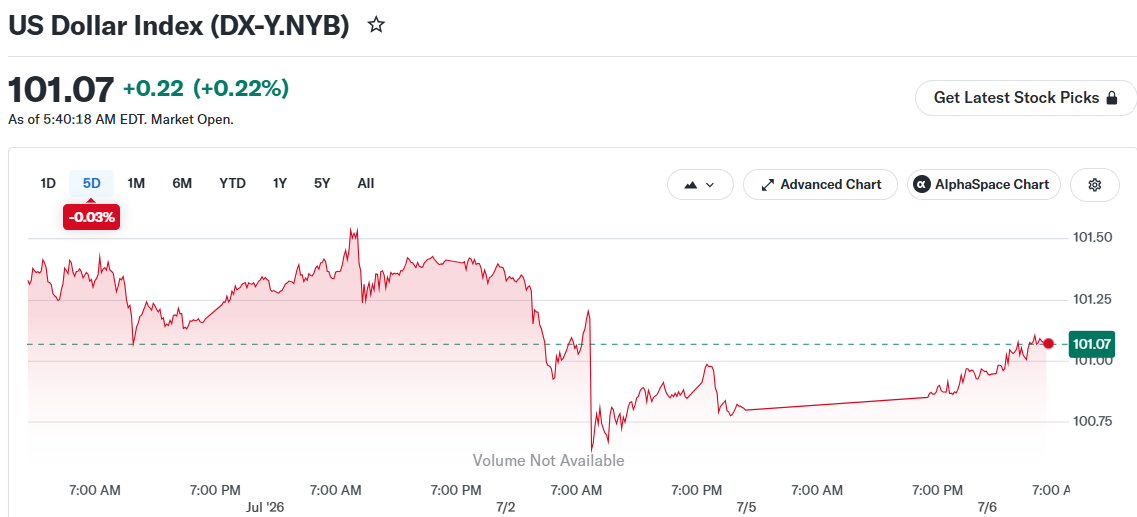
The trigger was June’s nonfarm payrolls report, which showed job growth slowed sharply. That raised questions about whether the Fed has enough reason to keep raising rates.
Still, losses were kept in check. The unemployment rate actually fell, which OCBC strategists said points to a still-tight labor market. They maintained their view of a moderate 2-3% dollar appreciation in the second half of 2026.
The euro was at $1.1435, near a two-week high. Sterling was at $1.3351. Both currencies dipped around 0.1% on Monday as the dollar edged back up.
Falling oil prices have helped ease some inflation concerns, which also played into reduced rate-hike expectations.
All eyes are now on the minutes from the Fed’s June meeting, due later this week. Policymakers at that meeting were reportedly leaning more hawkish due to sticky inflation.

However, new Fed Chair Kevin Warsh has said the central bank has given too much forward guidance in the past. Analysts at Commonwealth Bank of Australia warned the minutes may offer less insight than usual as a result.
Yen Near 40-Year Low, Intervention Watch Continues
The yen traded at around 161.57-161.82 per dollar on Monday, just off the 162.84 level hit last week — the weakest since 1986.
The Bank of Japan raised rates in June and signaled more hikes could come. But the wide gap between U.S. and Japanese interest rates continues to weigh heavily on the yen.
Japanese officials have issued verbal warnings against speculative yen selling in recent weeks. Tokyo last intervened in late April and early May, pushing the dollar-yen pair down to around 155. The pair quickly rebounded back above 160.
Analysts are divided on whether any new intervention would have a lasting effect. OCBC strategists said intervention alone is unlikely to reverse the pair’s direction without a real shift in economic fundamentals.
ING analysts said more hawkish communication from the Bank of Japan is still needed to stop dollar-yen from climbing again.
Marc Chandler of Bannockburn Global Forex noted that options market activity suggests large investors have been buying short-dated dollar puts as protection against a surprise intervention move.
Elsewhere, South Korea’s won held steady as Seoul launched 24-hour onshore dollar-won trading, a step toward gaining developed market status on the MSCI index. The Chinese yuan and Singapore dollar both edged slightly lower.
Stop guessing and start investing with confidence. KnockoutStocks gives you the AI insights, market intelligence, and stock research you need to spot opportunities, cut through the noise, and make smarter investment decisions — all in one powerful platform.
Sign up today and get 50% OFF full access to our premium stock picks.
Simply use coupon code SPECIAL50 at checkout to claim your exclusive discount.
Get 3 Free Stock Ebooks
Discover top-performing stocks in AI, Crypto, and Technology with expert analysis.
- Top 10 AI Stocks - Leading AI companies
- Top 10 Crypto Stocks - Blockchain leaders
- Top 10 Tech Stocks - Tech giants



