





TLDR
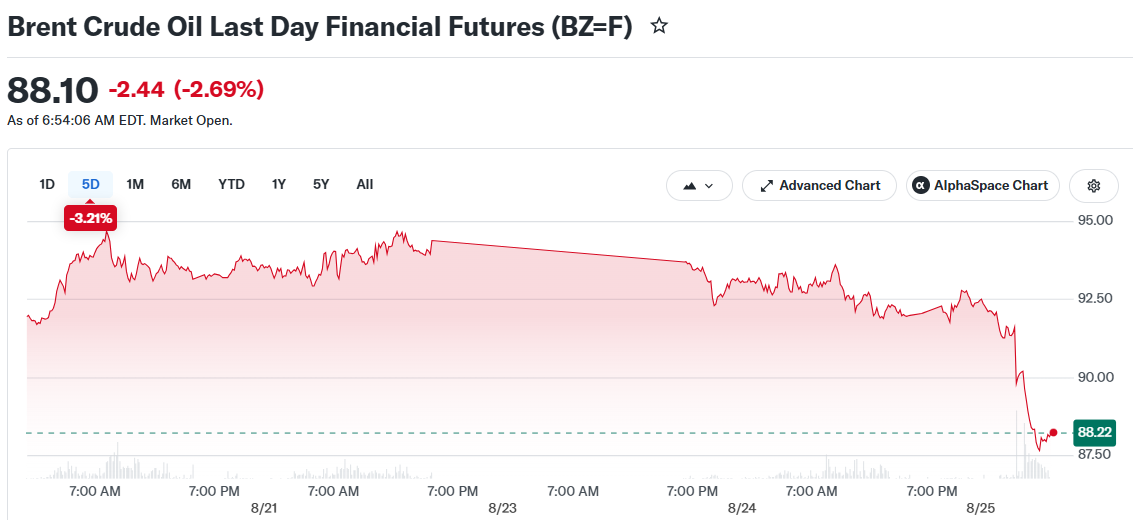
- Brent crude fell nearly 2% to around $90 a barrel; WTI dropped to a one-week low near $83
- The U.S. announced sanctions on 60 Iran-linked entities but set no timeline for penalties
- Traders viewed the sanctions as less aggressive than feared, reducing the oil risk premium
- Shipping through the Strait of Hormuz remains severely restricted, with only two tankers passing Monday
- Pakistan says “significant progress” has been made in Iran-U.S. peace talks
Oil prices slid to a one-week low on Tuesday after the latest round of U.S. sanctions against Iran failed to alarm markets the way traders had expected.
Brent crude futures fell around 2% to $90.38 a barrel. U.S. West Texas Intermediate crude dropped to roughly $83.25, its lowest point in a week.
The move came after Washington announced sanctions on 60 entities and individuals linked to Iran on Monday. But the Treasury Department did not immediately impose penalties, and Treasury Secretary Scott Bessent gave no specific timeline for when they would kick in.
Analysts at ING said traders were treating the sanctions as “marginal rather than market-moving.” ANZ analysts echoed that view, saying markets were “unimpressed” with what was described as an unprecedented campaign to isolate Iran economically.
Saxo Bank’s head of commodity strategy Ole Hansen said the U.S. shift away from military action toward economic pressure had reduced anxiety in oil markets. He added the announcement was less aggressive than many had anticipated.
Economic Pressure Eases Immediate Supply Fears
The Trump administration says the sanctions are designed to cut off Tehran’s economic lifeline and push Iran back to the negotiating table. The U.S. has warned other countries to cut commercial ties with Iran or risk secondary sanctions.
The U.S. 🇺🇸 reportedly offered Iran 🇮🇷 a deal to halt the siege and lift sanctions in exchange for reopening the Strait of Hormuz and ending proxy attacks, according to Al Arabiya.
— Wall St Engine (@wallstengine) August 25, 2026

Notably absent from the sanctions list was China, the largest buyer of Iranian oil. Analysts at ING flagged uncertainty over whether Washington would jeopardize its fragile trade relationship with Beijing by targeting Chinese entities.
Iran said it was ready to retaliate and has previously threatened to disrupt oil flows through the Middle East. U.S. Defense Secretary Pete Hegseth also confirmed military action remains on the table.
Strait of Hormuz Risk Remains
Despite the softer market reaction, physical supply risks have not gone away. Only two tankers passed through the Strait of Hormuz on Monday, the lowest daily count since early May. The waterway normally handles about one-fifth of global oil consumption.
An oil tanker was also struck by an unidentified projectile near Oman on Tuesday, according to the United Kingdom Maritime Trade Operations.
Tim Waterer, chief market analyst at KCM, said Iran still has the ability to disrupt shipping, keeping a residual risk premium in the oil price.
In Russia, the Novoshakhtinsk oil refinery in the Rostov region was damaged overnight by a Ukrainian drone, with operations suspended following the attack.
On the diplomatic front, Pakistan’s Interior Minister Mohsin Naqvi said Tuesday that talks with Iranian officials had “concluded on a highly positive note” and that progress was being made toward restoring a ceasefire between Iran and the U.S.
A previous ceasefire framework signed in June collapsed after tanker attacks in the Strait of Hormuz.
Stop guessing and start investing with confidence. KnockoutStocks gives you the AI insights, market intelligence, and stock research you need to spot opportunities, cut through the noise, and make smarter investment decisions — all in one powerful platform.
Sign up today and get 50% OFF full access to our premium stock picks.
Simply use coupon code SPECIAL50 at checkout to claim your exclusive discount.
Get 3 Free Stock Ebooks
Discover top-performing stocks in AI, Crypto, and Technology with expert analysis.
- Top 10 AI Stocks - Leading AI companies
- Top 10 Crypto Stocks - Blockchain leaders
- Top 10 Tech Stocks - Tech giants



